What explains Rome vs Persia frontier stability
TL;DR
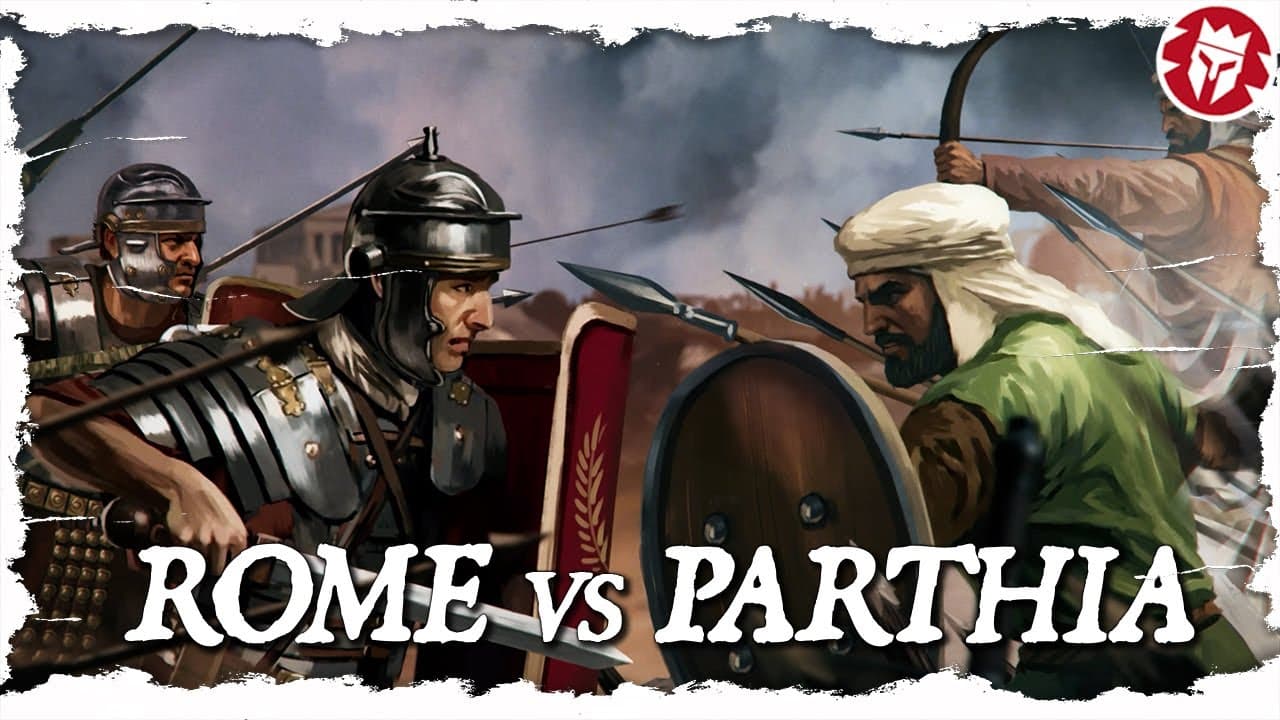
The frontier between Rome and Persia functioned as a zone of influence rather than a strict boundary. Its stability arose from geography, the use of client kingdoms, and logistics that allowed sustainable power projection without full conquest. Trajan’s eastern campaign exposed limits, while economic and logistical constraints kept the frontier in balance.
Transcript
The historic rivalry between the Roman Empire and the various iterations of the Persian Empire is one of the most bitter, bloody and enduring feuds in world history. Spanning over nearly 700 years, the spectacularly brutal battles of Carrhae, Rhandeia, and Ctesiphon are just a few of the long list of conflicts between Rome and Persia over... Read More
Key Insights
- Rome and Parthia did not view borders as strict boundaries but as zones of control.
- The stabilization of the frontier depended on periphery concepts and the balance of local tolerance.
- Client kingdoms acted as a buffer allowing indirect influence rather than direct control.
- Logistics and riverine routes were crucial to sustaining campaigns and garrisons.
- Economic costs and overstretch limited deep campaigns by both Rome and Persia.
- Trajan’s campaign showed that even aggressive expansion could be rolled back by logistics and rebellion.
- Equilibrium arose where the economies and logistics could sustain military presence.
- Interactions with local powers, like Armenia and Mesopotamian client states, shaped the frontier.
- More videos from this channel:
- More from this channel: Kings and Generals
Install to Summarize YouTube Videos and Get Transcripts
Explore YouTube Video Summarizer or Get YouTube Transcript Extractor
Questions & Answers
Q: What is meant by the frontier being a zone of control rather than a strict boundary?
The frontier is described as a zone where different cultures and political entities interact and where Rome exercised influence without fully annexing every territory. This concept explains why limits to control were flexible and why fortifications and administrative presence did not equate to a hard line. It highlights how Rome used client rulers and diplomacy to manage far flung regions rather than relying solely on distant armies. The idea shifts the focus from conquest to maintenance of influence at sustainable distances, balancing military, economic, and political pressures.
Q: How did geography influence the Roman Persian frontier?
Geography determined how far each empire could project power and sustain armies. River routes along the Rhone, Elbe, Tigris, and Euphrates provided logistical channels in some areas, while other regions required overland campaigns. This mix of navigable waterways and difficult terrain shaped strategic choices, including reliance on client rulers and limited direct control. Geography thus constrained expansion and helped define the periphery where each empire could operate within acceptable limits.
Q: What role did client kingdoms play in this frontier?
Client kingdoms served as intermediaries that extended influence with fewer costs and risks than direct occupation. They provided political legitimacy, local knowledge, and resources while allowing Rome and Persia to project power expeditionarily. The relationships with Armenia, Edessa, and other polities illustrate how client states facilitated strategic depth and flexibility, sustaining the region’s balance without demanding permanent garrison dominance.
Q: Why was Trajan’s campaign in Persia unique and ultimately unsustainable?
Trajan’s campaign pushed deeper into Persian territory than previous efforts, including a possible capture of Ctesiphon, which demonstrated Rome’s willingness to attempt dramatic expansion. However, the campaign proved unsustainable due to logistical overstretch, local uprisings, and the economic burden of maintaining distant garrisons. The failure highlighted that even ambitious imperial designs confront practical limits in supply, local support, and long-term viability.
Q: Did the concept of an eastern trade network influence Roman policy toward Parthia?
Modern questions about East Asian trade and the Silk Road have been used in historical debates, yet the provided text states that there is little evidence of a defined economic policy toward distant trade and that the motive of economic gain from eastern routes was contested. This suggests that strategic and defensive concerns, rather than direct economic exploitation of trade networks, guided Roman policy in the eastern frontier.
Q: How did the frontier’s stabilization relate to the periphery concept?
The periphery concept divides the frontier into an inner and outer zone, where the inner frontier could be reliably supplied and administered, and the outer frontier represented a broader area of influence. This framework explains how Rome maintained control in regions with fragile political structures while avoiding overextension. The equilibrium arose when the periphery allowed sustainable governance and aggression without incurring intolerable costs.
Q: What caused the frontier to stop expanding for Rome and Persia?
Both powers faced a combination of logistical limits, economic costs, and political resistance from local rulers and populations. The frontier stopped expanding where the supply networks and administrative systems could no longer sustain greater military presence, and where the political and social environment would tolerate extended control. The balance was achieved because further conquest would have been economically and logistically impractical.
Q: How did Armenian and Mesopotamian politics affect frontier dynamics?
Armenian and Mesopotamian polities acted as pivotal factors in frontier dynamics by serving as buffers and points of contention. Their loyalty, hostages, and alliances influenced who controlled border regions and how power was projected. Both Rome and Persia leveraged these relationships to stabilize or contest influence, making the frontier a fluid zone where diplomacy, client relationships, and military action continually renegotiated power.
Summary & Key Takeaways
-
The frontier is described as a zone of control rather than a hard line, shaped by geography and client states.
-
Rome and Parthia relied on client kingdoms and supply networks to project power without widespread conquest.
-
Trade routes, logistics, and regional resistance limited both powers, creating a natural equilibrium at the frontier.
Read in Other Languages (beta)
Share This Summary 📚
Summarize YouTube Videos and Get Video Transcripts with 1-Click
Try YouTube Summary with ChatGPT & Claude or YouTube Transcript Generator
Explore More Summaries from Kings and Generals 📚
Summarize YouTube Videos and Get Video Transcripts with 1-Click
Try YouTube Summary with ChatGPT & Claude or YouTube Transcript Generator