What Is the Evolution of Indo-European Languages?
TL;DR
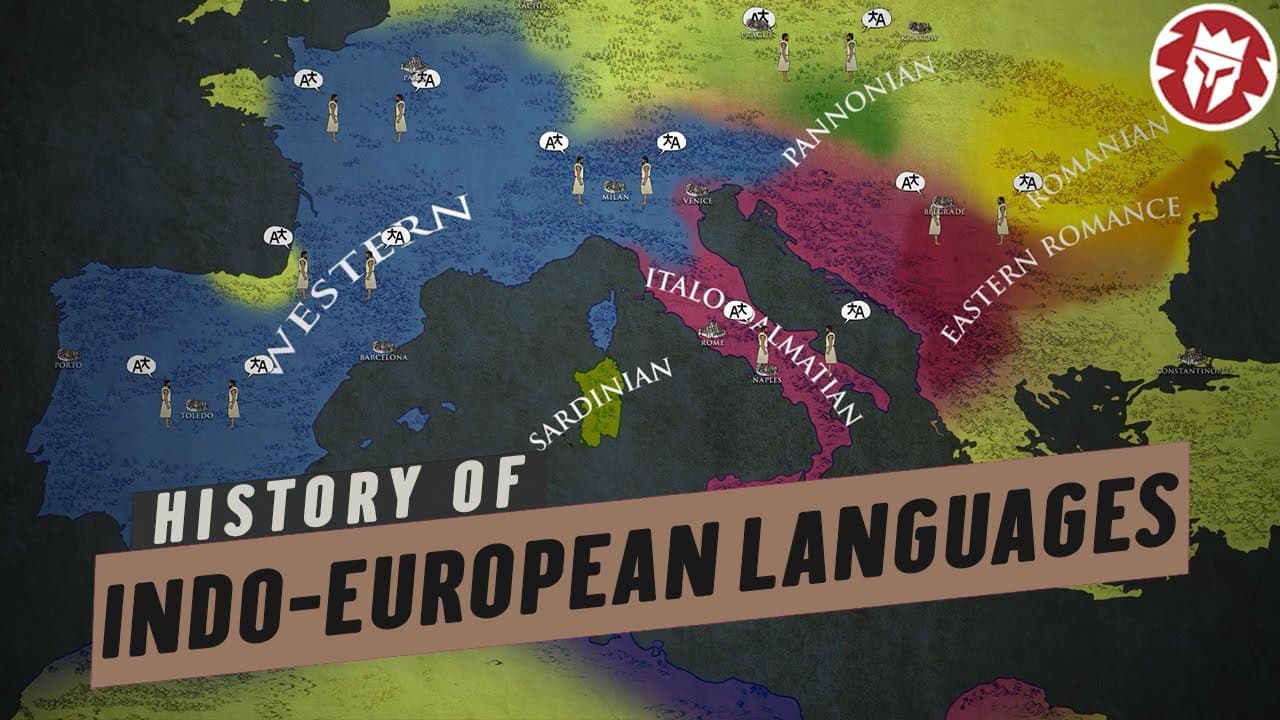
The Indo-European language family traces back to a common ancestor spoken by the Yamnaya people around 4000 BC, spreading across Eurasia as they migrated and interbred with local cultures. Over time, its daughter languages diverged into Italic, Greek, and many others, while writing and standardization emerged through political centralization, leading to the modern Romance and other branches.
Transcript
Portugal and India share a lot of common history ever since Vasco Da Gama’s voyage, but what may come as a surprise is that the Portuguese language already shared many similarities to the numerous languages spoken in India, including inflection, word structure, pronunciation, and vocabulary. Languages constantly change and adapt, but in the cas... Read More
Key Insights
- Indo-European languages share a common ancestor that spread with Yamnaya migrations from the Pontic Steppe.
- The Yamnaya expansion was rapid and involved interbreeding with local Neolithic populations, spreading Proto Indo-European vocabulary.
- Comparative methods allow reconstruction of Proto Indo-European words even without written records.
- Italic, Greek, and other branches formed as dialects diverged and interacted with neighboring languages.
- Latin developed into Vulgar Latin and Classical Latin, with later Romance languages emerging after the fall of the Empire.
- Standardization in medieval times, driven by rulers, helped define modern national languages and their dialects.
- Romance languages spread across regions through colonial and political processes, yet retain core vocabulary and structures.
- Koine Greek and the spread of the Greek alphabet influenced many later writing systems and loan words across languages.
- More videos from this channel:
- More from this channel: Kings and Generals
Install to Summarize YouTube Videos and Get Transcripts
Explore YouTube Video Summarizer or Get YouTube Transcript Extractor
Questions & Answers
Q: What is the origin of the Indo-European language family?
The Indo-European language family originated from a common ancestor that linguists reconstruct using the comparative method. This ancestor was spoken by early groups like the Yamnaya people around 4000 BC, and its spread across Eurasia occurred through migrations and interbreeding with local cultures. This expansion laid the groundwork for the diverse languages we group under Indo-European today.
Q: How did the Yamnaya culture influence language spread?
The Yamnaya culture expanded rapidly across Eurasia on their horses, intermarrying with Neolithic populations and spreading their Proto Indo-European language. This diffusion created a widespread linguistic core, from which later branches such as Italic, Greek, and others eventually diverged, preserving common vocabulary and grammatical features across distant regions.
Q: What role did writing play in Indo-European languages?
Writing emerged after the initial migrations, with concepts like writing evolving separately across regions. The words for writing, sea, and iron show variation across languages, but shared cognates in core terms like family and basic actions demonstrate their common origin. Writing later helped stabilize and transmit languages across empires.
Q: Which major branches developed from Proto Indo-European?
Major branches include Italic, Greek, and later Romance languages among others. Italic spread with Celtic and Greek neighbors, while Latin evolved into Classical and Vulgar Latin, which eventually led to Spanish, French, Italian, Portuguese, and Romanian through the process of standardization and regional evolution.
Q: How did Latin influence the Romance languages?
Latin, especially Vulgar Latin, served as the foundation for the Romance languages. As the Roman Empire expanded, Latin spread and diversified into regional dialects. After the fall of Rome, these dialects evolved independently, resulting in languages such as Spanish, French, Italian, Portuguese, and Romanian, each with its own standard form.
Q: What caused the standardization of languages in medieval Europe?
Standardization was driven by political rulers who selected specific dialects as the norm for administration and education. Examples include Castilian for Spanish, langue d’oïl for French, and Tuscan for Italian. This centralized language policy helped unify states and influence which varieties persisted into modern times.
Q: How did language transfer occur between cultures in antiquity?
Language transfer occurred through contact, trade, conquest, and colonization. Loan words and shared vocabulary appeared as different Indo-European languages interacted with each other and with non Indo-European languages. This exchange contributed to the diffusion of linguistic features across regions and enriched the vocabulary of many daughter languages.
Q: What is the significance of Koine and Greek in language history?
Koine Greek, spread by Alexander the Great, became a common version of Greek across vast areas, including Greece, Asia Minor, Egypt, and India. It provided a standard form that influenced later writing systems and contributed to the circulation of Greek loan words in various languages, shaping linguistic development beyond Greek itself.
Summary & Key Takeaways
-
The video explains how the Indo-European language family originated from a single ancestor and spread across Eurasia.
-
It highlights major branches such as Italic and Greek and shows how writing and standardization followed political changes in Europe.
-
It also discusses how modern languages like Spanish, French, Italian, and Portuguese evolved from Latin and how language families continued to diversify over time.
Read in Other Languages (beta)
Share This Summary 📚
Summarize YouTube Videos and Get Video Transcripts with 1-Click
Try YouTube Summary with ChatGPT & Claude or YouTube Transcript Generator
Explore More Summaries from Kings and Generals 📚



Summarize YouTube Videos and Get Video Transcripts with 1-Click
Try YouTube Summary with ChatGPT & Claude or YouTube Transcript Generator