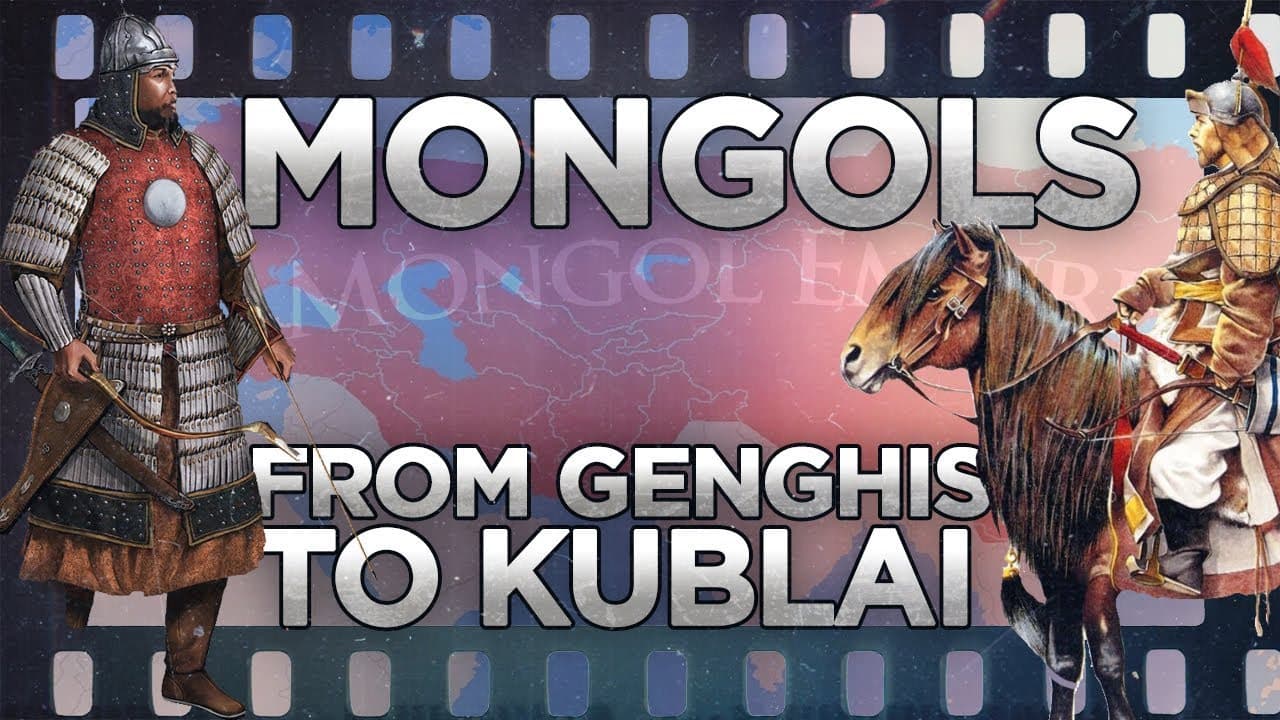
How did Genghis Khan unite the Mongol tribes?
TL;DR
Genghis Khan restructured Mongol society by promoting talent over bloodline and organizing the army into tens, hundreds, thousands, and ten thousands. He forged alliances, defeated rival leaders like Jamukha, and used siege warfare to subdue major powers such as the Jin and Khwarezmian empires, laying the groundwork for a vast empire.
Transcript
Mongols Season 1 Full - from Genghis to Kublai KINGS & GENERALS Hard places often breed hard people and Mongolia is one of the most inhospitable lands in the world This is the story of the people who came out of the steppes and built the biggest empire in history This is the story of Temujin and how he became Genghis Khan The history of the eastern... Read More
Key Insights
- Genghis Khan is elected leader after defeating Jamukha and uniting Mongol tribes under a single banner.
- The Mongol army is reorganized into a decimal structure with tens, hundreds, thousands, and ten thousands for disciplined, scalable command.
- Commanders are chosen by their soldiers, except the ten thousands, who are handpicked by the Khan to ensure loyalty and strategic cohesion.
- The Code of Hospitality guides treatment of envoys and guests, shaping Mongol diplomatic conduct and military conduct.
- The campaign against the Jin dynasty demonstrates Mongol siege warfare, mobility, and strategic patience in starving fortresses and exploiting terrain.
- Jebe and Subotai expand Mongol reach through flanking maneuvers and feigned retreats, turning battles into wider strategic gains.
- Invasion of Khwarezmia showcases multi-column siege tactics and the importance of intelligence, logistics, and rapid maneuvering across diverse terrains.
- The rise of Genghis Khan marks the shift from tribal raids to a centralized, professional army capable of sustained campaigns across Asia.
- More videos from this channel:
- More from this channel: Kings and Generals
Install to Summarize YouTube Videos and Get Transcripts
Explore YouTube Video Summarizer or Get YouTube Transcript Extractor
Questions & Answers
Q: What events lead to Genghis Khan becoming the ruler of all Mongols?
Genghis Khan becomes the ruler of all Mongols after assembling a council of Mongol chiefs who elect him following his defeat of his former ally Jamukha at the Battle of the Thirteen Sites. This unification ends internal rivalries and creates a single banner under which diverse tribes can coordinate military and political campaigns. The move consolidates power, grants him the title of Genghis Khan, and marks the formation of a unified Mongol nation with centralized leadership.
Q: How does the decimal military system affect Mongol campaigns?
The decimal military system divides the army into tens, hundreds, thousands, and ten thousands, creating scalable units that can be interchanged or reinforced quickly. This structure enables flexible command, precise responsibility assignment, and rapid maneuvering across vast distances. It also ensures discipline, as units are bound by loyalty and shared identity, with deserters facing collective consequences that maintain cohesion during long sieges and fast-paced raids.
Q: Why is hospitality considered sacred in Mongol law during conflicts?
Hospitality is sacred in the Mongol code, and guests and envoys should not be harmed. This principle governs diplomacy and hostage exchanges, enabling safe communications across rival groups and reinforcing trust. Violating this rule provokes retaliation and disrupts the campaign, but when honored it allows the Mongols to negotiate and absorb skilled individuals while maintaining strategic alliances that facilitate long campaigns.
Q: What tactics did Genghis Khan employ against the Jin dynasty?
Against the Jin, Genghis Khan employs mobility, siege warfare, and strategic feints. By bypassing the Great Wall and using coordinated attacks, including a rear assault led by Jebe and Subutai, the Mongols overwhelm fortified positions and open routes for rapid advance. They later besiege key cities and employ famine and disease to compel surrender, expanding Mongol control north of the Yellow River.
Q: What role did Jebe and Subotai play in expanding Mongol power?
Jebe and Subotai act as strategic vanguards, executing feigned retreats and flanking maneuvers that disrupt enemy formations and lure them into traps. Their campaigns expand the Mongol sphere by striking southern, western, and central targets, enabling rapid consolidation of newly conquered regions and providing crucial leadership for the broader invasion of Central Asia and beyond.
Q: How did the Khwarezmian campaign begin and escalate?
The Khwarezmian campaign begins after a caravan is unfairly treated and three ambassadors are executed, violating hospitality norms. Genghis Khan assembles three-column forces, leverages siege engineers, and launches a decisive invasion that splits the Khwarezmian realm through coordinated sieges and rapid marches. The conflict demonstrates Mongol strategic patience, logistical planning, and willingness to adapt tactics across different terrains.
Q: What strategic lessons emerge from the Battle of Yehuling?
The Battle of Yehuling demonstrates the importance of terrain awareness, fortified defense, and coordinated multi-pronged attacks. By luring the Jin into a vulnerable pass, then attacking from multiple directions after a feigned retreat, the Mongols exploit weaknesses in Jin defenses. The victory underlines the effectiveness of deception, mobility, and internal coordination in achieving strategic breakthroughs.
Q: How does Genghis Khan’s leadership style influence Mongol expansion?
Genghis Khan’s leadership emphasizes merit over bloodline, loyalty to the Khan, and collective responsibility within a disciplined, centralized command. This style fosters rapid recruitment of skilled leaders, reliable contingents, and cohesive decision making during sieges and marches. The result is a professional army capable of sustained campaigns and expansive territorial gains across diverse regions.
Summary & Key Takeaways
-
Genghis Khan rises from tribal orphan to unifier, using merit and loyalty to build a centralized nomadic state. He defeats old rivals, reforms military structure, and creates a legal code that governs hospitality and governance. These steps transform warring tribes into a coordinated force.
-
The campaign against the Jin dynasty demonstrates Mongol mobility and siege capability. By bypassing the Great Wall, using feigned retreats, and coordinating multi-pronged assaults, they convert battlefield victories into strategic control over large territories.
-
The Khwarezmian campaign shows how diplomacy fractures into decisive warfare. An insult to envoys triggers a three-column invasion, followed by sieges, massacres, and city takeovers that extend Mongol influence toward Central Asia, Iran, and beyond.
Read in Other Languages (beta)
Share This Summary 📚
Summarize YouTube Videos and Get Video Transcripts with 1-Click
Try YouTube Summary with ChatGPT & Claude or YouTube Transcript Generator
Explore More Summaries from Kings and Generals 📚
Summarize YouTube Videos and Get Video Transcripts with 1-Click
Try YouTube Summary with ChatGPT & Claude or YouTube Transcript Generator