What Was Minoan Crete Beyond the Myths?
TL;DR
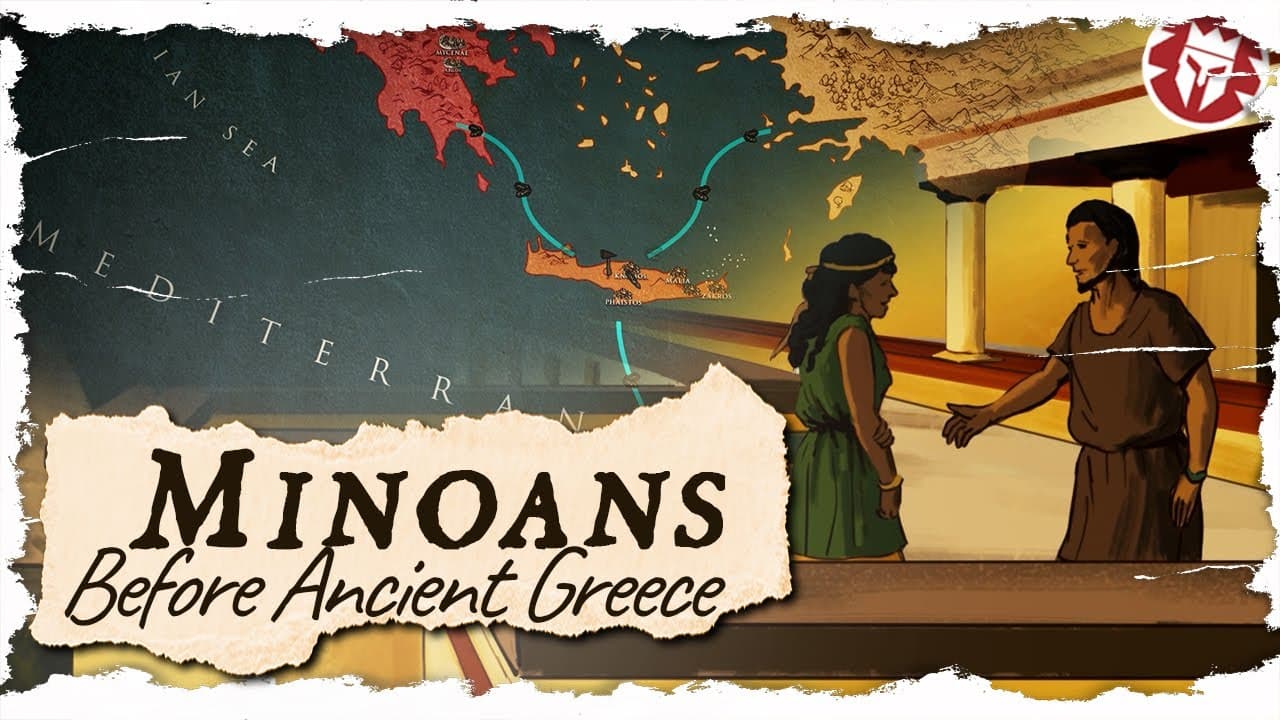
Beyond the myths, Minoan Crete was a prosperous Bronze Age society built on agriculture, specialized production, palace-based administration, and Mediterranean trade rather than a proven unified naval empire. Developing over almost two millennia, its communities became increasingly stratified and connected with Egypt, Asia Minor, Greece, and the Cyclades, while its undeciphered scripts still obscure its languages and identity. Read on to separate archaeological evidence from the legend of King Minos.
Transcript
Emerging from the clear blue waters of the Mediterranean with its lush mountains and pristine beaches, the island of Crete is one of the southernmost parts of Greece. While today it is part of the modern Greek nation, Crete has always had a distinct history and identity that is very different from the rest of Greece. This is evident from Greek ... Read More
Key Insights
- The term Minoan is a modern archaeological label created by Arthur Evans from the myth of King Minos after Evans excavated Knossos in the early 1900s. No surviving evidence establishes what Bronze Age Cretans called themselves or confirms a direct relationship with the legendary monarch.
- Minoan identity remains uncertain because neither Cretan Hieroglyphic nor Linear A has been deciphered. Linear A signs corresponding to Linear B signs do not appear to represent the archaic Greek of the Mycenaeans, supporting the conclusion that most Minoans were not Greek.
- The Prepalatial Period was a millennium of gradual transformation in which settlements expanded, painted ceramics became common, agriculture grew more important, and communities spread from plains into highlands. These developments created the social and economic foundations for Crete's later emergence as an industrial and mercantile center.
- Social stratification developed progressively rather than existing throughout early Minoan history. Early Minoan I tombs show relatively little wealth differentiation, while foreign products and seals increased during Early Minoan II, and elite tombs appeared at sites such as Moxlos during Early Minoan III.
- Minoan palaces were probably administrative complexes managing agricultural and mercantile activity, but historians cannot confidently identify them as royal residences. Their courtyards, seasonally opening roofs, bathhouses, and flushable toilets demonstrate elaborate construction, while repeated renovation indicates sustained use during much of the second millennium BCE.
- Palatial production brought industries such as weaving, pottery, metallurgy, and obsidian working under elite supervision. Large numbers of loom weights suggest organized textile manufacturing, while imported raw materials and expanding relationships with Egypt, the Near East, the Cyclades, Asia Minor, and Greece connected production to international trade.
- Cretan writing developed partly from the need to administer agricultural surpluses and account for goods. Cretan Hieroglyphic saw limited use, while Linear A survived until approximately 1450 BCE and inspired the similarly undeciphered Cypro-Minoan script used on Cyprus.
- Minoan influence across the Aegean does not necessarily prove the existence of a centralized thalassocracy. More recent interpretations propose that regional elites copied prestigious Cretan imagery because Crete was wealthy, while Egyptian records and Minoan-style frescoes at Tell el'Daba demonstrate the breadth of its commercial and cultural connections.
Install to Summarize YouTube Videos and Get Transcripts
Explore YouTube Video Summarizer or Get YouTube Transcript Extractor
Questions & Answers
Q: What was Minoan Crete beyond the myths?
Minoan Crete was a Bronze Age society that developed through agriculture, specialized industries, administrative centers, and extensive Mediterranean trade. Its people produced elaborate architecture and culture over almost two millennia, but the evidence does not confirm the legendary King Minos or a centralized naval empire.
Q: Who were the people called the Minoans?
The Minoans were the predominantly non-Greek people associated with Bronze Age Crete, although their identity remains uncertain. Archaeologist Arthur Evans created the name after excavating Knossos in the early 1900s, drawing it from the myth of King Minos. The Cretans' own name is unknown, and the island may have contained several ethnolinguistic groups.
Q: Why can the name Minoan be misleading?
The name suggests a connection between Bronze Age Cretans and the legendary King Minos, but the transcript calls that relationship dubious. Arthur Evans coined the term from Greek mythology, so it reflects a modern archaeological interpretation rather than a name known to have been used by the ancient population.
Q: What do Linear A and Cretan Hieroglyphic reveal about Minoan Crete?
They show that Bronze Age Cretans used at least two writing systems, including Cretan Hieroglyphic on the Phaistos Disc and the later Linear A. Neither script has been deciphered. Linear A signs corresponding to Linear B do not appear to represent the archaic Greek spoken by the Mycenaeans, supporting the conclusion that most Minoans were not Greek.
Q: How did Minoan society become socially stratified?
Early Minoan I tombs show little distinction in wealth, suggesting a relatively egalitarian society. From 2900 to 2650 BCE, settlements expanded, seals appeared, and foreign products became more common. By Early Minoan III, dated from 2300 to 2000 BCE, elite tombs at sites such as Moxlos indicate established social stratification.
Q: What functions did Minoan palace complexes serve?
The palace complexes probably served as administrative centers that managed agricultural surpluses, mercantile activity, production, and recordkeeping. Evidence such as numerous loom weights suggests that elites supervised textile manufacturing and other industries. Historians cannot confidently identify these complexes as royal residences.
Q: Was Minoan Crete a naval empire across the Aegean?
The evidence does not establish that Crete was a centralized naval empire controlling Aegean territories. Although early scholars interpreted widespread Cretan material culture as evidence of a thalassocracy, newer interpretations suggest that regional elites copied prestigious Cretan imagery because of the island's wealth and cultural influence.
Q: How extensive were Minoan trade and cultural connections?
Minoan connections reached the Cyclades, Asia Minor, Greece, the Near East, and Egypt. Crete imported raw materials for industries such as obsidian working and exported goods and cultural influence. Cretans appeared in Egyptian temple records, while frescoes dated to 1450 BCE at Tell el'Daba display a Minoan artistic style.
Summary & Key Takeaways
-
Bronze Age Crete developed from expanding Neolithic settlements into a complex society with painted pottery, agriculture, trade, specialized industries, and social hierarchy. Archaeologists call its people Minoans, but that modern name came from Arthur Evans and the myth of King Minos. Their own name, languages, and precise ethnic composition remain unknown.
-
During the Prepalatial Period, larger settlements, foreign products, seals, and increasingly wealthy tombs reveal gradual economic and social change. From approximately 2100 to 1900 BCE, early administrative complexes appeared at Knossos, Phaistos, Malia, and Palaikastro, laying the foundation for increasingly centralized production, surplus management, recordkeeping, and Mediterranean commerce.
-
Cretan influence reached its height during the Neopalatial Period from 1700 to 1470 BCE, when palaces expanded and trade networks flourished. Although early researchers described Crete as a centralized naval empire, newer interpretations attribute its widespread imagery to commercial wealth and cultural prestige rather than direct territorial rule across the Aegean Sea.
Read in Other Languages (beta)
Share This Summary 📚
Summarize YouTube Videos and Get Video Transcripts with 1-Click
Try YouTube Summary with ChatGPT & Claude or YouTube Transcript Generator
Explore More Summaries from Kings and Generals 📚
Summarize YouTube Videos and Get Video Transcripts with 1-Click
Try YouTube Summary with ChatGPT & Claude or YouTube Transcript Generator