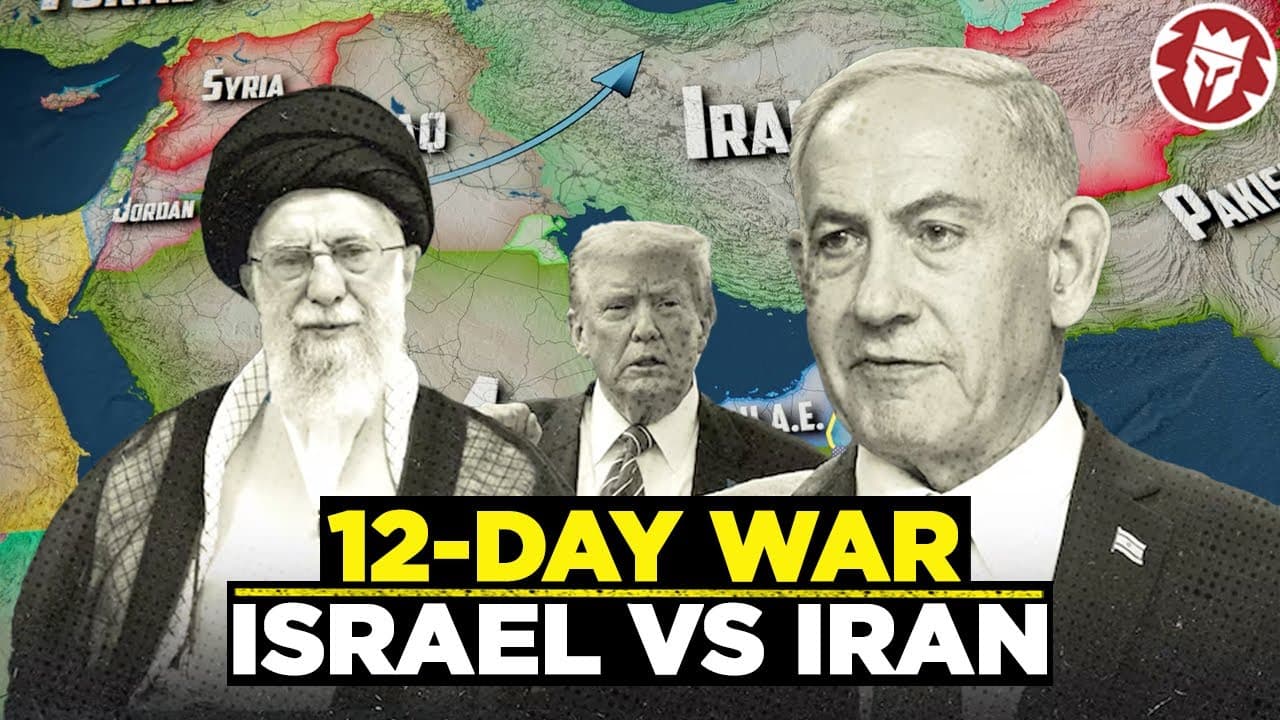
What sparked the Iran Israel 12-day war in 2025?
TL;DR
The 12-day war grew from a long history of Iran and Israel as enemies, worsened by Iran's nuclear ambitions and its support for proxies. Israel led a decisive air campaign against nuclear and missile sites, while Iran retaliated with a large missile strike, as diplomatic efforts by the US attempted to halt the conflict.
Transcript
The Middle East has been one big warzone since October 7, 2023. The war between Israel and Hamas then escalated into various forms of war between Israel and Hezbollah, the Yemeni Houthi campaign against Israel and vessels in the Red Sea and Israel’s deadly bombing of Gaza. Then, of course, there was the restart of the civil war in Syria ending ... Read More
Key Insights
- Iran and Israel are described as long-time enemies on a collision course after October 7, 2023.
- Iran started supporting anti-Israeli forces such as Hamas, Palestinian Islamic Jihad, Hezbollah and Houthis with weapons, funding and training.
- The Axis of Resistance is the loose coalition led by Iran that includes its proxies.
- Israel used covert operations to damage Iran’s nuclear program, including Stuxnet in the late 2000s.
- A May 2025 IAEA report indicated Iran had 408.6 kg of uranium enriched up to 60 percent.
- Western governments, including the US, viewed Iran’s enrichment activities as positioning for a nuclear weapon program.
- In October 2024 Iran launched around 200 ballistic missiles at Israel, signaling a major expansion of its strike capability.
- On June 13, 2025, Israel carried out airstrikes targeting Iran’s Natanz, Isfahan, Fordow and killed key figures of Iran’s military and nuclear program.
- More videos from this channel:
- More from this channel: Kings and Generals
Install to Summarize YouTube Videos and Get Transcripts
Explore YouTube Video Summarizer or Get YouTube Transcript Extractor
Questions & Answers
Q: What sparked the 12-day Iran Israel war in 2025?
The conflict arose from long-standing animosity between Iran and Israel and escalated after October 7, 2023, when Iran continued supporting anti-Israeli forces such as Hamas, Hezbollah and Houthis through weapons, funding and training. Israel viewed Tehran’s nuclear ambitions and regional influence as existential threats, which prompted a major air campaign and chained retaliations. The war quickly expanded across fronts, driven by proxy networks and a breakdown in diplomatic channels, culminating in intensified hostilities in June 2025.
Q: How did Iran contribute to the escalation through its proxies?
Iran supported anti-Israeli forces including Hamas, Palestinian Islamic Jihad, Hezbollah and Houthis with weapons, funding and training, creating a multi-front pressure on Israel. This support formed a loose coalition under Iran’s leadership, commonly referred to as the Axis of Resistance, enabling proxy attacks and contributing to the broader regional instability that fed into the direct conflict.
Q: What was Israel’s main strategy during the war?
Israel aimed to prevent Tehran from obtaining nuclear weapons and to degrade Iran’s ability to project military power by stripping away its nuclear and missile infrastructure. The strategy included a large scale air campaign, hitting multiple strategic sites like the Natanz and Fordow enrichment facilities and related missile depots, and utilizing advanced aircraft and drones to achieve air dominance.
Q: What role did the Stuxnet incident play in the narrative?
The Stuxnet malware, developed in part by Israel and the United States in the late 2000s, is cited as an example of covert operations used to damage Iran’s nuclear program. It demonstrated a precedent for cyber-physical disruption aimed at delaying Iran’s enrichment capabilities, influencing later military and intelligence strategies in the broader Iran-Israel conflict.
Q: What did the May 2025 IAEA report indicate about Iran’s nuclear program?
The IAEA report dated May 2025 noted that Iran had 408.6 kilograms of uranium enriched up to 60 percent, with approximately 42 kilograms sufficient to potentially produce a nuclear weapon. This reflected a rapid increase from earlier estimates and reinforced concerns about Iran’s breakout potential and the global security implications.
Q: How did Western governments view Iran’s enrichment efforts?
Western governments, including the United States, viewed Iran’s 60 percent enrichment as evidence that Iran could potentially produce nuclear weapons. Assessments from the IAEA and US intelligence described activities that better positioned Iran to develop a nuclear device, while Iran denied pursuing weapons and emphasized peaceful purposes.
Q: What happened on October 1, 2024, in the conflict?
On October 1, 2024, Iran launched around 200 ballistic missiles at Israel, hitting the Nevatim airbase. This attack demonstrated Iran’s capability to strike key military targets and tested Israel’s air defense and missile defense systems, highlighting the scale and seriousness of the escalation and the risk of broader confrontation.
Q: What notable actions occurred on June 13, 2025?
On June 13, 2025, the Israeli Air Force launched several waves of airstrikes that targeted Iranian nuclear facilities and military infrastructure, including Natanz, Isfahan, and Fordow. Key Iranian figures were killed, and the operation showcased Israel’s bid to achieve air superiority and degrade Iran’s strategic capabilities on the first day of major hostilities.
Summary & Key Takeaways
-
The 12-day war escalated from a longstanding rivalry between Iran and Israel and intensified after October 7, 2023, creating a direct clash. The conflict featured proxy networks and rapid shifts in regional power that strained regional security and exposed vulnerabilities on multiple fronts.
-
Israel pursued a strategy of degrading Iran’s nuclear and missile infrastructure through air strikes, highlighting the use of advanced aircraft and targeted facilities as a central component of its deterrence and response. The episode exposed the fragility of ceasefires amid strategic misgivings and external mediation efforts.
-
The crisis also involved the US and its allies attempting diplomacy and pressure, with mixed outcomes. The war demonstrated how covert operations, sanctions, and alliance-building interact with open military campaigns to shape escalation dynamics in the Middle East.
Read in Other Languages (beta)
Share This Summary 📚
Summarize YouTube Videos and Get Video Transcripts with 1-Click
Try YouTube Summary with ChatGPT & Claude or YouTube Transcript Generator
Explore More Summaries from Kings and Generals 📚

Summarize YouTube Videos and Get Video Transcripts with 1-Click
Try YouTube Summary with ChatGPT & Claude or YouTube Transcript Generator