Why Did the War of the Three Kingdoms Begin?
TL;DR
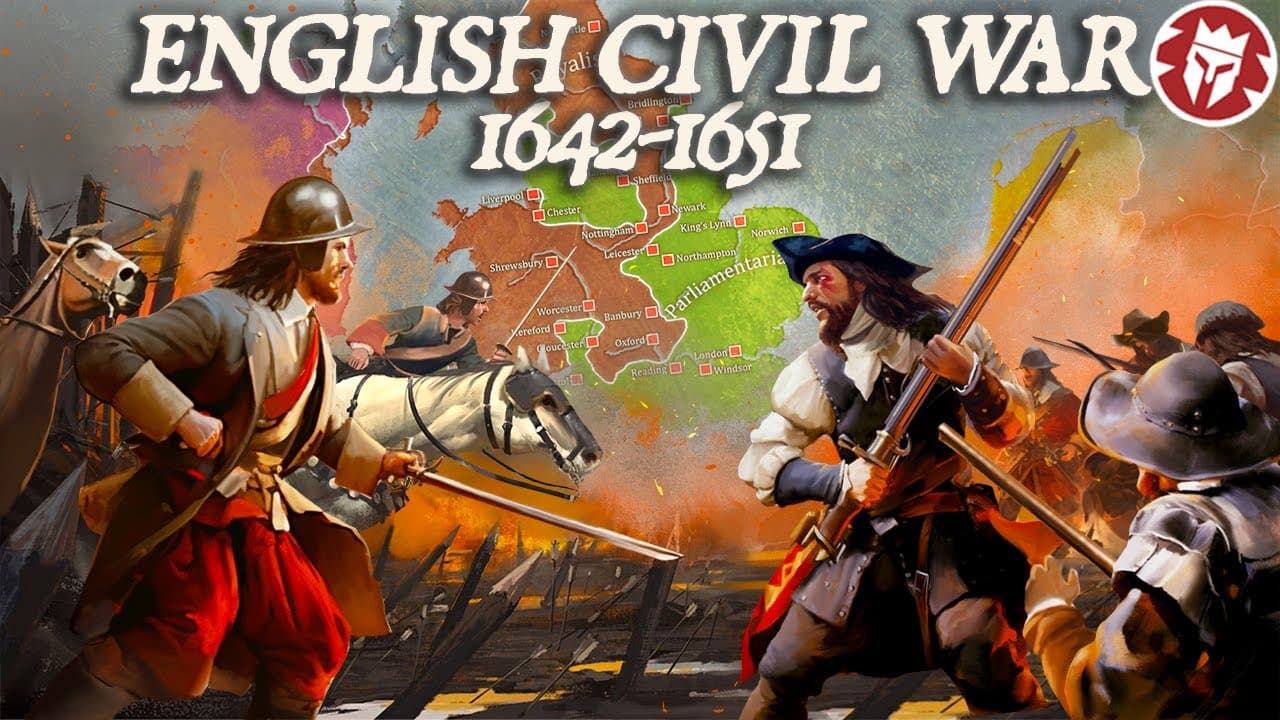
The conflict began because Charles I asserted strong royal authority while Parliament resisted taxation without consent, arbitrary imprisonment, and controversial religious policies. His unauthorized revenue collection, eleven years of personal rule, tolerance of Catholics, and support for William Laud’s Arminian reforms deepened distrust until political and religious tensions made armed conflict increasingly likely.
Transcript
Welcome to another installment of the full-length Kings and Generals Documentaries! Today, we're delving into one of the most pivotal and tumultuous periods in British history – the English Civil War also known as the War of the Three Kingdoms. This tumultuous conflict, which raged across the 17th century, was marked by intense battles, deep-seated... Read More
Key Insights
- The conflict was driven by overlapping constitutional, financial, and religious disputes. Charles I’s commitment to divine right collided with Parliament’s growing influence, while fears about Catholicism and resentment over taxation turned political disagreement into a national crisis.
- Parliament was not yet England’s executive government, but it possessed substantial practical power because it could raise taxes more effectively than the king. This financial leverage made parliamentary cooperation difficult for Charles to avoid, even though only the monarch could legally convene Parliament.
- Charles I’s revenue policies intensified opposition because he collected Tonnage and Poundage without parliamentary authorization, borrowed against the crown jewels, and imposed forced loans on wealthy subjects. These measures raised more than £250,000 but generated resistance, obstruction, and imprisonment.
- The Petition of Right challenged arbitrary royal government by declaring imprisonment without lawful process and taxation without parliamentary consent unacceptable. Charles accepted it while needing funds, but apparently regarded it as confirmation of existing liberties rather than a meaningful new restriction on his authority.
- Religious suspicion centered on Henrietta Maria’s Catholicism and William Laud’s Arminian reforms. Their influence led many Protestants, especially Puritans, to fear that Charles was moving England toward Roman Catholic practices, although the transcript says Charles himself was not becoming Catholic.
- The 1629 parliamentary confrontation ended with members physically holding Speaker John Finch in his chair while resolutions against royal taxation and religious reforms were read. Charles responded by dissolving Parliament and arresting leaders, inadvertently creating martyrs for resistance to absolute rule.
- The Personal Rule was initially more peaceful and prosperous than its hostile label, the Eleven Years’ Tyranny, suggests. Some ordinary people welcomed more formal worship, foreign religious fears diminished, and the royal family experienced a period of personal happiness and public celebration.
- William Laud’s appointment as Archbishop of Canterbury in 1633 worsened existing divisions because he extended religious changes beyond what many Puritans would tolerate. Charles’s hostility toward extreme Puritanism and tolerance of Catholics made his polarized religious position appear more threatening than he intended.
- More videos from this channel:
- More from this channel: Kings and Generals
Install to Summarize YouTube Videos and Get Transcripts
Explore YouTube Video Summarizer or Get YouTube Transcript Extractor
Questions & Answers
Q: Why did the War of the Three Kingdoms begin?
The conflict developed from a combination of disputes about royal authority, parliamentary consent, taxation, imprisonment, and religion. Charles I believed strongly in divine right, while Parliament resisted his collection of revenue without approval. His Catholic queen and support for William Laud’s Arminian reforms also alarmed Protestants, creating a political and religious divide that progressively made England a powder keg.
Q: How did taxation create conflict between Charles I and Parliament?
Parliament granted Charles I permission to collect Tonnage and Poundage for only one year instead of his entire reign, and its wider funding provisions did not meet his needs. Charles responded by continuing customs collection, borrowing against the crown jewels, and imposing forced loans. Although these methods raised more than £250,000, they angered property owners and strengthened claims that the king was violating established liberties.
Q: What was the Petition of Right intended to prevent?
The Petition of Right was designed to define liberties that Charles I could not lawfully violate. Its central concerns included arbitrary imprisonment and collecting taxes without Parliament’s consent. Charles accepted the document in 1628 because he urgently needed parliamentary funding, but he apparently believed he was merely reaffirming traditional rights rather than accepting a new constitutional limitation on royal power.
Q: Why did Charles I dissolve Parliament in 1629?
Charles dissolved Parliament after members challenged his continued collection of customs duties as contrary to the Petition of Right. When he ordered an adjournment, members held Speaker John Finch in his chair so the session could continue long enough to pass resolutions against royal taxation and religious reforms. Charles then dissolved Parliament on March 10, 1629, and arrested several participants.
Q: What was the Personal Rule of Charles I?
The Personal Rule was the period after Charles dissolved Parliament in 1629 and governed without it for roughly eleven years. Supporters used the neutral term Personal Rule, while opponents called it the Eleven Years’ Tyranny. Charles made peace with foreign enemies, supported culture, and initially enjoyed relative stability, but financial, constitutional, and religious grievances remained unresolved and contributed to later conflict.
Q: How did religion deepen opposition to Charles I?
Religious opposition grew because Charles married the strongly Catholic Henrietta Maria, tolerated Catholics, resisted extreme Puritans, and supported William Laud’s Arminian policies. Arminian worship restored practices that critics associated with Roman Catholicism. Even though Charles did not appear to be converting, many Protestants interpreted his household, alliances, and church reforms as evidence that England’s reformed religion was endangered.
Q: Was the Eleven Years’ Tyranny uniformly oppressive?
The transcript argues that the period was not as uniformly terrible as its hostile nickname implies. Many ordinary people initially accepted Laud’s more formal religious practices, the royal family experienced considerable happiness, and foreign religious anxiety declined after the death of Gustavus Adolphus in 1632. Charles also promoted theatre, painting, architecture, music, and other forms of high culture during these years.
Q: What role did William Laud play in the growing crisis?
William Laud promoted Arminianism, an anti-Calvinist form of Protestantism that restored some practices closer to those of the Roman Catholic Church. After becoming Archbishop of Canterbury in 1633, he expanded these reforms and overreached his authority. Puritans believed the Reformation remained unfinished, so Laud’s policies reinforced suspicions that Charles’s government was hostile to their faith and dangerously sympathetic to Catholicism.
Summary & Key Takeaways
-
Charles I inherited his father’s belief in divine right, but England’s monarch could not easily govern without Parliament’s effective tax-raising power. Disputes over inadequate funding, customs duties, forced loans, and imprisonment without trial transformed ordinary financial disagreements into a fundamental struggle over whether royal authority was constrained by established liberties.
-
Religious distrust magnified the political crisis. Charles married the Catholic Henrietta Maria, tolerated Catholics, opposed extreme Puritans, and supported William Laud’s Arminian reforms. Although Charles did not appear to be converting to Catholicism, these associations convinced suspicious Protestants that the monarchy threatened England’s reformed faith and favored Catholic practices.
-
After accepting the Petition of Right, Charles continued collecting customs duties, provoking a dramatic parliamentary confrontation in 1629. He dissolved Parliament, arrested leading opponents, made peace abroad, and governed personally for eleven years. The period initially brought stability and cultural patronage, yet unresolved constitutional and religious disputes continued preparing the ground for war.
Read in Other Languages (beta)
Share This Summary 📚
Summarize YouTube Videos and Get Video Transcripts with 1-Click
Try YouTube Summary with ChatGPT & Claude or YouTube Transcript Generator
Explore More Summaries from Kings and Generals 📚





Summarize YouTube Videos and Get Video Transcripts with 1-Click
Try YouTube Summary with ChatGPT & Claude or YouTube Transcript Generator