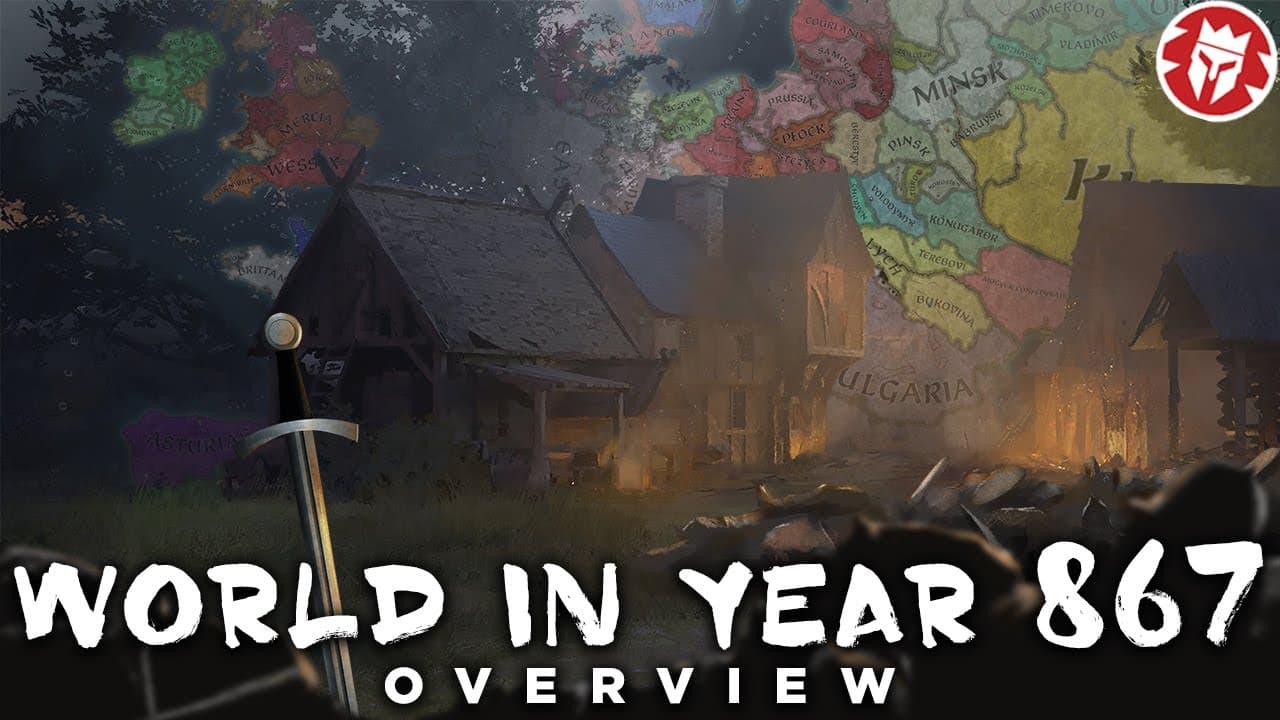
What did Afro-Eurasia look like in 867 CK3?
TL;DR
867 presents a fragmented, war driven world across Europe, the Middle East, and Africa in Crusader Kings III. The video covers the Great Heathen Army invasion of Britain, the division of the Frankish empire, the Byzantine rise and struggles, and the Abbasid Caliphate's regional fragmentation, shaping a complex medieval landscape.
Transcript
Today’s video is a special dedicated to the upcoming release of a new title in one of our favorite gaming franchises – Crusader Kings 3. The game will have 2 starting dates – 867 and 1066 and our friends at Paradox asked us to show how their gaming world looked during these dates. We think that Paradox did a great job choosing these 2 dates, as the... Read More
Key Insights
- 867 is a turning point for political fragmentation across Europe, the Middle East, and Africa.
- The Great Heathen Army transformed Anglo-Saxon England, leaving Wessex as a stronghold against Viking advances.
- West Francia and East Francia begin a long period of division that reshapes Frankish power.
- The Byzantine Empire consolidates in Anatolia and the Balkans, facing internal strife and external pressure.
- Muslim realms show increasing regional autonomy, signaling a weakening unification under Baghdad.
- Slavic polities and Great Moravia emerge, hinting at later national formations in Central Europe.
- Baltic and Finno Ugric regions face waves of external influence from neighbors, shaping future borders.
- The video emphasizes depth of CK3 mechanics in politics, religion, diplomacy, and warfare within a richly detailed map.
- More videos from this channel:
- More from this channel: Kings and Generals
Install to Summarize YouTube Videos and Get Transcripts
Explore YouTube Video Summarizer or Get YouTube Transcript Extractor
Questions & Answers
Q: What is the scope of 867 in Crusader Kings III overview?
The video provides a broad overview of Afro-Eurasia in the year 867 within Crusader Kings III, covering major kingdoms, dynasties, states, religions, and rivalries. It highlights the Great Heathen Army invasion of Britain, the Frankish empire division, Byzantium dynamics, and the Abbasid Caliphate’s fading centralized authority, all set against a landscape of political intrigue and transition.
Q: How does the Great Heathen Army affect Britain in 867?
The Great Heathen Army arrival in 865 destabilizes Northumbria and shifts power across the Anglo-Saxon kingdoms. By 867, only Wessex under Æthelred I and Alfred is prepared to resist Viking intrusions, while other kingdoms struggle with dynastic strife and external pressure. This creates a fragile balance that shapes subsequent conflicts and alliances in the British Isles.
Q: What happens to the Frankish empire around 867?
Western Francia and East Francia are depicted as separate realms following Charlemagne’s legacy, with internal fragmentation and external challenges from Brittany and Aquitaine in the west. The future Holy Roman Empire concept starts taking form under Louis II and Louis the German, signaling a shift in central European power dynamics.
Q: What is the Byzantine Empire’s situation in 867?
The Byzantine Empire consolidates in Anatolia and the Balkans after earlier conquests but faces persistent dynastic strife. The rise of the Macedonian Dynasty marks a stable line, while external pressures from Slavic and Bulgar neighbors test imperial resilience and influence in the surrounding regions.
Q: How does Abbasid Caliphate appear in 867 overview?
The Abbasid Caliphate remains the largest and most influential Muslim domain, yet its authority weakens as regional dynasties gain autonomy. Local powers in Egypt, North Africa, and Iran exercise increasing independence, illustrating a shift from a centralized caliphate to a mosaic of semi autonomous principalities.
Q: Which new regions or states emerge in 867 scene?
Central Europe sees Bohemian duchy and Moravia forming, while the Polans begin consolidating Western Slavic tribes into a nascent Polish milieu. In the north, Norway starts unifying under a new lineage, and the Khazars, Aghlabids, and other entities illustrate a world of evolving political boundaries bridged by trade routes and competing religions.
Q: What role do religions play in 867 CK3 world?
Christianity and Islam are the dominant faiths shaping political and cultural landscapes, but the video notes significant regional variation. Orthodox, Catholic, and local belief systems interact with dynastic politics, religious conversions, and interfaith dynamics, creating a complex religious map that influences alliances, warfare, and governance.
Q: Why is 867 considered a pivotal starting date in CK3?
867 is presented as a pivotal starting point because it captures peak fragmentation and geopolitical flux across continents. It shows powerful but aging empires, rising regional states, and evolving religious identities, offering a rich canvas for CK3 to simulate dynastic strategy, diplomacy, warfare, and cultural transformation in a historically dense era.
Summary & Key Takeaways
-
In 867, multiple faiths and powers coexist yet clash across a fractured political map, with Norse incursions, East and West Francia divisions, and a shifting Byzantine border, creating a tense balance of power.
-
The Abbasid Caliphate begins to break into regional realms, while local dynasties and emerging Slavic states push for independence, increasing political fluidity.
-
The video frames a broad Afro-Eurasian context for CK3 with focus on key players, battles, and religious dynamics that would define the medieval world for centuries.
Read in Other Languages (beta)
Share This Summary 📚
Summarize YouTube Videos and Get Video Transcripts with 1-Click
Try YouTube Summary with ChatGPT & Claude or YouTube Transcript Generator
Explore More Summaries from Kings and Generals 📚
Summarize YouTube Videos and Get Video Transcripts with 1-Click
Try YouTube Summary with ChatGPT & Claude or YouTube Transcript Generator