How Was Sparta Different From Other Greek City-States?
TL;DR
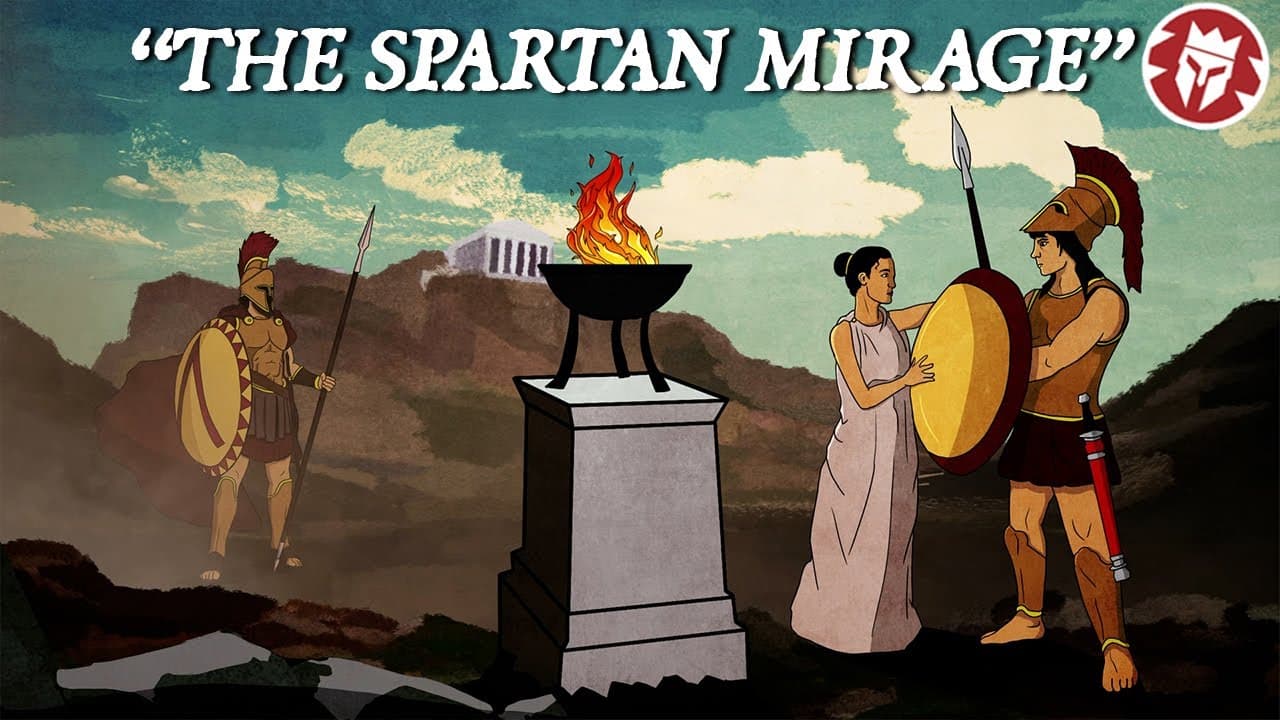
Sparta was not as unique as popular myth suggests. The episode shows wealth inequality, state control of land, and separate war and civic life; militarism existed but did not define all Spartan life. The Spartan Mirage is challenged by scholars, revealing a more typical Greek city with distinct practices.
Transcript
Ancient Sparta is a polity considered unique from all other Ancient Greek Cities, not just by modern audiences, but by its contemporaries and even its own population. There are many examples of Sparta’s deviation from the rest of the Greek world, from their supposed austerity in life, to their state-owned system of land control, to their extrem... Read More
Key Insights
- Spartan Mirage is the modern challenge to the idea that Sparta lived in a powerfully uniform and austere society.
- Sparta had wealth inequality and state land control, not a simple, communal economy as some myths suggest.
- Lakedaimonians cultivated social uniformity publicly, yet private wealth and land ownership existed among elites.
- Sparta’s militarism was real but did not entirely define civic life, which remained distinct from war.
- Spartan political institutions existed in a mixed system, blending kings, gerousia, ephors, and apella.
- War funding included coins from other cities and wealth from individual citizens, illustrating economic diversity.
- Spartan art, religion, and votive offerings indicate cultural sophistication not captured by the austere stereotype.
- External writers and later tourists helped shape the Spartan Mirage more than independent sources.
- More videos from this channel:
- More from this channel: Kings and Generals
Install to Summarize YouTube Videos and Get Transcripts
Explore YouTube Video Summarizer or Get YouTube Transcript Extractor
Questions & Answers
Q: A real search query question about the video (e.g. 'How to...', 'What is...', 'Why does...', 'When should...'). Question 1
What is the Spartan Mirage and how has it affected modern perceptions of Sparta? The Spartan Mirage refers to the popular image of Sparta as a city of austere warrior monks, uniform in wealth and culture. The video explains that this image was shaped by outsiders, including Xenophon, Thucydides, Herodotus, Romans, Enlightenment thinkers, and modern pop culture, and is contested by scholars. The reality is more nuanced, with notable wealth inequality, a mix of military and civilian life, and political complexity. Understanding this helps explain why Sparta often appears more myth than reality.
Q: What evidence challenges the idea of Spartans living in extreme austerity?
The evidence against universal Spartan austerity includes archaeological and textual indications of wealth and luxury. Coins appeared in the late 5th century BCE, including silver and precious metals, showing that Spartans engaged in standard coinage and economic exchange. Luxurious votive offerings found in rural shrines imply material wealth and religious patronage. These data points contradict the notion that Spartan society was uniformly austere and economically uniform, instead pointing to a more stratified economy with elite wealth.
Q: How did land and wealth actually structure Spartan society?
Land inequality and economic organization in Sparta contradict the idea of equal share within the polis. Historians note that wealthier Spartans owned large estates managed by Helots, while poorer citizens farmed smaller plots. The state exercised significant but not absolute control over land, reserving some land for state use while allowing private ownership. This arrangement created social distinctions and economic stratification within a city famous for its collective identity.
Q: Did Spartan militarism completely define social life?
Militarism did shape Sparta, with unique features such as long service and the Agoge training, but it did not fully define social life. Public and military spheres were designed to be separate, and ceremonial practices such as public funerals were not always held centrally in Sparta. Civic life included social units like the Syssitia, which were connected to military status but also reflected broader communal and civic dimensions. This shows a more layered society than a single war-centered model.
Q: What made Spartan politics appear unique, and how is it actually similar to other Greek poleis?
Sparta had a mixed government with two kings, a Gerousia, five ephors, and the Apella. While this combination created a distinctive political system, the video notes that similar elements can be found in other Greek poleis, and internal rivalries and factionalism occurred within Sparta as well. The portrayal of political harmony is questioned, revealing a politics as polarized and complex as in peers like Athens.
Q: How did external observers shape Sparta's reputation over time?
External observers such as Herodotus, Xenophon, Thucydides, and later Enlightenment thinkers contributed to Sparta’s reputation as a uniquely austere and militarized society. These voices helped propagate the Spartan Mirage, which modern scholarship now critiques by highlighting wealth disparities, state control of land, and nuanced social practices. The video emphasizes that reputation often hinges on external narratives rather than on a comprehensive internal record.
Q: What is the role of art, poetry, and religion in the Spartan image?
The Spartan image includes assumptions about cultural deprivation, yet evidence points to rich religious life and artistic offerings, such as votive objects in shrines. The video argues that Sparta was not devoid of cultural practices and spiritual expressions, countering the idea of a strictly Spartanless culture. This contributes to a more balanced view of Spartan society, recognizing both its martial emphasis and its religious and artistic dimensions.
Q: What do scholars like Hodkinson and Cartledge contribute to understanding Sparta?
Scholars such as Stephen Hodkinson and Paul Cartledge challenge the view of Sparta as a purely uniform and austere city. Hodkinson argues for wealth inequality and land tenure differences, while Cartledge critiques the simplistic notion of Spartan exceptionalism. Their work supports a more accurate picture of Sparta as a Greek city-state with its own complexities, not fundamentally different from others in the broader Hellenic world.
Summary & Key Takeaways
-
Sparta is shown to have wealth and land inequality, contradicting the idea of universal austerity and communal wealth distribution. The state exercised significant control over land, yet private estates and wealth existed within the polis.
-
Militarism did shape Spartan life, but war and civic affairs were kept relatively separate, with public funerals rarely held in Sparta to keep war costs distant from everyday life.
-
The Spartan political system combined two kings, a Gerousia, ephors, and the Apella, but politics were as complex and factional as in other Greek poleis, debunking the notion of effortless harmony.
Read in Other Languages (beta)
Share This Summary 📚
Summarize YouTube Videos and Get Video Transcripts with 1-Click
Try YouTube Summary with ChatGPT & Claude or YouTube Transcript Generator
Explore More Summaries from Kings and Generals 📚

Summarize YouTube Videos and Get Video Transcripts with 1-Click
Try YouTube Summary with ChatGPT & Claude or YouTube Transcript Generator