How did Japan invade Korea in 1592 and 1598
TL;DR
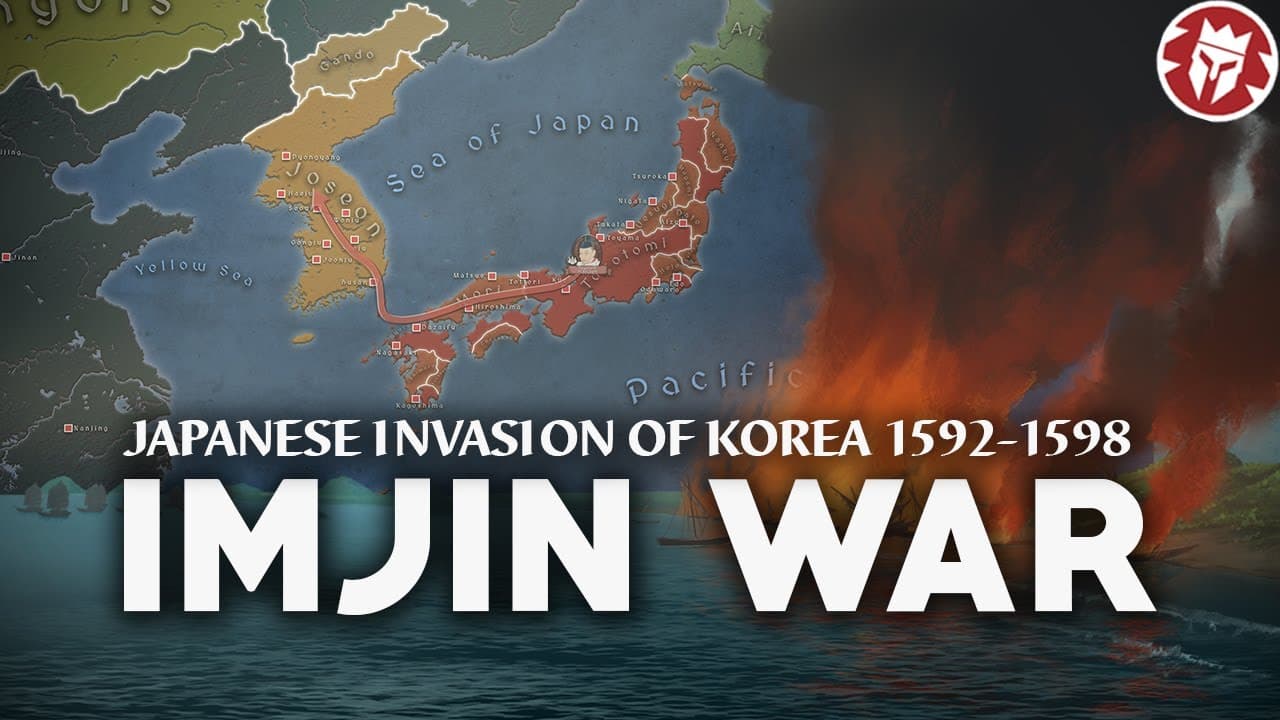
The invasion began in 1592 when Toyotomi Hideyoshi mobilized a large Japanese force to cross to Korea, using 335,000 total troops drawn from Kyushu, Honshu, and Shikoku. Koreans were unprepared despite some naval and cannon advantages, and Yi Sun-sin emerged as a key defender, while planning and logistics shaped the campaign.
Transcript
Japan at the dawn of the 17th century, was entering a new epoch... The country had just been united, and thus, the Sengoku Jidai, a near century and a half of endemic feudal warfare, had come to an end. Peace proved to be yet another challenge for the new overlord Toyotomi Hideyoshi, for his country was now home to hundreds of thousands of wa... Read More
Key Insights
- Japan planned to expand beyond its borders after unification, using a large invasion force to subdue Korea first, then press into China.
- Hideyoshi’s invasion force totaled 335,000 troops, drawn from Kyushu, Honshu, and Shikoku, and 700 ships ferried them to the Korean peninsula.
- The invading army was largely composed of ashigaru, peasants trained as soldiers, with some arquebus equipped troops.
- Korean naval and military readiness was compromised by internal corruption and strategic indecision, undermining early resistance.
- Yi Sun-sin emerged as Korea’s naval leader, studying command and preparing defenses to disrupt Japanese sea movements.
- Japan relied on a rapid assault to gain footholds in Busan and surrounding regions, aiming to control coastal access and force Korean capitulation.
- The first wave of invaders landed at Busan on May 24, 1592, initiating a sequence of sieges and swift advances by Japanese commanders.
- The campaign exposed the critical role of logistics, fleet coordination, and local governance in sustaining long military operations across water and land.
- More videos from this channel:
- More from this channel: Kings and Generals
Install to Summarize YouTube Videos and Get Transcripts
Explore YouTube Video Summarizer or Get YouTube Transcript Extractor
Questions & Answers
Q: How did Toyotomi Hideyoshi justify the invasion of Korea in this campaign?
Hideyoshi believed that Japan should extend its influence beyond its archipelago, using military power to unify and expand, with the aim of linking conquests in East Asia and eventually reaching China. His plans began after he unified Japan, and the invasion was marketed as a means to accomplish a greater destiny, combining political ambition with strategic need for new spoils and prestige.
Q: Which forces composed the invading army and how were they organized for the crossing to Korea?
The invasion force totaled 335,000 troops, with 158,000 from Kyushu, 57,000 from Honshu, and 19,600 from Shikoku. The army relied heavily on ashigaru foot soldiers, who fought with swords, spears, and bows, and included a significant portion armed with arquebuses. They were ferried by about 700 ships to Korea’s coast.
Q: What were the initial Japanese actions upon landing in Korea in 1592?
The first landing began after several days of advance construction and planning, with 5,000 men under Yoshitoshi and 7,000 under Yukinaga disembarking near Busan. After a brief siege, Busan fell, and the Japanese forces moved northward, capturing key locations and advancing rapidly along the peninsula, creating panic among Korean authorities.
Q: How did Korean leadership respond to the first Japanese invasion phase?
Korean authorities faced internal disagreements and a lack of decisive action, with corruption and fragmented factions hindering a swift and cohesive defense. Despite this, some provincial leaders attempted to organize resistance, but the initial lack of unified strategy and readiness allowed the Japanese to exploit coastal and inland targets early in the campaign.
Q: What role did Yi Sun-sin play in the Imjin War according to the video transcript?
Yi Sun-sin is highlighted as Korea’s most venerated war hero who, after recognizing the threat to coastal regions, studied naval command, prepared his fleet, and repaired infrastructure. His early work laid the groundwork for later, more effective Korean naval resistance, shaping the strategic balance at sea during the war.
Q: How did the Korean navy influence early engagements and outcomes?
Korean naval capabilities boasted greater shipbuilding and cannon technologies, yet they were undermined by internal corruption and mismanagement. Despite these advantages, the Koreans initially failed to leverage their naval superiority, allowing Japanese fleets to operate with relative freedom along key coastal routes during the early invasions.
Q: What strategic objectives did Japan have beyond conquering Korea initially?
Japan aimed to use Korea as a stepping stone to China, planning to mobilize manpower and resources from conquered territories to push further into Asia. The broader strategy envisioned a domino effect: after Korea, moving into China and beyond, leveraging a chain of conquests to expand influence across the region.
Q: How did the description characterize the ships and naval logistics used by Japan during the invasion?
The invasion relied on a fleet of roughly 700 ships requisitioned from coastal provinces, repurposed merchant or civilian vessels. These ships carried a large army to Korea, and the logistics also involved managing supplies for a prolonged campaign across land and sea, a major factor in the campaign's early stages.
Summary & Key Takeaways
-
In the Imjin War, Hideyoshi unified Japan and aimed to conquer Korea to reach China, assembling a vast army and planning further conquests. The early phase featured rapid Japanese landings and significant Korean morale and command failures, setting the stage for a protracted conflict.
-
Korean defects in readiness and leadership initially hindered resistance, while Yi Sun-sin later organized naval defenses and restructured coastal defense, becoming a central figure in Korea’s resistance and shaping naval warfare in the conflict.
-
The overall campaign highlighted the mismatch between Japan’s ambitious expansion and Korea and Ming China’s eventual coordinated defense, with the war exposing logistical, naval, and tactical challenges on both sides and influencing East Asian military history long after the fighting ended.
Read in Other Languages (beta)
Share This Summary 📚
Summarize YouTube Videos and Get Video Transcripts with 1-Click
Try YouTube Summary with ChatGPT & Claude or YouTube Transcript Generator
Explore More Summaries from Kings and Generals 📚


Summarize YouTube Videos and Get Video Transcripts with 1-Click
Try YouTube Summary with ChatGPT & Claude or YouTube Transcript Generator