How was England United by War in the Middle Ages
TL;DR
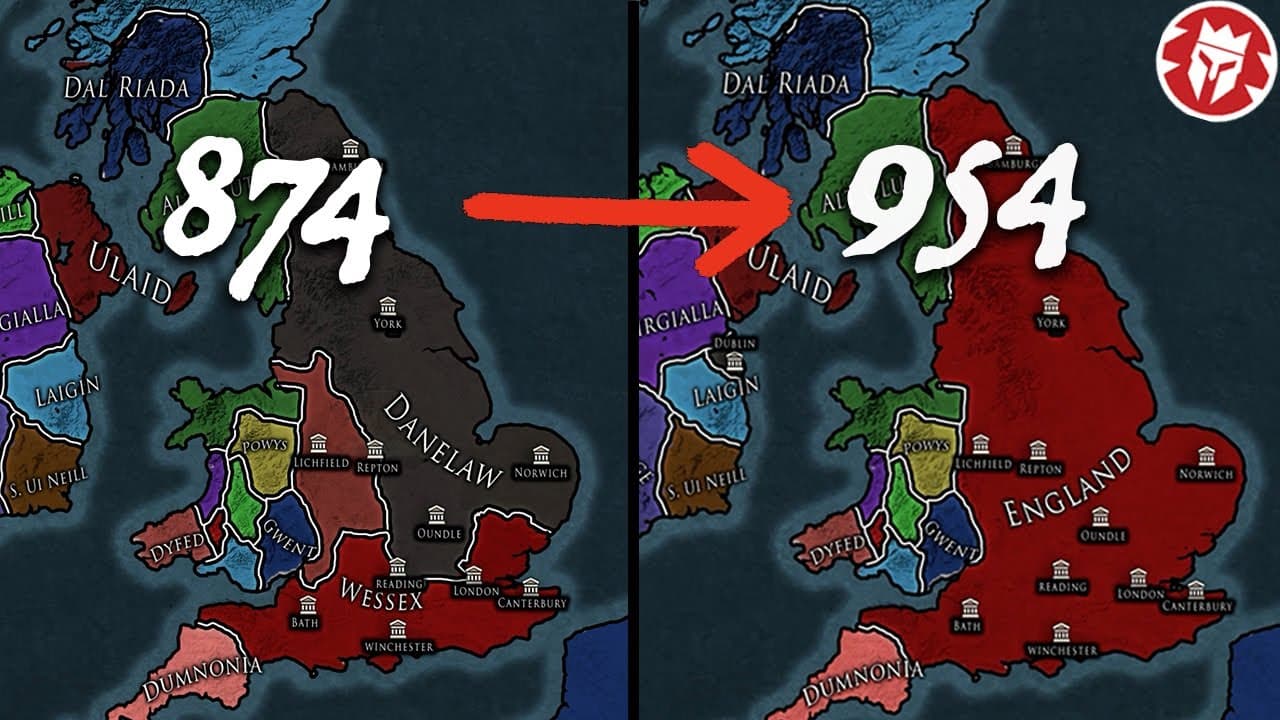
Wessex remained the last independent Anglo Saxon kingdom as Vikings overran others. Alfred the Great defended Wessex, built burhs, and formed standing forces to repel invasions. The unification progressed through dynastic alliances and conquests, culminating in 927 with Æthelstan taking York and uniting England.
Transcript
England is one of the world’s oldest nations. Among its many founding peoples, the most historically prominent were the Anglo-Saxons, who were collectively referred to as “the English people.” Yet for most of their recorded history, the Anglo-Saxons were not unified under an English Kingdom, but divided into many smaller states. It was ... Read More
Key Insights
- Wessex endured the Viking onslaught while other Anglo Saxon kingdoms fell. The surviving kingdom built fortifications, a standing army, and a fleet to defend against invasions. Alfred the Great led reforms that transformed military and political structures across the realm.
- The Viking Great Heathen Army of 865 to 867 shifted power dynamics, with York captured and Mercia fractured, leaving Wessex as the core of English resistance. Alfred capitalized on these shifts to consolidate power.
- Edington in Wiltshire became a turning point where Alfred achieved a decisive victory, enabling peace with Guthrum and paving the way for future expansion beyond Wessex borders.
- Mercia’s overlap with Wessex was strengthened through dynastic links, including Æthelred’s alliance and the marriage of Æthelflæd to Alfred’s daughter, reinforcing cross kingdom cooperation.
- Alfred’s reform era introduced burhs, ramparts, ditches, and a defensive network that supported a centralized military structure across England.
- The unification continued as Edward the Elder, Æthelflæd, and Æthelstan advanced campaigns that diminished Viking influence and reclaimed territories like London and York.
- The narrative shows how the last Viking strongholds fell under Æthelstan, marking the emergence of a united England fed by former rival kingdoms.
- The overarching theme is that England’s birth as a unified state was a long, war driven process rather than a single conquest.
- More videos from this channel:
- More from this channel: Kings and Generals
Install to Summarize YouTube Videos and Get Transcripts
Explore YouTube Video Summarizer or Get YouTube Transcript Extractor
Questions & Answers
Q: How did Wessex survive the Viking invasions when other kingdoms failed
Wessex survived because Alfred the Great organized a defense that included fortifications, such as burhs, and a standing army on horseback, along with a fleet to counter Viking raids. He also forged alliances with Mercia and implemented reforms that strengthened royal authority. This combination of military reform, geographic position, and political strategy allowed Wessex to withstand pressure from the Great Heathen Army and maintain a base from which to push back, eventually leading to broader resistance and reform across the remaining Anglo Saxon realms.
Q: What role did the Edington victory play in unifying England
The victory at Edington near Wiltshire was decisive because it broke the offensive momentum of the Viking forces led by Guthrum and allowed Alfred to negotiate peace terms, including Guthrum’s baptism. This victory stabilized the region, enabling Alfred to implement a network of burhs and a standing army, which strengthened central authority and set the stage for continued expansion beyond Wessex borders.
Q: How did dynastic marriages influence the unification process
Dynastic marriages linked different kingdoms and fostered political cooperation. For example, Æthelred of Mercia married Alfred’s daughter Æthelflæd, which helped to bind Mercia to Wessex. These alliances created domestic support for joint campaigns, facilitated governance across a broader area, and helped integrate Mercian and West Saxon leadership as part of a broader strategy to resist Viking power and stabilize the realm.
Q: What were burhs and why were they important
Burhs were fortified towns built across the kingdom to guard against future Viking attacks. They provided secure bases for local forces, improved communication, and allowed rapid response to invasions. The network of burhs, protected by ramparts and ditches, formed a backbone for a centralized defense that supported standing armies and improved overall security in the realm.
Q: Who was Æthelstan and what did he accomplish
Æthelstan was the successor who continued the expansion of Wessex influence, overseeing the consolidation of power and expansion into previously contested regions. His actions culminated in the capture of York in 927, which effectively completed the unification process by bringing the remaining Viking controlled areas under a single English crown.
Q: How did Alfred expand control beyond Wessex
Alfred extended his influence by arranging dynastic ties with Mercia, fostering alliances, and incorporating London into his sphere of control after capturing it. This expansion helped bring greater parts of the English Midlands under a centralized authority, reinforcing the defense and governance frameworks he had put in place across his kingdom.
Q: What was the Great Heathen Army and its impact
The Great Heathen Army was a large Viking force that invaded the English realm and captured York, leading to widespread disruption of several Anglo Saxon kingdoms. Its campaigns pressured Wessex to adapt rapidly, ultimately prompting Alfred to fortify defenses, reform the army, and align with Mercian rulers to resist further Viking incursions and drive back their advances.
Q: Describe the sequence leading to the fall of Northumbria and East Anglia
The Viking expansion crushed Northumbria and East Anglia through a series of sieges and battles during the 860s and 870s, with key events including the capture of York and the subjugation of East Anglia under Viking domination. This sequence narrowed English resistance to Wessex, setting the stage for Alfred’s military reforms and the eventual consolidation of power under a single English crown.
Summary & Key Takeaways
-
The video explains how multiple Anglo Saxon kingdoms were unified into England starting with Viking invasions and the survival of Wessex under Alfred. It details the construction of burhs, a centralized fleet, and the creation of standing armies that strengthened defense. The narrative culminates in Æthelstan’s rule and York’s capture in 927.
-
The documentary highlights key figures like Alfred the Great and Æthelstan, and explains how political marriages and territorial gains linked Mercia and Wessex to form a united realm.
-
The piece emphasizes the gradual, war driven process of unification rather than a single moment, noting the roles of conquest, diplomacy, and reform in creating the Kingdom of England.
Read in Other Languages (beta)
Share This Summary 📚
Summarize YouTube Videos and Get Video Transcripts with 1-Click
Try YouTube Summary with ChatGPT & Claude or YouTube Transcript Generator
Explore More Summaries from Kings and Generals 📚
Summarize YouTube Videos and Get Video Transcripts with 1-Click
Try YouTube Summary with ChatGPT & Claude or YouTube Transcript Generator