What sparked Rome vs Carthage in the First Punic War?
TL;DR
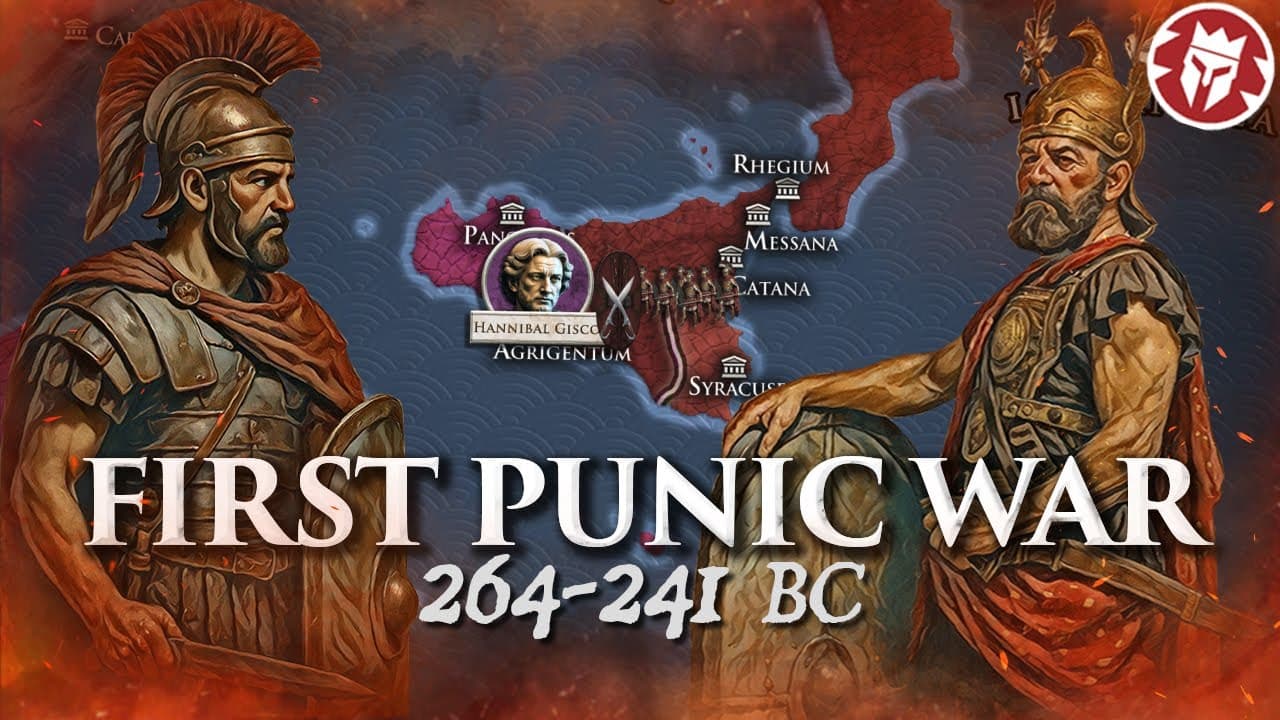
The First Punic War began over control of Sicily, with Rome and Carthage mobilizing large forces and using new naval tactics to gain advantage. Rome built a fleet and fought costly campaigns across Sicily, Sardinia, and Africa, ultimately forcing Carthage to sign a peace treaty in 241 BC.
Transcript
The Latin poet Virgil composed his epic The Aeneid between 30 and 19 BC. In the poem, the hero Aeneas escapes the destruction of Troy and eventually lands in Italy, where his descendants are destined to found the city of Rome. Along the way, he falls in love with Dido, the Queen of Carthage, but eventually abandons her to fulfil his desti... Read More
Key Insights
- Rome and Carthage fought over Sicily, triggering the First Punic War.
- The war saw Rome building a navy and adopting innovations to compete at sea.
- Agrigentum and Mylae were pivotal battles in the conflict.
- Carthage relied on mercenaries and a large army to resist Roman advances.
- Roman consuls led campaigns while overcoming supply and logistic challenges.
- The war featured major sieges and naval engagements that shaped the conflict.
- Hellenistic cities in Sicily shifted allegiances influencing the war.
- The war ended with a peace treaty in 241 BC, cementing Rome’s rise.
- More videos from this channel:
- More from this channel: Kings and Generals
Install to Summarize YouTube Videos and Get Transcripts
Explore YouTube Video Summarizer or Get YouTube Transcript Extractor
Questions & Answers
Q: What sparked the First Punic War between Rome and Carthage?
The initial spark was disputes in Sicily that drew both Rome and Carthage into a larger struggle for dominance in the western Mediterranean. As tensions rose, Mamertines appealed for help, alliances shifted, and Rome decided to intervene to prevent Carthage from gaining control over Messina. This set the stage for a broader, protracted conflict that tested naval power, supply lines, and strategic diplomacy for years.
Q: How did Rome respond to Carthage’s naval power at the start of the war?
Rome responded by building a fleet to challenge Carthage on the sea, a notable shift from its earlier land focus. They deployed consular forces to Sicily and used sea power to project military pressure, including blockades and amphibious operations. This transition required rapid adaptation, logistics management, and new tactical approaches to overcome Carthaginian advantages at sea.
Q: What role did Sicily play in the war according to the transcript?
Sicily was the central theater of war and the primary source of contention between Rome and Carthage. Control of Sicilian cities dictated strategic momentum, with both sides vying for influence, alliance networks, and local support. The campaign in Sicily determined much of the war’s early success or failure for each side and influenced subsequent campaigns.
Q: Who were the major commanders mentioned, and what were their actions?
Key commanders included Appius Claudius and Hanno of Carthage, among others. Claudius led Roman forces to confront Carthaginian attempts to control Messana and later Sicilian strongholds, while Hanno commanded Carthaginian efforts, including relief efforts for besieged positions and attempts to counter Roman maneuvers. Their actions shaped siege outcomes and battlefield deployments.
Q: What tactical innovations affected the war according to the description?
The war saw Rome introduce and apply naval innovations such as boardings and trireme tactics to compensate for its initial naval inexperience. These innovations, along with disciplined infantry and reorganized siege operations, helped Rome offset Carthage’s established maritime power and mercenary-based army structure, influencing the overall dynamics of engagements in Sicily and beyond.
Q: What were the major battles highlighted, and why were they important?
Major battles like Agrigentum and Mylae are highlighted as turning points. Agrigentum demonstrated Rome’s growing ability to sustain protracted sieges and coordinate combined arms, while Mylae underscored Rome’s improving naval capabilities. These battles collectively shifted momentum toward Rome and proved decisive in constraining Carthaginian influence.
Q: How did alliances affect the course of the war?
Alliances among Sicilian cities and shifting loyalties influenced the war by expanding or constraining each side’s operational reach. Support from local polities could tip regional balance, provide critical supply lines, and complicate strategic planning for both Rome and Carthage. The shifting allegiances ultimately affected military pressure points and campaign choices.
Q: What was the outcome and its significance for Rome?
The outcome was a Roman victory resulting in a peace treaty in 241 BC. This victory established Rome as a major Mediterranean power and laid the foundation for future expansion and conflicts, signaling a shift in regional power dynamics and highlighting Rome’s capacity to adapt from a primarily land-based force to a capable naval power.
Summary & Key Takeaways
-
The First Punic War started from disputes in Sicily and escalated into a prolonged struggle between Rome and Carthage for regional dominance. Rome adapted to naval warfare and introduced new tactics, like the corvus boarding device, to offset Carthage’s sea power and secure victories across multiple theaters.
-
The war featured significant battles such as Agrigentum and the decisive naval confrontations that tested both powers. Strategic sieges and logistics played critical roles as both sides endured attrition, while shifting alliances among Sicilian cities influenced the outcome and peace terms.
-
The conclusion of the war established Rome as a growing Mediterranean power and laid the groundwork for future conflicts, signaling a new era of imperial expansion and military experimentation that shaped subsequent chapters in Roman and Carthaginian history.
Read in Other Languages (beta)
Share This Summary 📚
Summarize YouTube Videos and Get Video Transcripts with 1-Click
Try YouTube Summary with ChatGPT & Claude or YouTube Transcript Generator
Explore More Summaries from Kings and Generals 📚
Summarize YouTube Videos and Get Video Transcripts with 1-Click
Try YouTube Summary with ChatGPT & Claude or YouTube Transcript Generator