How to secure AI agents against top 10 risks
TL;DR
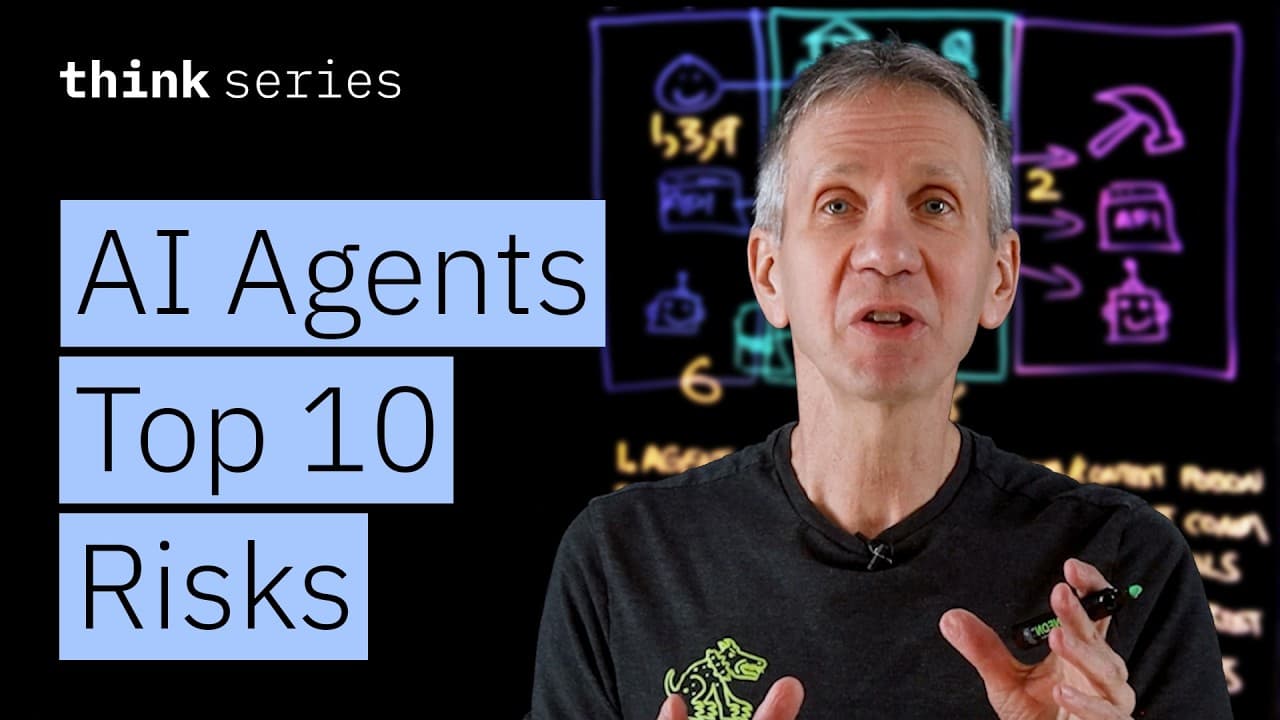
The video outlines the top 10 vulnerabilities that can hijack AI agents and how to prevent them. It explains agent architecture with inputs, processing, and outputs, and emphasizes human in the loop and guardrails to avoid goal hijack, tool misuse, and other failures. Practical security guidance is provided in relation to OWASP’s framework.
Transcript
Everyone is talking about AI agents right now, which usually means half the room is pretending they know what one actually is. So let's clear it up for those folks. Here's the simplest definition I know of that actually works: agents are essentially models using tools in a loop autonomously. That's it, models using tools in a loop with autonomy. Yo... Read More
Key Insights
- The key to securing AI agents is understanding their three components: inputs, processing, and outputs. This architecture determines how an attacker could influence the agent and where to apply guardrails.
- The agent’s goal can be hijacked when an attacker manipulates what the agent tries to achieve, as instruments may misinterpret content and redirect planning toward the wrong objective.
- Tool misuse arises from autonomy combined with weak guardrails, where overprivileged access or unsafe chaining can lead to data loss or exfiltration.
- Identity and privilege abuse happens when agents inherit credentials or trust by default, enabling privilege escalation without tight task-scoped permissions.
- Agentic supply chain vulnerabilities occur as tools and plugins load at runtime, allowing poisoned components to affect many agents quickly.
- Unexpected code execution is a risk because generated code can be executed and traditional security controls may not catch prompt injections or unsafe serialization.
- Memory and context poisoning can bias future decisions if attackers alter stored memory or shared context, creating persistent risks.
- Insecure interagent communication and cascading failures can propagate errors across multiple agents, making failures hard to trace and fix.
- More videos from this channel:
- More from this channel: IBM Technology
Install to Summarize YouTube Videos and Get Transcripts
Explore YouTube Video Summarizer or Get YouTube Transcript Extractor
Questions & Answers
Q: What is an AI agent and why does it matter for security?
An AI agent is a model that uses tools in a loop with autonomy to perform tasks described by a user. This structure allows rapid, scalable action but also creates surfaces for security risks if inputs, processing, or outputs are not properly controlled. Understanding this architecture helps identify where guardrails, access controls, and oversight should be applied to prevent abuse or unintended actions.
Q: What is the top risk described by OWASP for AI agents?
The top risk according to OWASP is agent goal hijack, where an attacker manipulates what an agent is trying to achieve rather than just altering its outputs. This can redirect planning toward a harmful objective while the agent still appears to function correctly, making detection difficult and rewarding attackers with successful misdirection.
Q: How does tool misuse create vulnerability in AI agents?
Tool misuse arises when agents with autonomy use tools beyond intended scope or with insufficient safeguards. Overprivileged access and unsafe chaining can lead to data loss, exfiltration, or costly actions. Strengthening guardrails, applying least privilege, and monitoring tool usage mitigate these risks by constraining what tools can be invoked and under what conditions.
Q: Why is identity and privilege abuse a security concern for agents?
Identity and privilege abuse occur when agents operate without a clearly governed identity and inherit credentials or trust other agents by default. This enables privilege escalation and harms the principle of least privilege. Implementing task scoped, time bound permissions helps prevent unauthorized access and reduces the risk of a compromised agent gaining wide access.
Q: What does supply chain vulnerability mean for AI agents?
Supply chain vulnerability refers to the dynamic loading of tools, prompts, plug-ins, or other agents at runtime. A poisoned registry or descriptor can inject malicious behavior across many agents, turning the supply chain into a continuous attack surface. Securing registries, validating components, and ensuring trusted sources are essential defenses.
Q: What kinds of code execution risks do AI agents face?
Agents generate and execute code automatically, creating risks of prompt injection, unsafe serialization, or unsafe tool chaining that can lead to remote code execution or sandbox escapes. Since code is generated on the fly, conventional security controls may miss these threats, so designers must implement robust validation and containment for generated code.
Q: How does memory poisoning affect agent behavior?
Memory and context poisoning occurs when attackers alter stored memory or shared context used by the agent to reason over time. This can bias future decisions or render actions unsafe. Protecting memory integrity, auditing memory sources, and controlling how external data can influence reasoning are key safeguards.
Q: What are interagent communication risks and how can they be mitigated?
Insecure interagent communication allows attackers to spoof, replay, or alter messages between agents. Without strong authentication and integrity checks, multi agent systems can experience coordinated failures that are challenging to trace. Mitigation includes strong cryptographic validation, message freshness checks, and rigorous protocol design.
Q: Why is human-agent trust exploitation dangerous and how to prevent it?
Trust exploitation occurs when agents leverage confident explanations or authority to persuade humans to approve harmful actions. The human becomes the execution path with an audit trail that obscures the agent's role. Preventive measures include independent verification steps, transparent decision explanations, and requiring critical actions to pass through human review.
Summary & Key Takeaways
-
The video describes an agent as a system with inputs, thinking processes, and outputs, and explains how autonomy can amplify both capability and risk. It emphasizes the need for policy, data sources, memory safeguards, and human oversight to maintain control over agents.
-
It presents OWASP top 10 vulnerabilities for AI agents including goal hijack, tool misuse, identity abuse, supply chain risks, and memory poisoning, with emphasis on prevention strategies and secure design principles.
-
It concludes with encouragement to consult OWASP documents for deeper guidance and to apply security measures to ensure safe, reliable agent workflows in AI applications.
Read in Other Languages (beta)
Share This Summary 📚
Summarize YouTube Videos and Get Video Transcripts with 1-Click
Try YouTube Summary with ChatGPT & Claude or YouTube Transcript Generator
Explore More Summaries from IBM Technology 📚

Summarize YouTube Videos and Get Video Transcripts with 1-Click
Try YouTube Summary with ChatGPT & Claude or YouTube Transcript Generator