How to Reduce AI Risk With Governance and Security
TL;DR
AI risk is reduced by combining governance controls for responsible, explainable, and reliable behavior with security controls for preventing, detecting, and responding to attacks. Organizations should define policies and accountability, verify model sources and lineage, establish acceptable use, manage intellectual property risk, test for prompt injection, prevent unauthorized access, and monitor configurations for sensitive-data exposure.
Transcript
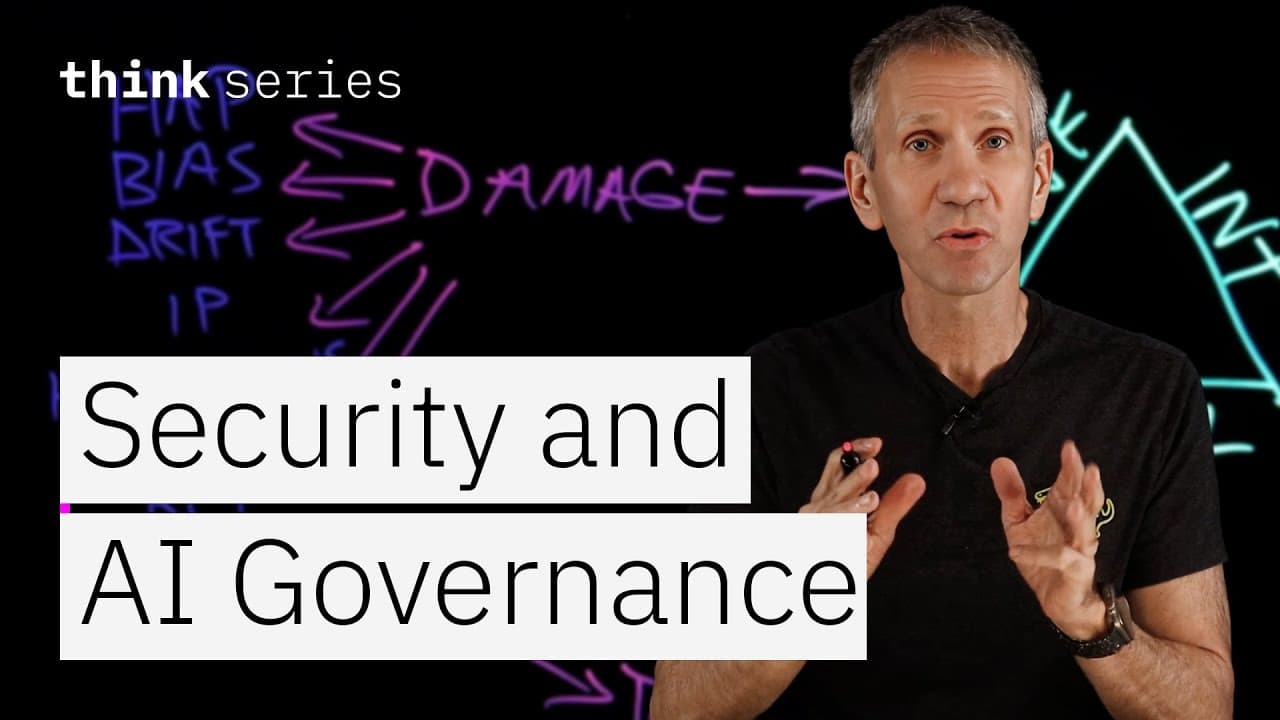
AI is already doing some great things and the best is yet to come. But with this greatness comes risk. Risk that the system will do the wrong thing, give incorrect answers and expose the organization to reputational and business damage. How can you reduce AI risk? Well, with a strong governance and security capability. Unfortunately, according to t... Read More
Key Insights
- AI governance is the discipline for ensuring that AI behaves responsibly, produces explainable and reliable results, and follows organizational policies. Documentation and source attribution make outputs traceable, helping an organization determine whether the system is operating as intended and representing it appropriately.
- AI security is the discipline for protecting AI systems from vulnerabilities, malicious insiders, external attackers, and unauthorized deployments. It includes controlling shadow AI because unapproved systems may process organizational information without proper safeguards and become sources of sensitive-data leakage.
- Governance failures are often self-inflicted and unintentional. They can result from choosing a poor model, using an unreliable source, training incorrectly, or supplying unsuitable data, with resulting harms that include misalignment, policy violations, ethical lapses, hallucinations, bias, and reputational damage.
- Security failures are more commonly associated with intentional actions by other parties. An internal bad actor or external attacker may attempt to manipulate the system, poison data, extract confidential information, gain unauthorized access, or make the AI service unavailable to legitimate users.
- The CIA triad is the security framework used to organize AI protection around confidentiality, integrity, and availability. Confidentiality prevents information exfiltration, integrity prevents manipulation and poisoned data, and availability protects the system against denial-of-service attacks that stop authorized people from using it.
- Governance controls are effective only when rules, policies, and accountability are explicitly defined. An organization cannot reliably judge success without first defining intended outcomes, approved use cases, responsible owners, acceptable AI behavior, and the limits governing how employees may use AI.
- Model governance depends on verified training sources and traceable lineage. Organizations should know where a model came from, whether it is an authentic and current version, who handled it along the way, and whether the information used for training belongs to the organization or is properly authorized.
- AI security operations require prevention, detection, and response. Protections should address prompt injection, unauthorized access, penetration testing, automated testing of numerous prompt-injection variations, and posture management that identifies misconfigurations capable of exposing sensitive organizational information.
Install to Summarize YouTube Videos and Get Transcripts
Explore YouTube Video Summarizer or Get YouTube Transcript Extractor
Questions & Answers
Q: How can organizations reduce risk in AI systems?
Organizations can reduce AI risk by combining governance and security capabilities instead of treating either discipline as sufficient alone. Governance should define responsible behavior, explainability, approved use cases, accountability, training sources, model lineage, acceptable use, and intellectual property controls. Security should prevent, detect, and respond to prompt injection, unauthorized access, malicious manipulation, data exposure, configuration weaknesses, and service disruption.
Q: What is the difference between AI governance and AI security?
AI governance focuses primarily on whether an AI system behaves responsibly, reliably, explainably, and consistently with policies and ethical expectations. AI security focuses on vulnerabilities and intentional attacks against the system, including prompt injection, unauthorized access, data exfiltration, manipulation, and denial of service. The areas overlap, but they mostly complement each other as parts of an integrated risk program.
Q: Who is responsible for AI governance and AI security?
The chief risk officer may serve as the primary stakeholder for AI governance, while the chief information security officer may lead AI security. These are not the only people who care about either area, and both roles can have an interest in both disciplines. Clear accountability structures should identify who owns each part of the policy, controls, monitoring, and response process.
Q: What risks should an AI governance policy address?
An AI governance policy should address harmful or profane outputs, hate and abuse, unfairness, bias, model drift, hallucinations, policy violations, ethical lapses, intellectual property concerns, and reputational harm. It should also require reliable outputs, documentation, source attribution, appropriate training sources, traceable model lineage, acceptable-use rules, defined AI use cases, and accountability for managing each responsibility.
Q: How does the CIA triad apply to AI security?
The CIA triad applies to AI through confidentiality, integrity, and availability. Confidentiality means preventing the system from sending sensitive information to unauthorized people. Integrity means preventing manipulation, unintended behavior, bad answers, and data poisoning. Availability means keeping the AI accessible to authorized users by protecting it from attacks, such as denial of service, that could make the system unavailable.
Q: Why are model sources and lineage important for AI governance?
Model sources and lineage help an organization determine whether an AI model and its inputs can be trusted. The organization should know where a model originated, whether it is an authentic and current version, and who handled it along the way. It should also verify that training information is reliable and that the organization has the rights needed to use any intellectual property involved.
Q: How should organizations protect AI systems from prompt injection?
Organizations should treat prompt injection as a major attack concern for generative AI. Attackers may give the system instructions intended to override its original directions and cause unintended behavior. Protection should include access controls, model penetration testing, and tools that automate testing across many prompt-injection variations. Prevention should be paired with detection and a defined response when attacks or vulnerabilities are discovered.
Q: What is shadow AI, and why does it create security risk?
Shadow AI is an AI instance created or operated without organizational approval or authorization. Because it exists outside established governance and security processes, it may lack appropriate controls and could become a source of data leakage. Organizations should discover and manage AI use cases, identify unauthorized systems, and lock down deployments that could expose sensitive information or operate beyond approved purposes.
Summary & Key Takeaways
-
AI governance and AI security address complementary parts of the same risk problem. Governance focuses mainly on responsible behavior, explainability, reliability, documentation, source attribution, ethical conduct, and policy compliance. Security focuses on vulnerabilities, unauthorized AI deployments, malicious insiders, external attackers, and protection of confidentiality, integrity, and availability.
-
Governance controls should include documented rules, clear accountability structures, approved use cases, proper model training, verified information sources, traceable model lineage, acceptable-use policies, and intellectual property safeguards. These measures help organizations prevent self-inflicted problems such as hallucinations, bias, model drift, policy violations, and reputational damage.
-
Security controls should support prevention, detection, and response throughout the AI system. Important measures include defenses against prompt injection, access restrictions, model penetration testing, automated testing across many attack variations, and posture management for configuration weaknesses. An integrated, layered framework can apply governance and security protections around AI use cases.
Read in Other Languages (beta)
Share This Summary 📚
Summarize YouTube Videos and Get Video Transcripts with 1-Click
Try YouTube Summary with ChatGPT & Claude or YouTube Transcript Generator
Explore More Summaries from IBM Technology 📚




Summarize YouTube Videos and Get Video Transcripts with 1-Click
Try YouTube Summary with ChatGPT & Claude or YouTube Transcript Generator