How Does Risk Determine an AI Architecture?
TL;DR
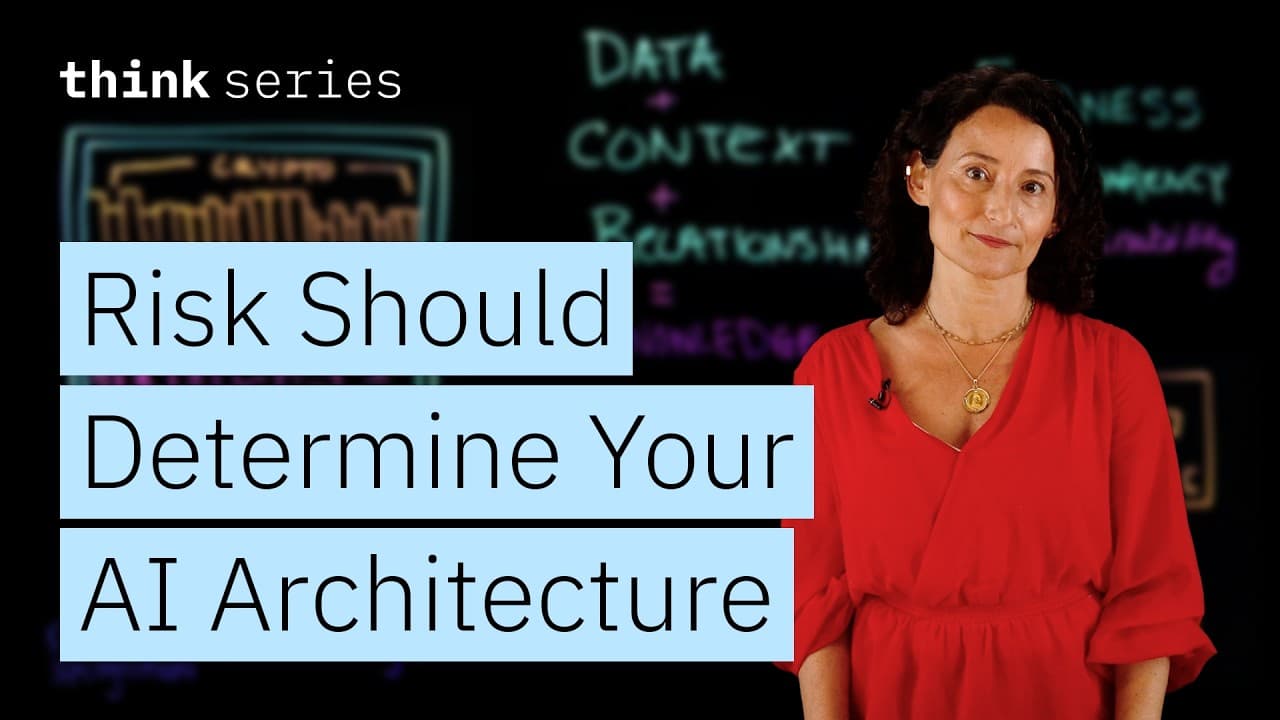
Risk should dictate how an AI system is built from the start, guiding requirements, architecture, and governance. Baseline explainability is often enough for low risk, while high risk use cases require traceable, verifiable explanations and data lineage. The question is whether the system can be defended six months later given the assigned risk level.
Transcript
I was in a conversation recently with a public sector leader. They told me AI is so easy to build now. We can just have an AI build an AI and they're not wrong. A lot of things are easy to built badly because there's easy AI and there is risk appropriate AI. And those two, they are not the same thing. Most teams approach this backwards. They build ... Read More
Key Insights
- AI systems are often built in the wrong order, with governance and risk not informing architecture early.
- Risk level determines the required team skills and architectural burden for the system to be trustworthy.
- Principles without operational requirements fail to guide real construction and contracts in practice.
- Explainability should be implemented as a spectrum: baseline, enhanced, and vigilant, tailored to use case risk.
- Data without context and relationships cannot produce true knowledge, only pattern recognition.
- Auditable explanations are an architectural feature, not a model issue, and should be planned before deployment.
- Low risk does not justify laxity; even then, a defensible architecture is essential for future accountability.
- Governance should operationalize principles into concrete, contractable requirements that can be evaluated by boards and auditors.
- More videos from this channel:
- More from this channel: IBM Technology
Install to Summarize YouTube Videos and Get Transcripts
Explore YouTube Video Summarizer or Get YouTube Transcript Extractor
Questions & Answers
Q: How can risk drive AI architecture from the start?
Risk drives architecture by mapping the potential impact of an AI system to concrete requirements, the team skills needed, and the governance structures that will supervise the system. The idea is to design the architecture around the risk level so that explanations, data lineage, testing, and accountability are built in from day one rather than added later. This approach ensures a system that can be defended and audited six months after deployment, rather than a fragile setup that fails under scrutiny.
Q: What is the difference between data, information, and knowledge in AI terms?
Data is an artifact of human experience, information arises when data has context, and knowledge emerges when information is connected through relationships. In AI, many systems remain at the data level, lacking context and relationships needed for trustworthy decision making. This gap explains why purely probabilistic models can mislead without auditable explanations that connect data to decisions.
Q: What are baseline, enhanced, and vigilant explainability?
Baseline explainability answers why a recommendation was made in simple terms, such as using prior behavior, and is acceptable when the cost of wrong decisions is low. Enhanced explainability adds sources and data lineage to provide more context but may still lack the reasoning path. Vigilant explainability requires full data lineage, provenance, testing, and traceable reasoning for high risk cases like clinical triage, ensuring that explanations are tied to the specific decision and moment.
Q: Why is principle-level language insufficient without operationalization?
Principles are statements of intent and cannot be audited or contracted on their own. Operationalization translates those principles into concrete functional and non-functional requirements that can be implemented, tested, and governed. This enables a buyer to contract for what will actually be built, and a governance board to review what was delivered, creating accountability and measurable outcomes.
Q: How does risk influence the required team and governance for AI systems?
The risk level of a system determines the architecture that must be built, the skills of the team needed to develop and maintain it, and the governance framework that will oversee it. Low risk may allow probabilistic systems with basic explainability, while high risk demands rigorous, traceable architectures, responsible for outcomes that are contestable and defensible.
Q: What role does data provenance play in trustworthy AI?
Data provenance is essential for providing auditable reasoning behind a decision. It ties the decision to sources and data lineage, enabling evaluation of how inputs influenced outputs. Without provenance, explanations may be superficial and insufficient for accountability, particularly in high stakes use cases where decisions affect safety or rights.
Q: Why should organizations ask if they can defend what they build six months later?
Defensibility over time is a core test of an AI system's architecture. If a system cannot be explained, tested, and justified after deployment, it indicates a failure in risk-aligned requirements and governance. By designing for defendability from the outset, organizations ensure continued compliance, trust, and ability to audit and improve the system as conditions change.
Q: When is it appropriate to accept a lower level of explainability?
Lower explainability can be acceptable when risk is low and the consequences of an error are minimal, such as minor efficiency gains. In higher risk scenarios where decisions are critical and could cause harm, enhanced or vigilant explainability with full data lineage and traceable reasoning is required to maintain safety, accountability, and public trust.
Summary & Key Takeaways
-
AI architecture should be driven by risk level and governance needs, not by budget or ease of construction.
-
Explainability must be operationalized into concrete requirements rather than merely stated as a principle.
-
High risk AI use cases demand rigorous architectural burden, data provenance, and auditable explanations to ensure accountability.
Read in Other Languages (beta)
Share This Summary 📚
Summarize YouTube Videos and Get Video Transcripts with 1-Click
Try YouTube Summary with ChatGPT & Claude or YouTube Transcript Generator
Explore More Summaries from IBM Technology 📚



Summarize YouTube Videos and Get Video Transcripts with 1-Click
Try YouTube Summary with ChatGPT & Claude or YouTube Transcript Generator