What is the difference between AI and ML and how they relate?
TL;DR
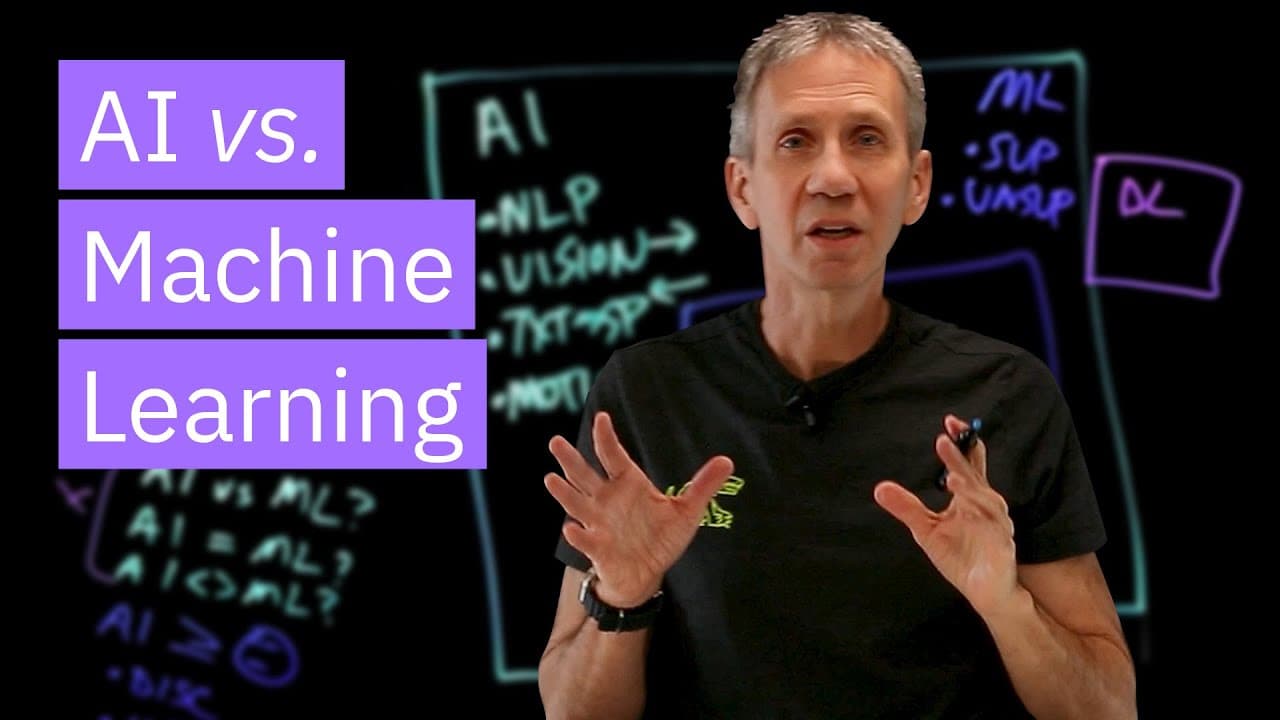
AI is the overall field that includes ML and other capabilities. ML is a data driven approach that makes predictions or decisions, and is a subset of AI. Deep learning is a deeper subset of ML using neural networks, and there are other AI elements like natural language processing and robotics. Thus ML is part of AI, not the entire thing.
Transcript
Artificial intelligence (AI) and machine learning (ML). What's the difference? Are they the same? Well, some people kind of frame the question this way: it's "AI versus ML". Is that the right way to think of this? Or is it "AI = ML"? Or is it "AI is somehow something different than ML"? So here's three equations. I wonder which one is going to be r... Read More
Key Insights
- AI is a superset that includes ML, DL, and other capabilities.
- ML is a data driven approach that makes predictions or decisions.
- DL is a subset of ML that uses neural networks with multiple layers.
- ML relies on data and learning rather than explicit programming.
- Unsupervised ML can discover patterns without labeled data.
- Supervised ML uses labeled data to guide learning.
- Robotics is a subset of AI focusing on physical actions.
- The correct framing is ML as part of AI, not AI being only ML.
- More videos from this channel:
- More from this channel: IBM Technology
Install to Summarize YouTube Videos and Get Transcripts
Explore YouTube Video Summarizer or Get YouTube Transcript Extractor
Questions & Answers
Q: What is AI in simple terms as described in the video?
AI is basically exceeding or matching the capabilities of a human, including reasoning, discovering new information, and inferring from data. It encompasses a broad set of technologies that aim to replicate or augment human intelligence, beyond just learning from data. This broader view places ML and DL inside AI as components rather than the entirety.
Q: How is machine learning different from traditional programming?
Machine learning differs from traditional programming in that it learns from data rather than relying on manually coded rules. While traditional programming requires explicit instructions for every outcome, ML adjusts models based on data inputs to produce predictions or decisions. This data driven learning enables models to improve as more information is provided.
Q: What does deep learning add to machine learning?
Deep learning adds neural networks with multiple layers to ML, creating a deeper representation of data. This allows more complex patterns to be learned and can yield powerful results, but it may also make the reasoning behind certain outputs less transparent. Deep learning is a subset of ML focused on layered neural architectures.
Q: Why does the speaker say AI is a superset of ML?
The speaker argues that AI includes ML and DL along with other capabilities such as natural language processing, vision, and robotics. This means ML is a part of AI, while AI also encompasses additional technologies. The Venn diagram metaphor illustrates ML as contained within AI rather than AI and ML being interchangeable.
Q: What are some other capabilities that count as AI beyond ML and DL?
Other AI capabilities include natural language processing, vision, speech synthesis, and robotics. These areas involve perception, understanding, and interaction that go beyond pure data driven learning. They are described as parts of AI that work alongside ML and DL to achieve broader intelligent behavior.
Q: What is the main point about how to think of ML and AI together?
The main point is to view ML as a subset of AI, with AI encompassing ML, DL, and other technologies. This avoids the incorrect equation AI equals ML and emphasizes that ML is a specific approach that contributes to the larger goal of AI. By this view, ML is a tool within a broader AI toolbox.
Q: Does the video claim ML can be fully explained from data alone?
The video notes that deep learning, a form of ML, may not always reveal how the results were derived, highlighting challenges with interpretability. While learning from data drives ML, some models may produce insights without fully transparent explanations, especially in complex neural networks. This underlines the need to consider reliability and explainability.
Q: What is the practical takeaway when discussing AI and ML relationships?
The practical takeaway is to recognize ML as a data driven subset of AI, with DL as a specialized part of ML. This framing helps in understanding how different technologies relate and where they fit in a broader system. It also emphasizes the importance of data quality and understanding the scope of each technology within the AI landscape.
Summary & Key Takeaways
-
AI and ML are defined by their relationship, not by competing claims. The video explains that AI is a superset that includes ML, DL, and other technologies. ML focuses on learning from data to predict or decide, while DL uses neural networks with many layers.
-
Deep learning is described as a subset of ML that leverages multi layer neural networks, which can yield powerful insights but may obscure how results are derived. The video emphasizes the interpretability issue and the role of data in ML.
-
The overall message is to rethink the common equations and view ML as a component of AI, with other capabilities such as vision, speech, and robotics fitting under the AI umbrella.
Read in Other Languages (beta)
Share This Summary 📚
Summarize YouTube Videos and Get Video Transcripts with 1-Click
Try YouTube Summary with ChatGPT & Claude or YouTube Transcript Generator
Explore More Summaries from IBM Technology 📚




Summarize YouTube Videos and Get Video Transcripts with 1-Click
Try YouTube Summary with ChatGPT & Claude or YouTube Transcript Generator