How to Build AI Agents for Real-World Workflows
TL;DR
Effective production AI agents should coordinate narrowly scoped workflows across systems, enforce policies, maintain context, and escalate ambiguous or high-risk decisions to humans. Their primary value comes from reliably managing state, timing, dependencies, routine actions, and exceptions within existing processes, rather than acting as isolated or fully independent decision makers.
Transcript
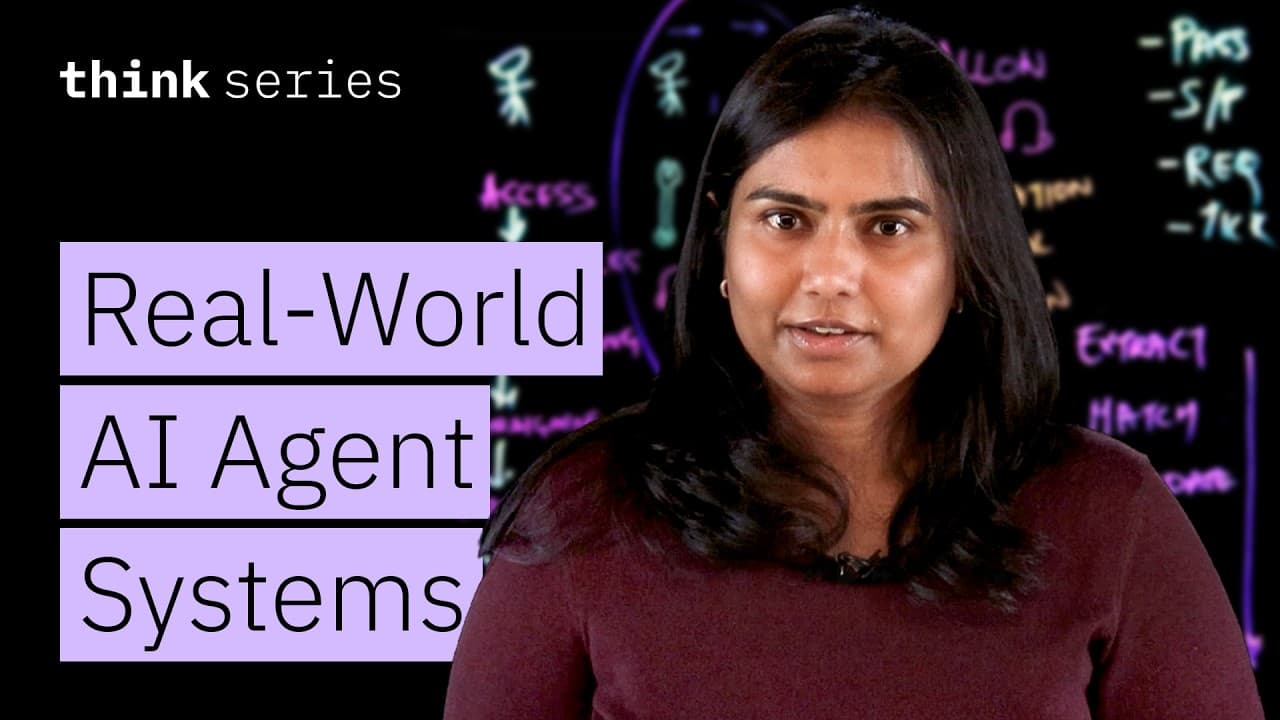
Today, there's a lot of excitement around AI agents. We've seen impressive demos of agents that plan, reason, and act across tools. But the real question isn't whether we can build them or not. The real question is what it takes to make an AI agent effective in real-world environments. When agents move from demo into production systems, many fall s... Read More
Key Insights
- Successful AI agents are coordination layers that maintain context, orchestrate actions across systems, enforce rules, and determine when control should pass to a human. They are not presented as standalone decision makers operating independently from established organizational processes.
- Real-world agent workflows are complex because they span multiple systems and include policies, approvals, timing requirements, dependencies, and exceptions. Production effectiveness therefore depends on reliable integration and workflow management, not merely an agent's ability to plan or reason.
- Employee onboarding is a multi-step workflow involving access provisioning, entitlements, resource orders, initial scheduling, required training, and completion tracking. An agent can sequence these activities by using contextual signals such as the employee's role, location, and start date.
- Policy-governed execution requires explicit boundaries around what an agent may do automatically. In IT support, low-risk requests can follow permitted execution paths, while ambiguous or high-risk requests require validation, approval, escalation, or direct human involvement.
- Exception handling is the central challenge in structured processes such as invoice processing and order management. Agents can extract data, compare it with existing records, validate rules, route approvals, update downstream systems, and surface missing, mismatched, or non-standard cases.
- Triage agents improve consistency when organizations receive large volumes of work. In customer service, an agent can analyze and categorize requests, set priorities, route cases to appropriate teams, and suggest responses based on historical data while humans remain responsible for resolving issues.
- Human involvement is a required design element for production agents. Effective systems automate predictable and permitted actions, then bring people into the process when policies demand judgment, conditions are ambiguous, risk is elevated, or workflow behavior deviates from expectations.
- Production-ready agents are narrowly scoped and designed for integration rather than isolation. Their practical value comes from alignment with workflows, limits, rules, signals, and accountability structures, allowing them to function as reliable components within a larger system architecture.
- More videos from this channel:
- More from this channel: IBM Technology
Install to Summarize YouTube Videos and Get Transcripts
Explore YouTube Video Summarizer or Get YouTube Transcript Extractor
Questions & Answers
Q: How should AI agents be designed for real-world workflows?
AI agents should be designed as narrowly scoped coordination layers within existing workflows. They need to preserve relevant context, orchestrate actions across multiple systems, apply policies and approvals, monitor state and timing, and recognize exceptions. They should automate permitted and predictable actions while transferring control to humans whenever rules require judgment, validation, approval, or escalation.
Q: Why do AI agents often fall short in production systems?
AI agents often fall short after moving beyond demonstrations because real-world environments are complex, constrained, and interconnected. Production workflows may cross several systems and include dependencies, policies, approvals, access controls, timing requirements, and unexpected conditions. The main difficulty is therefore reliable orchestration within these limits, rather than whether the underlying technology can plan, reason, or act.
Q: What role should humans play in AI agent workflows?
Humans should remain involved at clearly defined control points. Agents can consistently execute low-risk actions that policies explicitly permit, but they should escalate ambiguous, sensitive, high-risk, or non-standard situations. This arrangement keeps automated behavior predictable while ensuring that people provide judgment when rules are insufficient, approvals are required, or a workflow deviates from expected behavior.
Q: How can an AI agent support employee onboarding?
An AI agent can coordinate onboarding activities across the systems responsible for access, entitlements, required resources, scheduling, and training. It can use contextual signals such as a new employee's role, location, and start date to sequence actions, track workflow state, monitor training completion, and flag deviations. The agent supports people by coordinating the process rather than replacing them.
Q: How can AI agents handle IT support requests safely?
An IT support agent can interpret a request's intent, identify the policies that apply, and determine whether the requested action is permitted. Well-defined, low-risk requests may be executed automatically. Requests involving ambiguity, higher risk, validation, or approval should be escalated. Explicit control boundaries ensure that automation remains predictable and that humans intervene exactly where organizational rules require them.
Q: How do AI agents manage exceptions in invoice processing?
In invoice processing, an agent can extract structured data, match it against existing records, validate the information against relevant rules, route necessary approvals, and update downstream systems. The routine path is relatively straightforward. The agent's greater value lies in detecting missing data, mismatches, and non-standard conditions, then surfacing those exceptions for focused human review.
Q: How can AI agents improve customer service triage?
AI agents can analyze and categorize incoming customer requests, assign priorities, route work to the appropriate teams, and suggest responses based on historical data. This helps apply context, priority, and routing decisions consistently when request volumes are large. Humans still resolve the underlying issues, while the agent organizes incoming work and directs attention to the appropriate destination.
Q: What makes an AI agent reliable in production?
A reliable production agent has a narrow scope, integrates with the systems already used by the workflow, maintains context and state, applies established rules, and reacts to relevant signals. It also respects timing, dependencies, access controls, and approval requirements. Most importantly, it includes explicit mechanisms for exception handling, accountability, and timely transfer of control to humans.
Summary & Key Takeaways
-
Real-world AI agents face complex, constrained, and interconnected environments. Effective agents serve as coordination layers that preserve context, orchestrate actions across multiple systems, enforce policies, monitor workflow state, and transfer control to people when necessary. Their success depends on fitting existing workflows and keeping humans involved at appropriate decision points.
-
Employee onboarding illustrates multi-system orchestration. An agent can use role, location, and start-date signals to coordinate access provisioning, entitlements, resource orders, initial scheduling, training assignments, and completion tracking. The central challenge is not reasoning alone, but executing dependent actions reliably while satisfying organizational policies and timing constraints.
-
IT support, invoice processing, order management, and customer service demonstrate policy enforcement, exception handling, and work triage. Agents can automate permitted routine paths, identify missing or mismatched information, prioritize requests, route work, and surface risky or unusual cases. Production reliability comes from narrow scope, integration, explicit controls, and human accountability.
Read in Other Languages (beta)
Share This Summary 📚
Summarize YouTube Videos and Get Video Transcripts with 1-Click
Try YouTube Summary with ChatGPT & Claude or YouTube Transcript Generator
Explore More Summaries from IBM Technology 📚



Summarize YouTube Videos and Get Video Transcripts with 1-Click
Try YouTube Summary with ChatGPT & Claude or YouTube Transcript Generator