How to Choose Between RAG and Fine Tuning
TL;DR
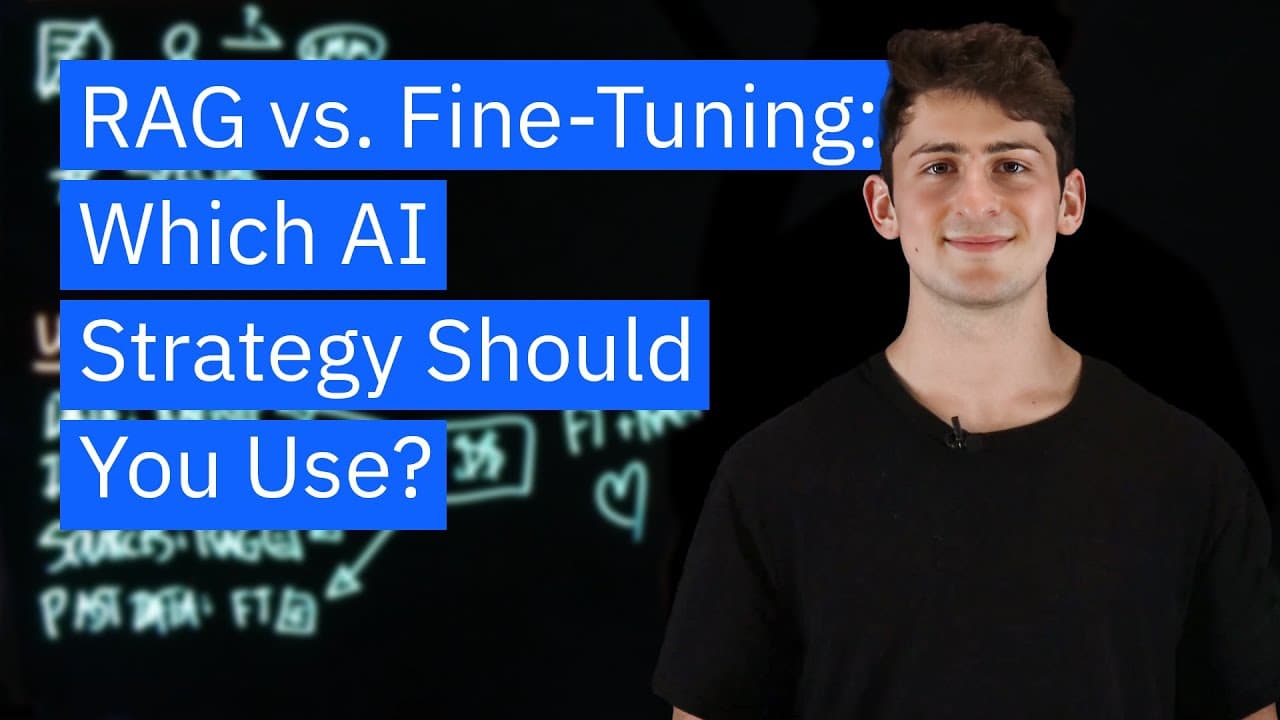
Retrieval Augmented Generation (RAG) and fine-tuning are two techniques to enhance large language models. RAG retrieves up-to-date external information to augment model responses, ideal for dynamic data sources. Fine-tuning customizes a model with specific data, embedding context into the model's weights, suitable for specialized industries. Both methods have unique strengths and can be combined for optimal results.
Transcript
Let's talk about RAG versus fine tuning. Now, they're both powerful ways to enhance the capabilities of large language models. But today you're going to learn about their strengths, their use cases and how you can choose between them. So one of the biggest issues with dealing with generative AI right now is one, enhancing the models, but also two, ... Read More
Key Insights
- Retrieval Augmented Generation (RAG) enhances model capabilities by retrieving external data and augmenting prompts.
- RAG is effective for dynamic data sources, such as databases, ensuring up-to-date information is used.
- Fine-tuning involves customizing a model with specific data, embedding context directly into the model's weights.
- Fine-tuning is suitable for specialized industries with unique terminology and writing styles.
- RAG helps mitigate hallucinations by providing source context, enhancing trust and transparency.
- Fine-tuning enhances model speed and reduces inference costs by embedding context into the model.
- A combination of RAG and fine-tuning can build robust applications, leveraging both up-to-date data and specialized context.
- Choosing between RAG and fine-tuning depends on data dynamics, industry requirements, and application priorities.
Install to Summarize YouTube Videos and Get Transcripts
Explore YouTube Video Summarizer or Get YouTube Transcript Extractor
Questions & Answers
Q: How does Retrieval Augmented Generation (RAG) work?
Retrieval Augmented Generation (RAG) enhances a model's capabilities by retrieving external, up-to-date information to augment the original prompt. This process involves using a retriever to pull relevant documents and context, which are then combined with the original prompt to generate a response. This approach is particularly useful for dynamic data sources, ensuring the model's outputs are current and contextually accurate.
Q: What are the benefits of fine-tuning a language model?
Fine-tuning a language model involves customizing it with specific data, embedding context directly into the model's weights. This process allows for greater influence over the model's behavior and output, making it suitable for specialized industries with unique terminology and writing styles. Fine-tuning improves model speed, reduces inference costs, and ensures the model can handle specific use cases effectively.
Q: When should you use RAG over fine-tuning?
RAG should be used over fine-tuning when dealing with dynamic data sources that require up-to-date information. It is ideal for applications where real-time data retrieval is crucial, such as product documentation chatbots or systems needing transparency and trust. RAG provides the ability to continuously update the model's responses with the latest data, making it suitable for environments where information changes frequently.
Q: What are the limitations of fine-tuning?
The limitations of fine-tuning include the model's reliance on the data it was trained with, leading to potential cutoffs where no new information can be integrated post-training. This means that once the model is fine-tuned, it cannot access or incorporate new data unless retrained. Additionally, fine-tuning requires labeled and targeted data, which may not always be available or feasible to obtain.
Q: How can combining RAG and fine-tuning optimize AI applications?
Combining RAG and fine-tuning optimizes AI applications by leveraging the strengths of both techniques. RAG provides real-time data retrieval and transparency, ensuring the model's outputs are current. Fine-tuning embeds specialized context and knowledge into the model, enhancing its ability to handle specific tasks. Together, they provide a comprehensive solution, allowing applications to benefit from both up-to-date information and specialized domain expertise.
Q: What are some common use cases for RAG?
Common use cases for RAG include applications that require continuous access to dynamic data, such as chatbots for product documentation, financial news reporting services, or any system where real-time information retrieval is essential. RAG is also beneficial in scenarios where transparency and trust are critical, as it provides context and sources for the information used in model responses.
Q: Why is transparency important in RAG?
Transparency is important in RAG because it enhances trust and reliability in AI systems. By providing context and sources for the information used in model responses, RAG helps mitigate hallucinations and ensures users can verify the accuracy of the data. This transparency is crucial in applications where trust in the AI's output is essential, such as in legal, financial, or healthcare industries.
Q: What factors should be considered when choosing between RAG and fine-tuning?
When choosing between RAG and fine-tuning, consider factors such as the nature of the data (dynamic vs. static), industry-specific requirements, application priorities, and the need for transparency. RAG is suited for dynamic environments needing real-time data, while fine-tuning is ideal for specialized industries requiring embedded context. The choice depends on the specific use case, data characteristics, and desired outcomes for the AI application.
Summary & Key Takeaways
-
Retrieval Augmented Generation (RAG) enhances model performance by retrieving and integrating external data into prompts, making it ideal for dynamic data environments. It helps reduce hallucinations and provides contextual transparency.
-
Fine-tuning customizes models with specific data, embedding context into the model's weights. This approach is beneficial for specialized industries requiring unique terminology and style, offering improved speed and reduced inference costs.
-
Combining RAG and fine-tuning can optimize applications by utilizing both real-time data retrieval and specialized context embedding, depending on the specific needs and priorities of the AI-enabled application.
Read in Other Languages (beta)
Share This Summary 📚
Summarize YouTube Videos and Get Video Transcripts with 1-Click
Try YouTube Summary with ChatGPT & Claude or YouTube Transcript Generator
Explore More Summaries from IBM Technology 📚




Summarize YouTube Videos and Get Video Transcripts with 1-Click
Try YouTube Summary with ChatGPT & Claude or YouTube Transcript Generator