How to secure AI data models and usage for safer systems
TL;DR
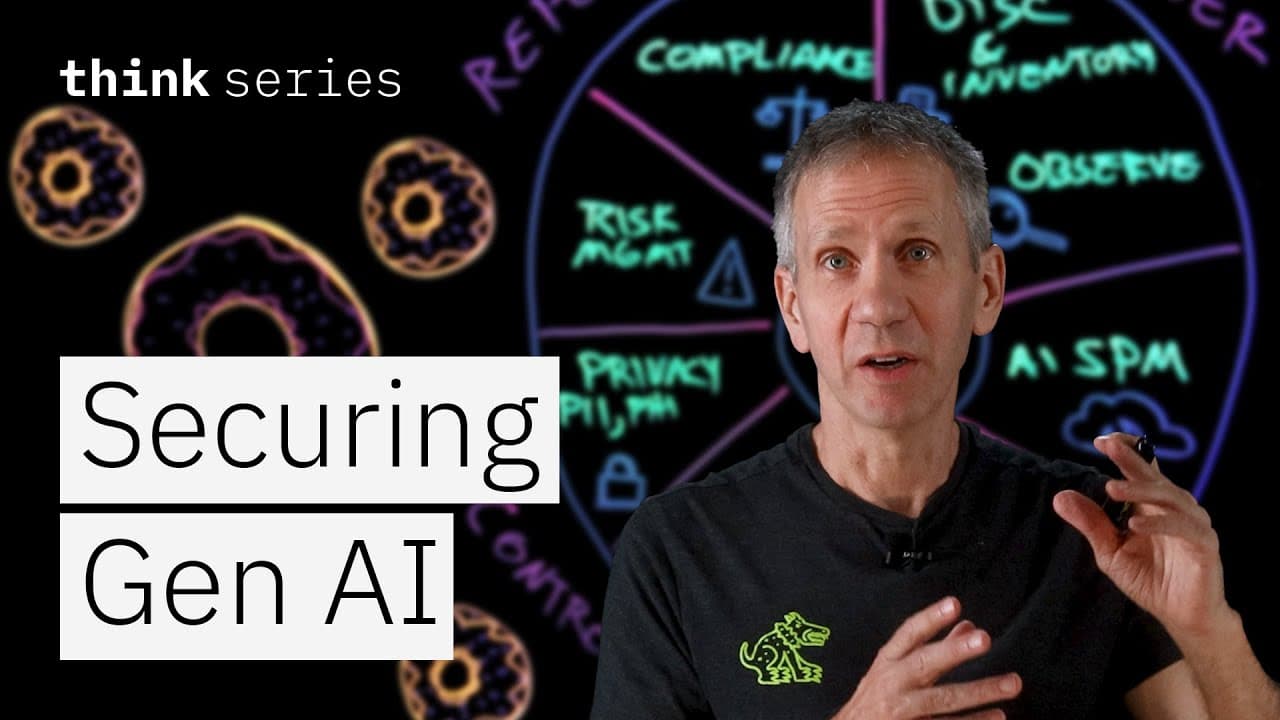
The video presents a four-part defense model for AI security: discover, assess, control, and report. It covers finding both known and shadow AI across environments, assessing vulnerabilities and misconfigurations, controlling prompts and data flow, and reporting risks with a governance layer. It also emphasizes privacy protection and the use of frameworks like OWASP and MITER for risk management.
Transcript
AI is at the center of everything we do these days. But what goes around this center to protect it? In many cases, not very much. I'm gonna suggest that we consider wrapping this AI with a donut of defense capabilities. Why a donut? Because donuts are delicious, right? Previously, I did a video on "AI, the New Attack Surface", where I talked about ... Read More
Key Insights
- AI security rests on a four step donut: discover, assess, control, report, and govern the entire AI system. This structure helps align defenses with intent and respond to risks effectively.
- Shadow AI must be discovered and observed before it can be secured, because unseen AI usage cannot be controlled or protected from misuse or data leakage.
- Security posture requires continuous scanning for vulnerabilities and misconfigurations, plus the ability to correct drift and to verify models from third party sources for malware or tampering.
- A central AI gateway acts as the control point for prompts, blocking or monitoring suspicious prompts and preventing prompt injection and jailbreak attempts.
- Guardrails and privacy checks are essential at the input and output stages to prevent sensitive data from leaking and to enforce data handling policies.
- Risk visualization through dashboards is necessary to prioritize vulnerabilities, monitor incidents, and inform governance, compliance, and policy enforcement.
- Compliance mapping against frameworks like MITER and OWASP helps prove adherence to security policies and regulatory requirements.
- The approach integrates discovery, assessment, control, and reporting to keep AI at the center of a secure donut, preventing breaches and misuses.
Install to Summarize YouTube Videos and Get Transcripts
Explore YouTube Video Summarizer or Get YouTube Transcript Extractor
Questions & Answers
Q: How to start securing AI data and usage in an organization
Begin by discovering all AI usage across cloud and on premises, including shadow AI, using an agentless approach if possible. Then observe logs and aggregate them in a data lake to enable threat management. This sets the foundation for assessing vulnerabilities, drift, and policy alignment, leading to informed risk decisions and governance.
Q: What is shadow AI and why is it important
Shadow AI refers to AI systems that exist outside formal inventories. It is important because you cannot secure what you cannot see, so identifying all AI implementations is a prerequisite for effective protection. Discovering shadow AI allows you to bring these systems into posture management, remediation, and policy enforcement.
Q: What does AI security posture management involve
AI security posture management involves scanning for vulnerabilities and misconfigurations, then taking corrective actions to restore policy alignment. It includes penetration testing, assessing third party models for malware, and ensuring third party AI sources are safe before integration into the environment.
Q: How can a gateway improve AI security
An AI gateway sits between users and AI systems to evaluate prompts for legitimacy and potential prompt injection attacks. It can monitor or block prompts, apply guardrails to prevent jailbreaks, and centralize control of API calls so that all interactions pass through a single, secure point.
Q: Why is privacy protection critical in AI security
Privacy protection is critical to prevent leakage of sensitive information through AI outputs. By monitoring outbound data and enforcing protections for personally identifiable information and confidential data, organizations can reduce the risk of data exfiltration and maintain compliance with privacy policies.
Q: What role do dashboards play in AI risk management
Dashboards visualize discovered risks, vulnerabilities, and policy deviations in one place, enabling prioritized decision making. They support incident visualization, progress tracking, and governance reporting, helping organizations balance risk tolerance with security controls and regulatory obligations.
Q: How do frameworks like OWASP and MITER help
Frameworks like OWASP and MITER provide structured guidance for measuring AI risk, aligning controls with recognized security practices, and enabling standardized reporting. They help map controls to known categories, support audit readiness, and improve governance across AI deployments.
Q: What is the end goal of the four capability model discover assess control report
The end goal is to keep AI secure at the center of a defensive donut, ensuring comprehensive protection of data, models, and usage while enabling governance, compliance, and safe operational practices. This approach creates a resilient AI environment that is easier to monitor, manage, and defend against threats.
Summary & Key Takeaways
-
The video explains a donut shaped defense model for securing AI, centered on four capabilities: discover, assess, control, and report, to protect data, models, usage, and governance. It emphasizes shadow AI, agentless discovery, and the need for threat monitoring and logging in a unified security approach.
-
It describes discovery and observation to map all AI usage across cloud and on premises, along with shadow AI, and highlights the importance of a data lake style log aggregation for threat management and forensics.
-
It outlines assessment and control steps, including posture management, model scanning for malware, pen testing, and a gateway for prompt control, with privacy protection and governance reporting as final layers.
Read in Other Languages (beta)
Share This Summary 📚
Summarize YouTube Videos and Get Video Transcripts with 1-Click
Try YouTube Summary with ChatGPT & Claude or YouTube Transcript Generator
Explore More Summaries from IBM Technology 📚
Summarize YouTube Videos and Get Video Transcripts with 1-Click
Try YouTube Summary with ChatGPT & Claude or YouTube Transcript Generator