How does federated learning protect private data?
TL;DR
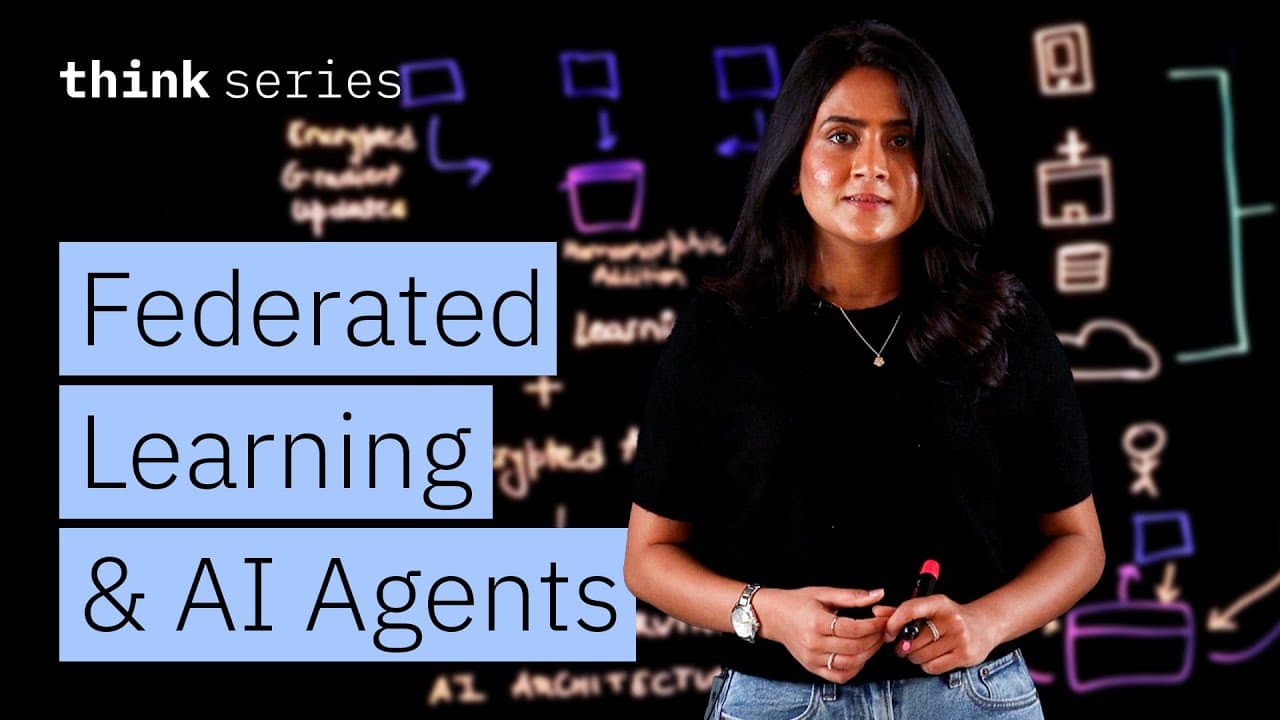
Federated learning trains models on local data and only shares encrypted updates to a central aggregator, so raw data never leaves the original environment. Encrypted AI agents use cryptographic techniques to allow learning from encrypted gradients without exposing underlying data, preserving privacy while maintaining model performance.
Transcript
Every time we train an AI model, it learns from data. Lots of it. But that data usually lives in different places, on phones, hospital systems, enterprise servers or private cloud environments. Now, what happens when you can't move that data because it's private or sensitive? Do you stop training the model or find new ways to learn without ever see... Read More
Key Insights
- Federated learning trains locally and avoids transferring raw data by exchanging encrypted gradients.
- The central coordinator performs secure aggregation to create a global model from encrypted updates.
- Encrypted AI agents use cryptographic methods to compute on data without seeing it directly.
- Privacy is preserved by keeping data in place while still enabling distributed learning.
- The system supports auditability and compliance by maintaining data locality and encrypted exchanges.
- Real-world examples include labs collaborating to detect diseases without sharing patient records.
- The approach balances model performance with strong privacy guarantees through secure protocols.
- This architecture is described as privacy-preserving AI that combines local training with encrypted collaboration.
- More videos from this channel:
- More from this channel: IBM Technology
Install to Summarize YouTube Videos and Get Transcripts
Explore YouTube Video Summarizer or Get YouTube Transcript Extractor
Questions & Answers
Q: How does federated learning enable model training without moving data
Federated learning enables model training by having each node train on its local data and only sending updated model parameters or gradients to a central aggregator. The aggregator then combines these encrypted updates to improve the global model. This preserves privacy because raw data never leaves its original environment, while still allowing collective learning across diverse sources.
Q: What role do encrypted AI agents play in this framework
Encrypted AI agents handle learning on encrypted data using cryptographic techniques such as secure multi-party computation. They can process encrypted gradient updates without exposing the underlying data, ensuring that even the learning process does not reveal sensitive information. This adds a layer of security while maintaining model performance.
Q: How is privacy maintained during gradient aggregation
Privacy is maintained during aggregation by encrypting the gradients before they are transmitted and processed. The central coordinator performs secure addition over these encrypted updates, producing a smarter global model without ever exposing individual gradients or raw data. This prevents leakage through the aggregation process.
Q: What is the main benefit of combining federated learning with encrypted agents
The main benefit is achieving both data privacy and effective learning. Data stays local, and updates are exchanged in encrypted form, enabling collaboration across distributed environments. This combination supports trustworthy AI that can scale while remaining auditable, compliant, and resistant to data leakage.
Q: How can this approach help in healthcare data collaborations
In healthcare, multiple labs can train locally on patient data and share encrypted updates to improve a common model, such as early disease detection, without transferring sensitive records. The secure aggregation ensures only the aggregated knowledge is used, protecting patient privacy while enabling cross-institutional research.
Q: What challenges does this approach address in AI development
This approach addresses the challenge of training AI on sensitive or regulated data without moving it, enabling privacy-preserving collaboration. It also helps maintain model performance by allowing diverse, distributed data to contribute to learning, while cryptographic techniques reduce the risk of leaking private information.
Q: Why is auditability important in privacy-preserving AI
Auditability is important because it provides a verifiable trail that data handling and learning procedures comply with privacy and regulatory requirements. By keeping data local and using secure aggregation, organizations can demonstrate that sensitive information is not exposed during training while still enabling trustworthy model development.
Q: What future impact could federated learning and encrypted agents have
The future impact could be broader adoption of privacy-respecting AI across industries, enabling collaboration without compromising data security. As cryptographic techniques evolve, models may become even more robust and scalable, while maintaining strong privacy guarantees and compliance across global distributed networks.
Summary & Key Takeaways
-
Federated learning lets each node train locally on its data before secure aggregation to build a global model.
-
Encrypted AI agents enable learning over encrypted information using methods like secure computation, reducing privacy risks.
-
The approach supports collaboration across distributed environments without exposing private records or sensitive features.
Read in Other Languages (beta)
Share This Summary 📚
Summarize YouTube Videos and Get Video Transcripts with 1-Click
Try YouTube Summary with ChatGPT & Claude or YouTube Transcript Generator
Explore More Summaries from IBM Technology 📚

Summarize YouTube Videos and Get Video Transcripts with 1-Click
Try YouTube Summary with ChatGPT & Claude or YouTube Transcript Generator