How Do Large Language Models Work and Apply?
TL;DR
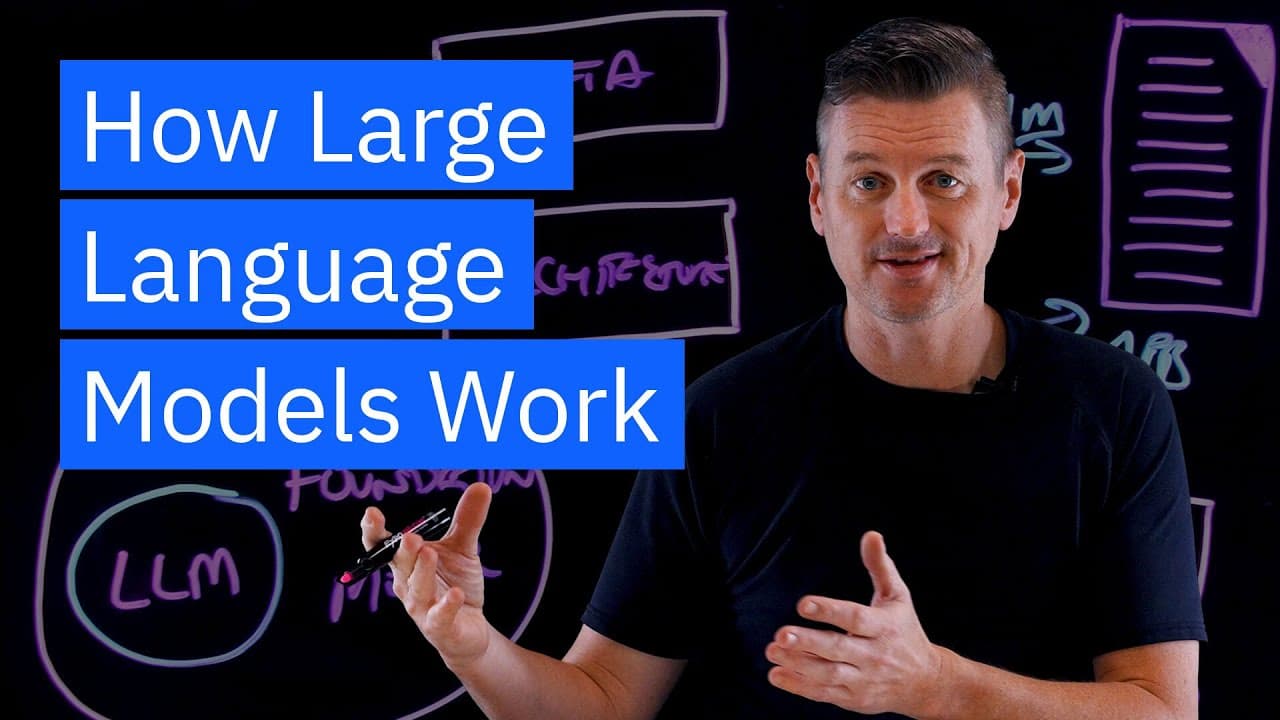
LLMs are built from foundation models trained on vast text datasets using a transformer architecture to predict the next word in a sequence. They learn from data, architecture, and training, then can be fine tuned for specific tasks and applied to customer service, content creation, and software development. The result is adaptable, text producing models that grow with more data and refinement.
Transcript
GPT, or Generative Pre-trained Transformer, is a large language model, or an LLM, that can generate human-like text. And I've been using GPT in its various forms for years. In this video we are going to number 1, ask "what is an LLM?" Number 2, we are going to describe how they work. And then number 3, we're going to ask, "what are the business app... Read More
Key Insights
- LLMs are defined as foundation models trained on large unlabeled data and self supervised learning, enabling generalizable outputs across tasks.
- The transformer architecture lets the model understand context by relating each word to others in a sequence, enabling coherent sentence generation.
- Training involves predicting the next word and adjusting parameters to reduce prediction error, gradually improving accuracy and coherence.
- Fine tuning specializes a general model to perform specific tasks more accurately by exposing it to task focused data.
- Large language models are described as having huge data requirements, potentially up to tens of gigabytes and even petabytes for training datasets.
- Business applications highlighted include intelligent chatbots for customer service, content creation such as articles and scripts, and assistance in software development through code generation and review.
- The speaker emphasizes that LLMs are still evolving and that new applications will continue to emerge as data and techniques mature.
- The video positions LLMs as a field with practical impact and invites audience engagement for further exploration.
- More videos from this channel:
- More from this channel: IBM Technology
Install to Summarize YouTube Videos and Get Transcripts
Explore YouTube Video Summarizer or Get YouTube Transcript Extractor
Questions & Answers
Q: What is an LLM and how does it fit as a foundation model?
An LLM is an instance of a foundation model, which are pre trained on large amounts of unlabeled data using self supervised methods. This setup enables the model to learn broad patterns and representations that can be adapted to a variety of language tasks. The combination of data and architecture allows these models to generalize beyond specific training examples, supporting coherent text generation and task flexibility.
Q: How does the transformer architecture help LLMs understand language?
The transformer architecture enables the model to handle sequences of text by considering each word in relation to every other word in the sentence. This contextual awareness allows the model to build a cohesive understanding of sentence structure and meaning, improving its ability to predict subsequent words and generate fluent, relevant responses. It is this attention mechanism that underpins contextual processing.
Q: What happens during the training phase of an LLM?
During training, the model learns to predict the next word in a sentence. It starts with an initial guess and adjusts its internal parameters to reduce the difference between its prediction and the actual word. Through many iterations, it improves accuracy, moving from producing random or incorrect tokens to generating coherent and contextually appropriate text.
Q: What does fine tuning accomplish for an LLM?
Fine tuning specializes a general language model for a specific task by training it on task focused data. This process refines the model’s understanding and behavior so it performs particular duties more accurately, such as answering customer queries in a given domain or generating content with a defined style or format.
Q: What are some business applications of LLMs mentioned in the video?
The video cites several business applications including intelligent customer service chatbots that handle common queries, content creation tools for drafting articles, emails, and scripts, and support for software development through code generation and review. These use cases illustrate how LLMs can automate and assist knowledge work.
Q: How large can LLM datasets be according to the video, and what does this imply?
The video notes that models can be trained on enormous data amounts, including tens of gigabytes and potentially petabytes of data. This scale implies that LLMs have access to vast linguistic patterns and information, which supports broad generalization but also highlights the importance of data quality and efficient training methods.
Q: What is the relationship between data, architecture, and training in LLMs?
The three components—data, architecture, and training—form the core of an LLM. Data provides the textual material for learning, the architecture (a transformer) enables effective contextual processing, and training aligns the model’s predictions with actual outcomes. Together, they create a system capable of producing coherent language and adapting to tasks.
Q: Why are LLMs likely to evolve and expand their applications over time?
LLMs are likely to evolve because advances in data availability, model architectures, and training methods continuously improve performance and efficiency. As organizations refine datasets, improve alignment, and develop better fine tuning techniques, new use cases will emerge, expanding their role across industries and enabling more sophisticated interactions and automation.
Summary & Key Takeaways
-
LLMs are described as foundation models trained on large text corpora and built with transformer architectures to handle context across sequences.
-
They learn by predicting the next word during training and improve through fine tuning on task specific data.
-
Business applications include chatbots, content generation, and code related tasks, with ongoing potential as models evolve.
Read in Other Languages (beta)
Share This Summary 📚
Summarize YouTube Videos and Get Video Transcripts with 1-Click
Try YouTube Summary with ChatGPT & Claude or YouTube Transcript Generator
Explore More Summaries from IBM Technology 📚
Summarize YouTube Videos and Get Video Transcripts with 1-Click
Try YouTube Summary with ChatGPT & Claude or YouTube Transcript Generator