How to mine data for insights and predict trends
TL;DR
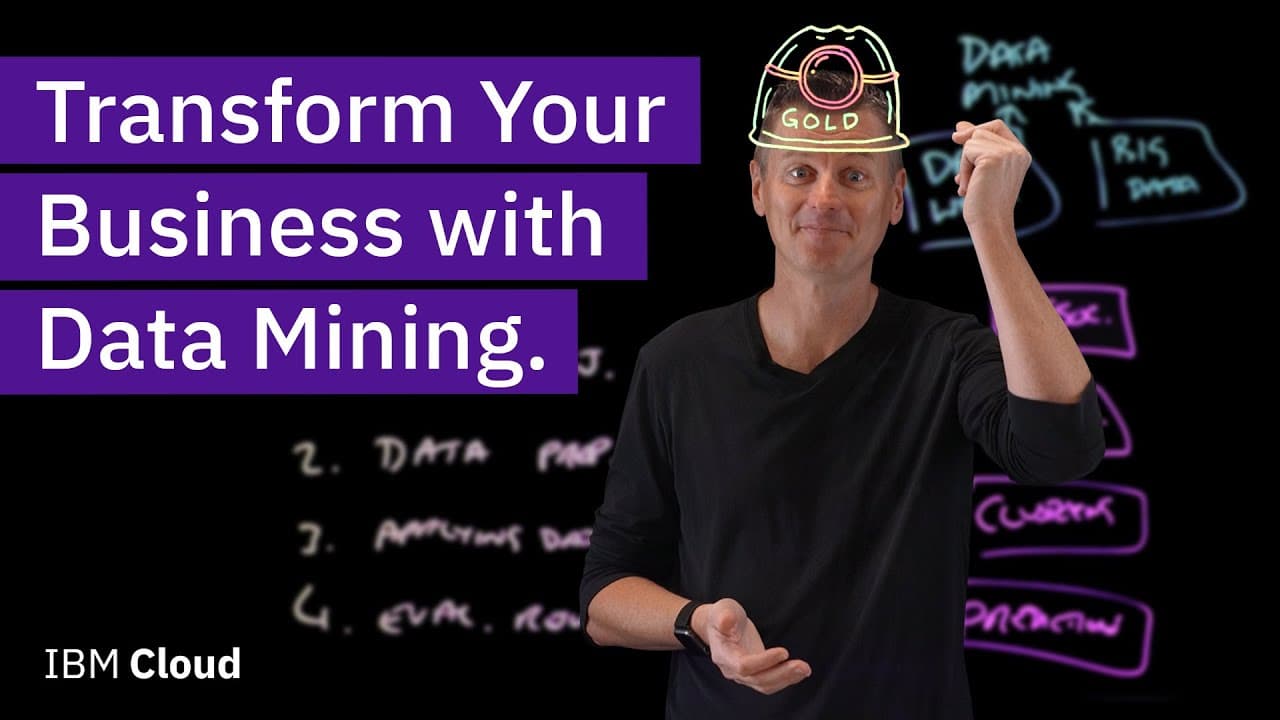
Data mining is the process of extracting valuable information from large datasets using patterns and relationships. It combines business stakeholders and data scientists, uses techniques like association, classification, and clustering, and aims to turn data into actionable insights and predictions. The workflow includes setting objectives, preparing data, applying algorithms, and evaluating results.
Transcript
If you've ever been panning for gold, you'll know that it takes a lot of time and effort to find even a small nugget. It's estimated that to extract enough go to make a single gold ring, you'd need to sort through around twenty six tons of rock and other stuff. That's a lot to sift through. The same is true when mining data, except the gold is repl... Read More
Key Insights
- Mining is the process of extracting valuable information from large data collections by identifying patterns and trends. It relies on turning raw data into actionable knowledge through structured steps.
- Effective data mining depends on clear business objectives defined with data scientists and stakeholders to guide data selection and modeling choices.
- Data preparation is essential and includes cleaning noise such as duplicates and missing values to ensure reliable results.
- Association rules uncover relationships between items and can suggest next actions based on observed patterns like purchases.
- Classification assigns data into predefined categories by comparing attributes to known definitions, enabling predictive labeling for new instances.
- Clustering groups similar data points to reveal structure and segment populations for targeted analysis and strategy.
- Deep learning and neural networks enable complex pattern recognition and predictive modeling even with large, unlabeled datasets.
- Choosing the right technique is context dependent; experimentation and evaluation are necessary to determine which method yields valid, novel, and useful results.
- More videos from this channel:
- More from this channel: IBM Technology
Install to Summarize YouTube Videos and Get Transcripts
Explore YouTube Video Summarizer or Get YouTube Transcript Extractor
Questions & Answers
Q: A real search query question about the video (e.g. 'How to...', 'What is...', 'Why does...', 'When should...'). Question 1
Data mining is the process of extracting valuable information from large datasets by identifying patterns and relationships. It combines business goals with statistical and machine learning techniques to turn data into insights that can predict trends and guide decisions. The methods include association, classification, clustering, and deep learning, each useful for different data types and objectives.
Q: Question 2
What are the main steps in the data mining workflow and why does each step matter? The typical workflow starts with setting objectives so the effort is aligned with business needs. Next, data preparation cleans and selects relevant information. Then algorithms are applied to discover patterns. Finally, evaluating results validates usefulness and applicability, ensuring insights are credible.
Q: Question 3
How does association mining work and when is it useful? Association mining looks for rules that describe how items co-occur in data, such as products bought together. It is useful for uncovering buying patterns and helping with cross selling and recommendation systems, guiding decisions on which combinations to promote or stock.
Q: Question 4
What is classification in data mining and how is it applied? Classification sorts data into predefined categories by learning from labeled examples. It is applied to predict the class of new data points by comparing their attributes to established definitions, enabling tasks such as customer segmentation or fault detection.
Q: Question 5
What role does clustering play in data mining and what insights can it provide? Clustering groups similar data points to form natural segments, revealing structure and patterns that may not be visible otherwise. It helps tailor marketing, customize products, and identify outliers or unique subgroups for further study.
Q: Question 6
How do deep learning techniques fit into data mining and what advantages do they offer? Deep learning uses neural networks to uncover complex patterns in large datasets, enabling predictions and discovering nonlinear relationships. It is especially powerful for high dimensional data like images, text, and time series.
Q: Question 7
Why is there no one size fits all solution in data mining and how should one proceed? Different datasets and questions require different techniques. The process often involves trial and error, testing multiple methods, and validating results to determine which approach provides valid, novel, and useful insights for the business.
Q: Question 8
What is the overall value of data mining for a business? When done correctly, data mining turns raw data into actionable insights that can improve decision making, forecast trends, optimize operations, and potentially provide competitive advantages through better understanding of customers and markets.
Summary & Key Takeaways
-
Data mining transforms raw data into useful knowledge by identifying patterns, correlations, and trends that inform business decisions and strategy. The process emphasizes collaboration between stakeholders and data scientists to ensure objectives align with measurable outcomes. It highlights practical steps from data preparation to predictive insights.
-
The video explains four core steps: define objectives, prepare data, apply mining algorithms, and evaluate results, with emphasis on how data quality and proper technique selection affect outcomes. It also covers common methods like association, classification, clustering, and deep learning based predictions.
-
Different mining techniques are described as suitable for different data and questions, showing that there is no one size fits all solution. The speaker stresses trial and error to find the best method for a given dataset and business goal.
Read in Other Languages (beta)
Share This Summary 📚
Summarize YouTube Videos and Get Video Transcripts with 1-Click
Try YouTube Summary with ChatGPT & Claude or YouTube Transcript Generator
Explore More Summaries from IBM Technology 📚


Summarize YouTube Videos and Get Video Transcripts with 1-Click
Try YouTube Summary with ChatGPT & Claude or YouTube Transcript Generator