How to connect AI agents to tools with MCP and vaults
TL;DR
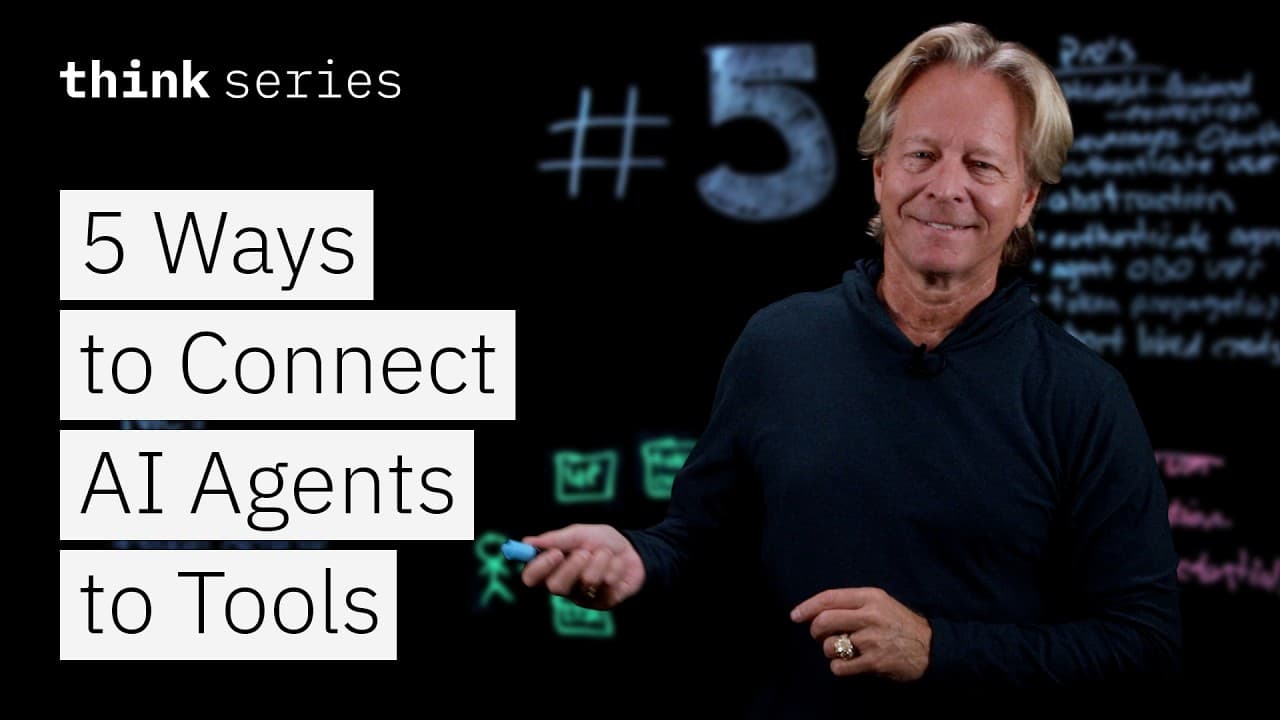
Directly connecting an agent to a tool is simple but lacks user visibility, while introducing MCP and vaults adds abstraction and short lived credentials for security. The five patterns evolve from direct connections to token vault based architectures, increasing security, observability, and control over who can act on behalf of whom.
Transcript
Agentic systems are emerging everywhere now and are being integrated into our enterprise processes. Now there are lots of ways to connect agents to tools in these processes. And today we're going to count down the top five patterns for connecting agents to the tools. Let's start with number five. And this is a direct connection. Basically what this... Read More
Key Insights
- Direct connection is the simplest pattern where the agent uses its own credentials to access a tool, but it hides user identity and permissions.
- OAuth based flows add user authentication but create impersonation and long lived credentials that pose security risks if compromised.
- MCP introduces an abstraction layer so agents only need to understand MCP rather than every tool protocol, increasing scalability.
- Token exchange allows authenticating the agent and delegating actions on behalf of the user, improving traceability and control.
- Pattern two reduces direct tool dependencies by using delegation while Pattern three adds MCP for broader tool compatibility.
- Vaults are introduced to store long term credentials and issue short lived tokens, reducing exposure from token replay.
- Short lived credentials dramatically limit risk by ensuring credentials expire quickly after use.
- The progression from direct connection to vault based credentials demonstrates a security and observability maturation path for agent tool integration.
- More videos from this channel:
- More from this channel: IBM Technology
Install to Summarize YouTube Videos and Get Transcripts
Explore YouTube Video Summarizer or Get YouTube Transcript Extractor
Questions & Answers
Q: How do direct connections between an agent and a tool work, and what is a major drawback?
Direct connections involve the agent using its own credentials to access a tool via APIs or similar interfaces. The major drawback is that the tool cannot see who the user is or what permissions they have, leading to a lack of visibility and potential overexposure of information in enterprise contexts.
Q: What change does adding OAuth bring to the agent tool connection pattern?
Adding OAuth introduces user authentication so the tool can see who is making the request. The agent authenticates and uses an access token, enabling interactions that reflect the user rather than the agent alone. However, this can create impersonation concerns and long lived credentials if tokens are not managed carefully.
Q: How does Model Context Protocol (MCP) change the interaction model?
MCP adds an abstraction layer so the agent does not need to know the specifics of every tool. Instead, the agent communicates with MCP, which orchestrates tool interactions. This improves scalability by decoupling agents from tool specifics and allows easier integration across multiple tools.
Q: What is the role of token exchange in pattern two, and why is it important?
Token exchange authenticates both the user and the agent and enables actions to be performed on behalf of the user. This provides a secure delegation mechanism, ensuring that tokens can be validated and tracked while enabling controlled access to tools.
Q: Why is impersonation a concern in earlier patterns and how is it addressed later?
Impersonation arises when a tool only sees the user as the actor, not the actual agent, which obscures accountability. Later patterns mitigate this by authentication of the agent and token propagation with clear delegation, improving traceability and reducing ambiguity about who performed which action.
Q: What security advantage do vaults provide in the top pattern?
Vaults store long lived credentials securely and issue short lived access to MCP. This reduces the risk of credential leakage or replay attacks, since tokens are short lived and tightly controlled, limiting the window of opportunity for misuse.
Q: How does short lived credential issuance improve security in pattern one?
By issuing short lived credentials, the system minimizes the risk that a stolen token can be reused over a long period. This containment means that even if credentials are compromised, their usefulness is limited to a brief time frame, enhancing overall security.
Q: What is the overall security progression described in the video from pattern five to pattern one?
The progression starts with a direct connection and gradually introduces identity, delegation, abstraction, and token based security. Each step adds visibility, authentication, authorization, and secure token management via vaults, culminating in short lived credentials that greatly reduce risk while improving control and observability.
Summary & Key Takeaways
-
The summary explains how each pattern moves from simple direct access to a secure vault based model, emphasizing the role of authentication, MCP, and token management in enterprise agent tool integration.
-
The summary highlights how OAuth and impersonation are addressed and then replaced by token exchange and vault mechanics to improve security and observability.
-
The summary notes that short lived credentials reduce risk and that full visibility is achieved when tokens are managed via a vault.
Read in Other Languages (beta)
Share This Summary 📚
Summarize YouTube Videos and Get Video Transcripts with 1-Click
Try YouTube Summary with ChatGPT & Claude or YouTube Transcript Generator
Explore More Summaries from IBM Technology 📚


Summarize YouTube Videos and Get Video Transcripts with 1-Click
Try YouTube Summary with ChatGPT & Claude or YouTube Transcript Generator