How does MCP differ from API for AI data access
TL;DR
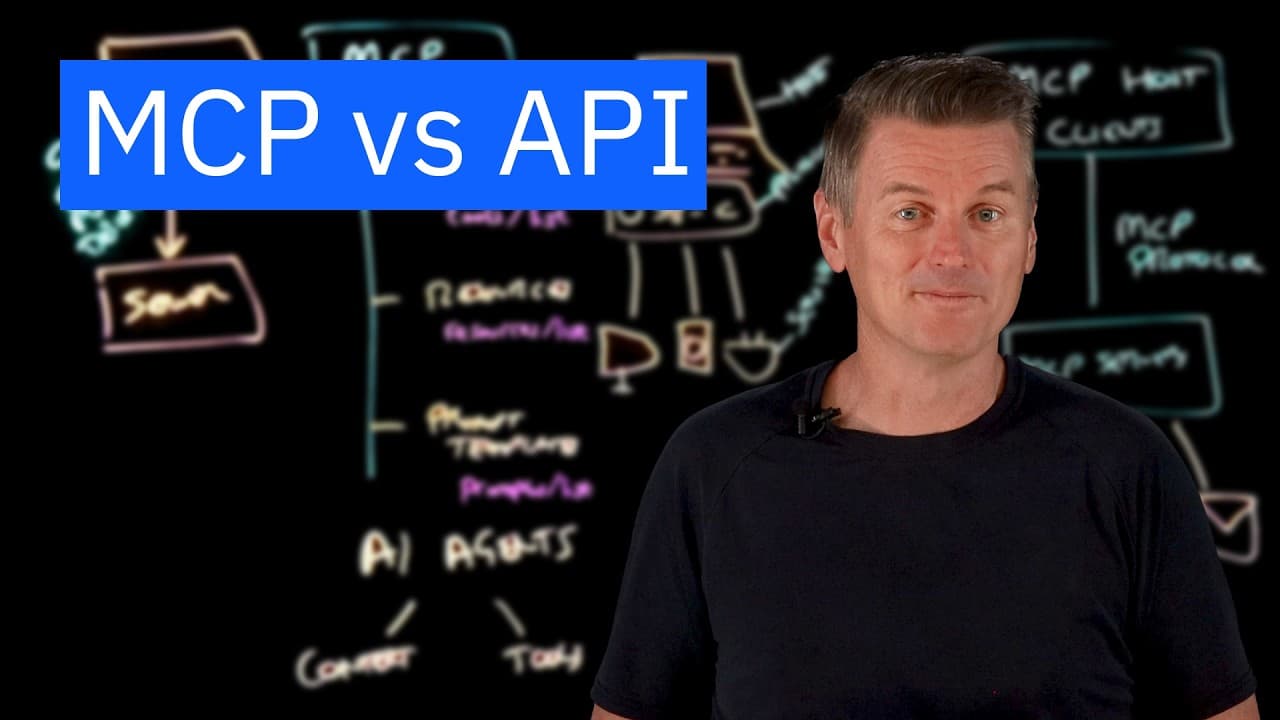
MCP standardizes how AI apps obtain external context and execute tools, enabling dynamic discovery and uniform interactions across servers, while APIs remain general purpose interfaces that require adapters and lack built in AI runtime discovery. MCP servers expose tools, resources, and prompts in a consistent protocol the AI can discover at runtime.
Transcript
For large language models to be truly useful, they often need to interact with external data sources and services and tools. And until recently, that was typically done with application programming interfaces or APIs. Now, in late 2024, Anthropic introduced a new open standard protocol, that's model context protocol or MCP. And it has already made ... Read More
Key Insights
- MCP is designed to integrate LLM based AI agents with external data and tools, providing a standardized way to retrieve context and invoke actions.
- MCP introduces three primitives: tools, resources, and prompt templates, where tools are actionable functions, resources are read only data items, and prompts offer predefined templates.
- MCP uses a uniform protocol with JSON RPC 2.0 sessions, enabling AI clients to discover available primitives from MCP servers at runtime.
- A key advantage of MCP is dynamic discovery, allowing clients to learn what a server can do without redeploying code.
- Standardization is stronger in MCP because every MCP server speaks the same protocol, reducing the need for multiple adapters.
- Many MCP servers wrap traditional APIs under the hood, translating MCP calls to existing REST or other API requests.
- APIs are general purpose and not AI tailored, so traditional REST APIs lack built in runtime discovery available in MCP.
- MCP and APIs are complementary layers, with MCP often wrapping APIs to create AI friendly interfaces.
- More videos from this channel:
- More from this channel: IBM Technology
Install to Summarize YouTube Videos and Get Transcripts
Explore YouTube Video Summarizer or Get YouTube Transcript Extractor
Questions & Answers
Q: What is MCP and why was it introduced for AI agents?
MCP, or Model Context Protocol, is a standard for connecting AI agents to external data sources and tools. It was introduced to provide a consistent, AI friendly interface that enables agents to retrieve context and perform actions through a uniform set of primitives. This standardization helps agents adapt to new capabilities without redeploying code and supports dynamic discovery of available tools, resources, and templates.
Q: How does MCP handle discovery of capabilities?
MCP supports dynamic discovery by allowing an AI client to query an MCP server for its published primitives. The server returns a machine readable catalog of tools, resources, and prompts, enabling the client to adapt to whatever capabilities are available. This avoids hard coded endpoints and allows seamless integration as new features are added.
Q: What are the main MCP primitives and what do they do?
The main MCP primitives are tools, resources, and prompt templates. Tools are discrete actions or functions that an AI can call, such as getting weather or creating a calendar event. Resources are read only data items like documents or database schemas that can be retrieved. Prompt templates provide predefined prompt guidance the AI can use in interactions.
Q: How does MCP compare to REST APIs in terms of standardization?
MCP standardizes the interface across servers, meaning all MCP servers respond to the same kinds of calls in a uniform way. In contrast, REST APIs are unique to each service with different endpoints, parameters, and authentication schemes. This makes MCP easier to integrate with multiple providers without writing new adapters for each one.
Q: Can MCP work with existing APIs, and how?
Yes, MCP servers can act as wrappers around existing APIs. They translate MCP style calls into the underlying API requests, exposing high level tools like repository/list while internally using the service’s REST API. This allows AI agents to interact with many services through a single AI friendly interface.
Q: Why might an AI developer prefer MCP over a pure API approach?
An AI developer might prefer MCP because it provides dynamic discovery, uniform primitives, and a consistent interface for interacting with diverse data sources and tools. This reduces the need for bespoke adapters, lets agents adapt at runtime to new capabilities, and simplifies building scalable AI powered workflows.
Q: Are MCP and APIs mutually exclusive or complementary?
They are complementary layers. MCP can wrap existing APIs to create an AI friendly interface, while APIs remain useful for general software integration. The MCP layer standardizes access for AI agents and can translate requests to underlying APIs, combining the strengths of both approaches.
Q: What practical examples demonstrate MCP's use cases?
MCP enables AI agents to query data sources like databases or knowledge bases, and to call external tools such as weather services or email gateways, through a standardized protocol. This makes it easier to assemble AI powered workflows across file systems, maps, code repositories and enterprise data sources without custom integration work.
Summary & Key Takeaways
-
MCP creates a USB-C like standard for AI applications to connect to external data and tools, enabling uniform interactions and runtime discovery across diverse servers. It organizes capabilities into tools, resources, and prompts, which a client can query and invoke without bespoke adapters. This makes AI agent integration more scalable and adaptable.
-
APIs provide general purpose access via REST or other protocols, serving as abstraction layers between clients and services. They require specific endpoint knowledge, differ by service, and typically lack built in discovery. MCP can wrap APIs and present a unified AI friendly interface on top, reducing integration friction.
-
The talk contrasts MCP and APIs by purpose, standardization, and runtime discovery. MCP is designed for AI agents and external data access, supporting dynamic capability discovery, while APIs are broader, require adapters, and do not inherently expose a dynamic capability catalog.
Read in Other Languages (beta)
Share This Summary 📚
Summarize YouTube Videos and Get Video Transcripts with 1-Click
Try YouTube Summary with ChatGPT & Claude or YouTube Transcript Generator
Explore More Summaries from IBM Technology 📚



Summarize YouTube Videos and Get Video Transcripts with 1-Click
Try YouTube Summary with ChatGPT & Claude or YouTube Transcript Generator