How to Govern AI Agents with Five Core Pillars
TL;DR
Govern AI agents through five connected pillars: alignment, control, visibility, security, and societal integration. Organizations should translate each pillar into policies, processes, and controls, including drift tests, human authorization, activity logs, threat modeling, and accountability rules, then continuously revise the framework as agents, organizational goals, and regulations change.
Transcript
Why does this driverless car that I'm in keep driving around this parking lot in circles? Is this a bug in the software or somebody playing a joke on me? Because I can't figure out how to make this thing stop. You can probably tell I'm not really in an autonomous vehicle right now, but this scenario has actually happened to people, and it's a littl... Read More
Key Insights
- AI agents are goal-based systems that use large language models to act autonomously and complete tasks. Users provide high-level goals rather than explicit instructions for every step, so the agent determines how to pursue the requested outcome.
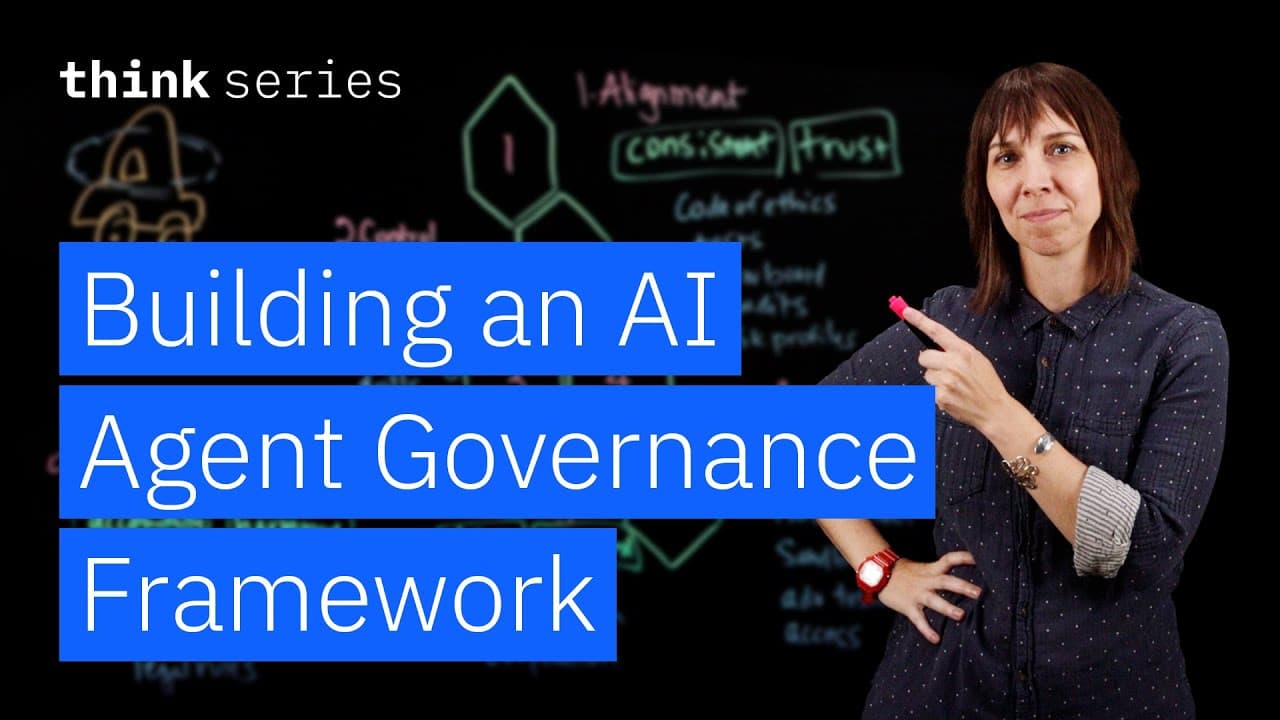
- Alignment is the foundation for ensuring that agents behave consistently with organizational values and intentions. Supporting measures include a code of ethics, goal-drift metrics, predeployment and recurring tests, automated output audits, encoded risk profiles, and review by a governance board.
- Control is the use of predefined boundaries to limit what agents can do independently. An action authorization policy should distinguish autonomous actions from those requiring human involvement, while an approved tool catalog should document permitted databases, APIs, plug-ins, and tool lineage.
- Intervention mechanisms are necessary for responding to agent misbehavior. Organizations can run shutdown and rollback drills, design soft stops for orderly shutdowns, implement hard stops at the orchestration layer for emergencies, and record actions, inputs, and outputs in activity logs.
- Visibility is the ability to make agent actions observable, traceable, and understandable. Unique agent IDs support behavior tracking across environments, while incident investigation protocols define steps from retrieving logs through conducting root cause analysis after unexpected behavior occurs.
- Multi-agent cooperation requires continuous evaluation because coordination failures can affect users. Automated testing can assess how agents interact and cooperate, giving organizations a way to identify problematic behavior before failures reach people who depend on the system.
- Security is supported by threat modeling, sandboxed execution, adversarial testing, and access controls. These measures address prompt injections, adversarial inputs, vulnerabilities, unauthorized access, and unwanted data transmission while testing whether agents continue to perform reliably when attacked.
- Societal integration is the governance pillar that addresses accountability, inequality, concentration of power, regulation, and legal compliance. Responsibility should be allocated among developers, business owners, auditors, and users, while regulatory engagement and legal rules engines help agents operate within applicable laws.
- More videos from this channel:
- More from this channel: IBM Technology
Install to Summarize YouTube Videos and Get Transcripts
Explore YouTube Video Summarizer or Get YouTube Transcript Extractor
Questions & Answers
Q: What are the five pillars of AI agent governance?
The five pillars are alignment, control, visibility, security, and societal integration. Alignment connects agent behavior with organizational values and intentions. Control establishes operational boundaries. Visibility makes actions observable and traceable. Security protects data and supports resilience against threats. Societal integration addresses accountability, inequality, concentrated power, regulation, and the legal implications of deploying autonomous agents.
Q: How can organizations keep AI agents aligned with their goals?
Organizations can establish a code of ethics that states their values, standards, and expected conduct, then embed it in every agent development project. They can define metrics and tests for goal drift, run those tests before deployment and regularly afterward, automate audits of outputs, encode organizational risk preferences into agent parameters, and use a governance review board to approve deployments.
Q: How should human oversight be built into AI agent control?
Human oversight should begin with an action authorization policy that separates actions agents may take autonomously from actions requiring a human in the loop. Organizations should also maintain an approved tool catalog, record agent activities, and test intervention procedures. Soft stops can support orderly shutdowns, while hard stops at the orchestration layer can provide emergency termination when rapid intervention is required.
Q: Why do AI agents need activity logs and unique IDs?
Activity logs record each agent action along with relevant inputs and outputs, making it possible to investigate, reverse, or modify behavior when needed. Unique agent IDs extend that traceability across environments. Together, these controls support incident response by helping investigators retrieve the correct records, connect actions to a specific agent, and conduct root cause analysis after unexpected behavior.
Q: How can organizations test whether multiple AI agents cooperate safely?
Organizations can automate continuous testing of interactions among multiple agents and evaluate their cooperation capabilities. The purpose is to observe how agents coordinate, identify failures in their joint behavior, and detect problems before those failures affect users. This testing belongs within the visibility pillar because it makes otherwise complex multi-agent actions more observable, understandable, and open to investigation.
Q: How can AI agents be protected from security threats?
Organizations can create a threat-modeling framework to identify and mitigate prompt injections, adversarial inputs, and vulnerabilities. Agents can operate inside isolated, monitored sandboxes that prevent unauthorized access and data transmission. Regular adversarial testing can challenge their resilience under attack, while access controls can ensure that only authorized users are able to reach agents and provide instructions.
Q: What does societal integration mean for AI agent governance?
Societal integration addresses agent accountability, inequality, concentration of power, and harmonious adoption. Organizations can define how legal responsibility is distributed among developers, business owners, auditors, and users. They can maintain active dialogue with regulators and industries, help shape standards, and build legal rules engines that automatically check proposed agent actions against relevant legislation before those actions proceed.
Q: Why must an AI agent governance framework evolve continuously?
An AI agent governance framework is not a one-time checklist because agents continue to grow in capability and regulations continue to change. The framework should be adaptable to different organizational goals, strategies, and risk preferences. Policies, processes, controls, tests, and approval practices therefore need regular review and iteration so governance remains aligned with the environment in which agents operate.
Summary & Key Takeaways
-
AI agents are goal-based systems that use large language models to act autonomously. Users specify high-level goals without prescribing every step, leaving agents to choose how tasks are completed. Because this autonomy creates reliability and safety concerns, organizations need governance frameworks that keep agent behavior consistent with their intentions and values.
-
Alignment and control establish behavioral expectations and operational boundaries. Organizations can create ethical codes, test for goal drift, automate audits, define risk profiles, approve tools, classify actions by required authorization, and maintain intervention mechanisms. Shutdown drills, rollback procedures, activity logs, soft stops, and hard stops help organizations respond when agents misbehave.
-
Visibility, security, and societal integration address traceability, threats, cooperation, accountability, and legal compliance. Unique agent IDs, incident protocols, multi-agent testing, sandboxing, adversarial testing, access controls, regulatory engagement, and legal rules engines support these goals. The overall framework must remain adaptable and evolve alongside agent capabilities and changing regulations.
Read in Other Languages (beta)
Share This Summary 📚
Summarize YouTube Videos and Get Video Transcripts with 1-Click
Try YouTube Summary with ChatGPT & Claude or YouTube Transcript Generator
Explore More Summaries from IBM Technology 📚

Summarize YouTube Videos and Get Video Transcripts with 1-Click
Try YouTube Summary with ChatGPT & Claude or YouTube Transcript Generator