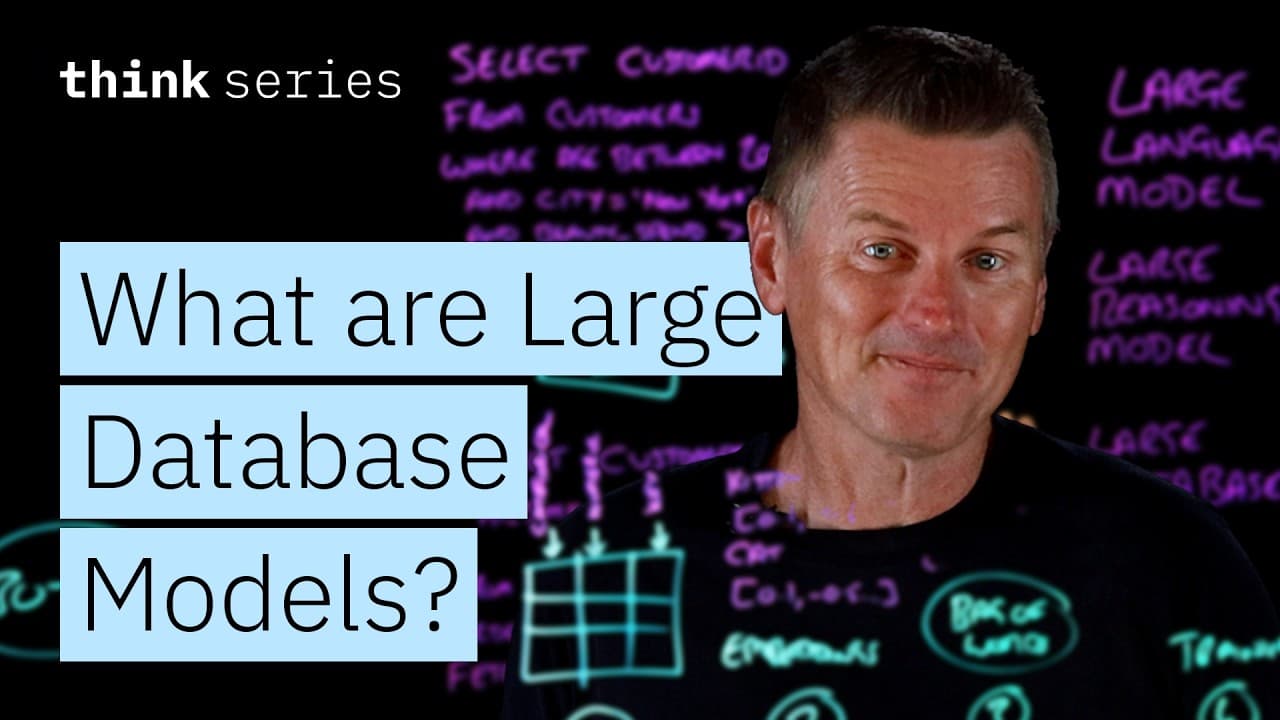
What Is a Large Database Model for AI in SQL?
TL;DR
A Large Database Model enables AI to query data that stays inside a relational database by learning from the selected columns of tables. It combines AI semantic queries with standard SQL to find similar customers, cluster items, and identify common patterns without moving data. This reduces data movement and keeps data secure.
Transcript
Okay, let's test your AI model acronym knowledge. Let me give you a few. So LLM, it's pretty easy, right? That's Large Language Model. And if you've ever used the Extended Thinking Mode in one of those models, you might also know LRM, that's Large Reasoning Model. But how about this one? L-D-M. Now, if you said Large Data Model, that's a smart gues... Read More
Key Insights
- LDM stands for Large Database Model and is distinct from LLM and LRM.
- LDMs are trained on a selected subset of tables or views within a relational database.
- Values are tokenized into embeddings, with numeric values bucketed into IDs for consistency.
- Rows are converted into unordered sentences or bag-of-words representations.
- Columns are tagged with their names to avoid cross-column ambiguity.
- Training produces vectors for tokens that enable similarity and clustering queries.
- Queries can combine AI semantic features with traditional SQL filters.
- LDMs execute within the database, reducing data movement and improving security.
- More videos from this channel:
- More from this channel: IBM Technology
Install to Summarize YouTube Videos and Get Transcripts
Explore YouTube Video Summarizer or Get YouTube Transcript Extractor
Questions & Answers
Q: What is a Large Database Model and how does it differ from traditional SQL queries?
A Large Database Model is an AI model trained on a selected set of table columns within a relational database. It learns vector representations for tokens from those columns and exposes semantic capabilities through SQL. Unlike rigid SQL filters, LDMs allow similarity, clustering, and analogy queries directly inside the database, without moving data.
Q: How are numeric and categorical values handled in LDMs?
In LDMs, each value is turned into a token and numeric values are bucketed into IDs to create stable embeddings. Each token is tagged with its column name to prevent confusion between the same value appearing in different columns. This tokenization enables consistent vector learning across rows.
Q: What is the role of embeddings in an LDM?
Embeddings convert tokens into numerical vectors so the model can learn relationships between values. Similar values end up with nearby vectors, which allows the LDM to assess similarity between customers, products, or transactions. This vector space enables semantic queries like finding similar customers without explicit feature selection.
Q: How does an LDM represent a row of data for learning?
Each row is treated as an unordered sentence or bag of words, where tokens consist of column name and value pairs. This format ensures that the model learns relationships across the entire row rather than relying on positional feature ordering, improving the quality of embedded representations for downstream queries.
Q: What capabilities does an LDM expose through SQL?
An LDM exposes capabilities such as similarity search, clustering, analogy, and commonality queries directly through SQL. This enables users to discover patterns, identify outliers, and relate products or customers based on learned data representations without exporting the data for external processing.
Q: Where do LDMs run and why is this important?
LDMs run where the data lives, inside the relational database. This minimizes data movement, reduces IT costs associated with data transfer, and maintains security and governance controls. It also allows teams with basic SQL skills to perform advanced AI-driven queries.
Q: What is the business impact of using LDMs in AI for SQL data?
LDMs unlock AI insights by enabling semantic access to the vast majority of enterprise data stored in databases. They can improve recommendations, risk assessment, fraud detection, and product discovery by enabling faster, more accurate queries that reflect real data relationships learned from the database itself.
Q: What examples of industries or use cases are mentioned for LDMs?
The video mentions insurance for contract retrieval and quote prediction, fraud detection for flagging unusual transactions, and retail for exploring product similarity and nutritional matching. These examples illustrate how LDMs can be applied to search, similarity, and pattern detection across diverse datasets within enterprises.
Summary & Key Takeaways
-
A Large Database Model (LDM) enables AI to work directly where data resides inside relational databases, using embeddings and tokenization. It prioritizes selected columns and treats each row as a sentence, enabling semantic and vector-based querying through SQL. This approach reduces data movement and preserves security.
-
LDMs support similarity search, clustering, and analogy queries within the database, leveraging learned embeddings to reveal relationships in data. They merge AI capabilities with conventional SQL, avoiding the need to export data for analysis.
-
Commercially, IBM has integrated LDMs into SQL Data Insights products, illustrating practical deployments in insurance, fraud detection, and product similarity tasks. This signals a shift toward native AI in SQL environments without data leaving the database.
Read in Other Languages (beta)
Share This Summary 📚
Summarize YouTube Videos and Get Video Transcripts with 1-Click
Try YouTube Summary with ChatGPT & Claude or YouTube Transcript Generator
Explore More Summaries from IBM Technology 📚


Summarize YouTube Videos and Get Video Transcripts with 1-Click
Try YouTube Summary with ChatGPT & Claude or YouTube Transcript Generator