How do word embeddings turn words into numbers?
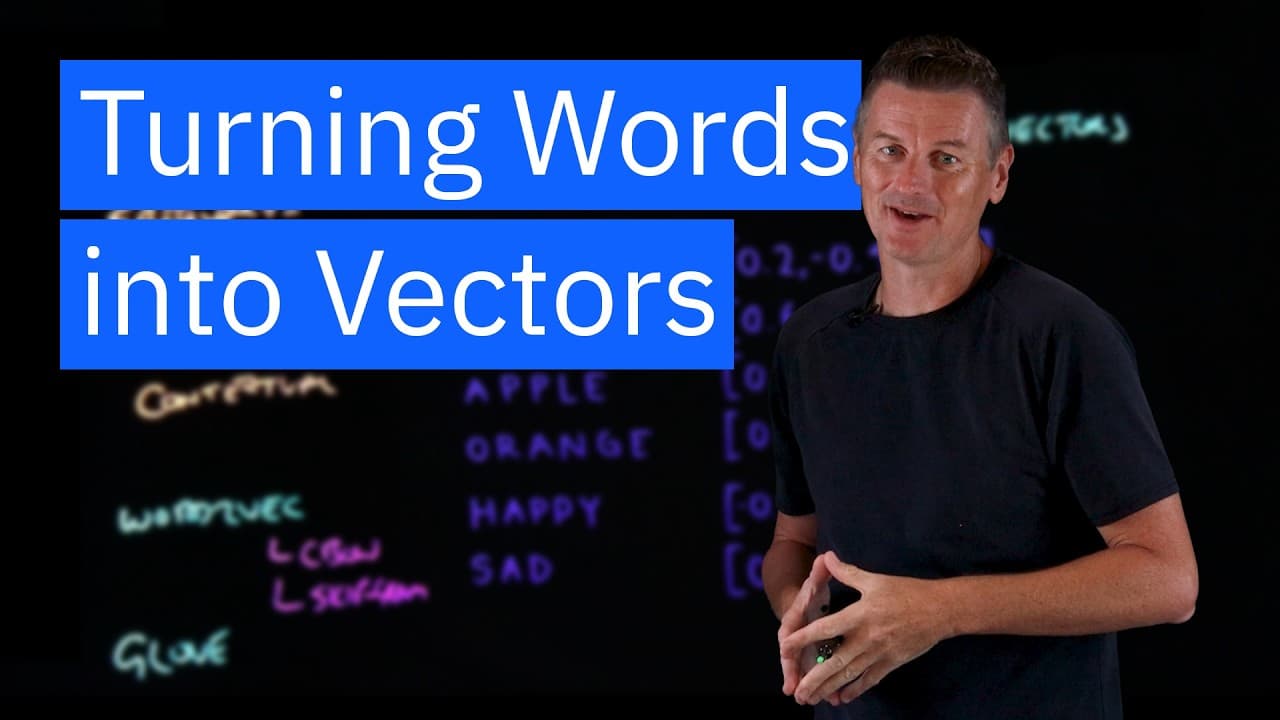
TL;DR
Word embeddings convert words into numeric vectors that encode semantic relationships. They enable ML models to process text by capturing context and similarity, using methods like TF-IDF, Word2Vec, and GloVe, and increasingly contextual embeddings from transformers. These representations improve tasks such as text classification and NER by placing related words close in vector space.
Transcript
A word on word embeddings. Maybe a few words. Word embeddings represent words as numbers, specifically as numeric vectors, in a way that captures the semantic relationships and contextual information. So that means words with similar meanings are positioned close to each other, and the distance and direction between vectors encode the degree of sim... Read More
Key Insights
- Word embeddings represent words as numeric vectors to capture semantic relationships.
- Taxonomies include frequency based embeddings and prediction based embeddings.
- TF-IDF highlights document specific words while downplaying common terms.
- Word2Vec has CBOW and skip-gram architectures to learn word context.
- GloVe uses global co-occurrence statistics to form vectors.
- Contextual embeddings change word representations with context in transformers.
- Fixed embeddings limit nuance compared to contextual embeddings.
- Embedding models are trained on large text corpora to learn relationships.
- More videos from this channel:
- More from this channel: IBM Technology
Install to Summarize YouTube Videos and Get Transcripts
Explore YouTube Video Summarizer or Get YouTube Transcript Extractor
Questions & Answers
Q: What are word embeddings?
Word embeddings are representations of words as numeric vectors that encode semantic relationships and contextual information. They position similar meanings close together in vector space so that distance and direction reflect similarity. These embeddings enable machine learning models to process language, which cannot be done with raw text alone, making NLP tasks feasible.
Q: Why are numbers needed for language models?
Numbers are needed because most machine learning algorithms cannot process raw text. Word embeddings convert language into a fixed numeric format, allowing algorithms to measure similarity, distance, and context between words. This numeric representation is essential for tasks like classification, clustering, and answering questions in NLP.
Q: What is TF-IDF in embeddings?
TF-IDF is a frequency based embedding technique that highlights words frequent in a document but rare across the entire corpus. It emphasizes topic specific terms like espresso in a coffee document while downplaying common words. TF-IDF helps identify distinctive vocabulary for classification and retrieval tasks.
Q: What are Word2Vec CBOW and skip-gram?
Word2Vec includes two architectures: CBOW and skip-gram. CBOW predicts a target word from its surrounding context words, while skip-gram predicts surrounding context words given a target word. Both learn fixed vector representations that capture word relationships and semantic similarity from large text corpora.
Q: How does GloVe differ from Word2Vec?
GloVe uses global co-occurrence statistics to create word vectors, taking a broader view of how often words appear together across the entire corpus. This contrasts with Word2Vec’s focus on immediate contextual prediction. Together they provide complementary methods for modeling word meanings in vector space.
Q: What are contextual embeddings?
Contextual embeddings are representations where a word’s vector changes based on its surrounding context. In transformer models, the same word can have different vectors in different sentences, capturing nuanced meanings and relationships. This context sensitivity improves performance on many NLP tasks by reflecting usage variability.
Q: Why are embeddings important for NLP tasks?
Embeddings are important because they provide a numerically tractable way to represent language, enabling tasks like text classification, NER, and similarity measures. By encoding meaning and context, embeddings allow models to reason about words, detect relationships, and generalize across languages and domains more effectively.
Q: What role do transformers play in embeddings?
Transformers introduce contextual embeddings where word vectors depend on surrounding text. This advances traditional fixed embeddings by capturing sense variation and nuanced meaning. The transformer’s attention mechanism enables more accurate modeling of semantics, which leads to better performance on NLP tasks such as classification, Q&A, and information retrieval.
Summary & Key Takeaways
-
Word embeddings transform text into dense vectors that reflect meaning and context, enabling machines to process language.
-
Different embedding methods exist, including frequency based TF-IDF and prediction based models like Word2Vec and GloVe, each with unique strengths in capturing word relationships.
-
Contextual embeddings from transformers adapt word representations to the surrounding text, improving nuanced language understanding across NLP tasks.
Read in Other Languages (beta)
Share This Summary 📚
Summarize YouTube Videos and Get Video Transcripts with 1-Click
Try YouTube Summary with ChatGPT & Claude or YouTube Transcript Generator
Explore More Summaries from IBM Technology 📚






Summarize YouTube Videos and Get Video Transcripts with 1-Click
Try YouTube Summary with ChatGPT & Claude or YouTube Transcript Generator