What is machine learning, AI, and deep learning?
TL;DR
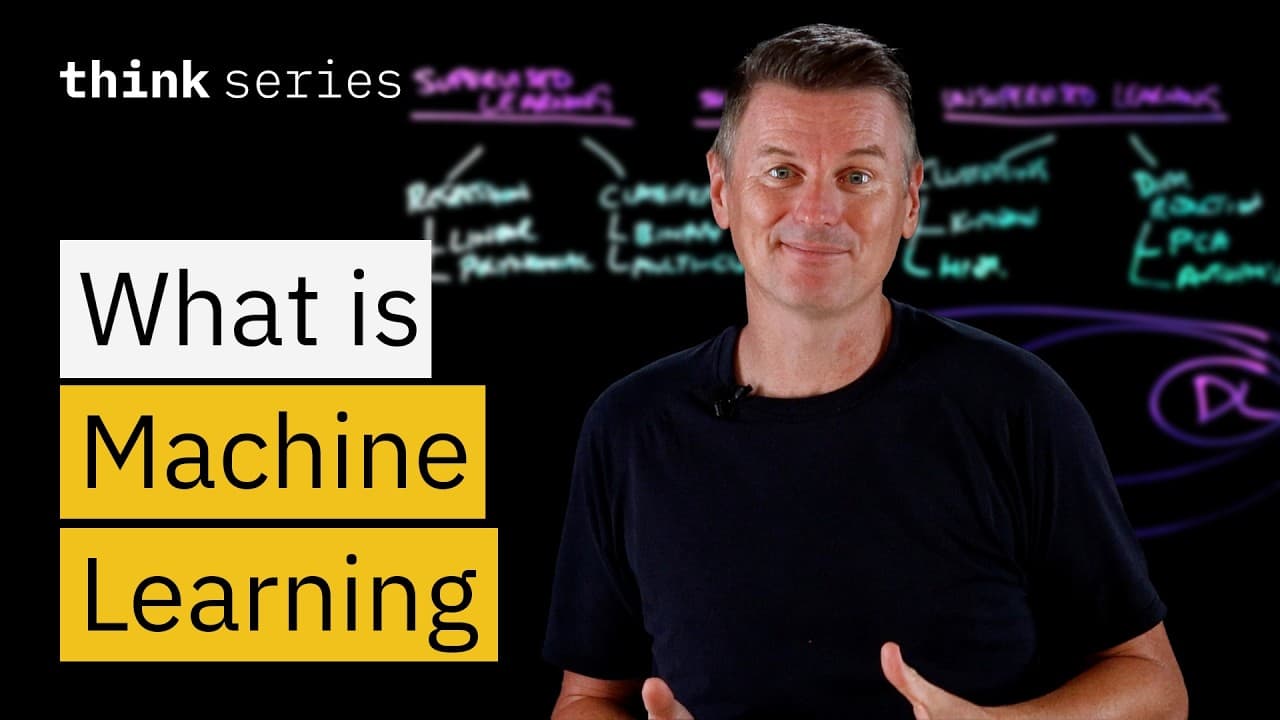
Machine learning is a subset of AI that learns patterns from training data to make inferences on new data. Deep learning is a further subset using multi layer neural networks. ML models are trained to perform tasks and then deployed for AI inference, with supervised, unsupervised, and reinforcement Learning as core paradigms.
Transcript
What is machine learning? Well, I think you have a basic idea. Right? It's the tech that recommends which video to watch next on YouTube. The machine is learning your preferences and its bot powers chatbots. But is ML or machine learning synonymous with AI? Or what about deep learning? DL. Are deep learning and machine learning the same thing? Well... Read More
Key Insights
- ML sits inside AI and DL sits inside ML.
- Model training optimizes performance on real world task data.
- Supervised learning uses labeled examples for predictions.
- Unsupervised learning finds structure in unlabeled data.
- Reinforcement learning optimizes a policy via rewards and penalties.
- Dimensionality reduction reduces data to fewer features while preserving meaning.
- Ensemble methods combine multiple models for better accuracy.
- RLHF extends reinforcement learning with human feedback to align outputs.
- More videos from this channel:
- More from this channel: IBM Technology
Install to Summarize YouTube Videos and Get Transcripts
Explore YouTube Video Summarizer or Get YouTube Transcript Extractor
Questions & Answers
Q: What is machine learning and how does it relate to AI and DL?
Machine learning is a subset of AI that focuses on algorithms able to learn patterns from training data and then make inferences about new, unseen data. Deep learning is a subset of machine learning that uses neural networks with many layers to learn hierarchical representations. So ML sits inside AI and DL sits inside ML, forming a hierarchy from AI to ML to DL.
Q: What are the main learning paradigms in machine learning?
The main learning paradigms are supervised learning, unsupervised learning, and reinforcement learning. Supervised learning trains models with labeled data to predict outputs, unsupervised learning discovers structure in unlabeled data such as clustering or dimensionality reduction, and reinforcement learning optimizes a policy by rewarding desirable actions and punishing incorrect ones over time.
Q: How does supervised learning differ from unsupervised learning?
Supervised learning uses labeled examples to teach a model to predict a known output for each input, often requiring human input for ground truth. Unsupervised learning uses unlabeled data to discover hidden structure, grouping similar items together or reducing dimensionality, without explicit target labels guiding the learning process.
Q: What is a regression model and how does it function?
A regression model predicts continuous numerical values, such as prices or temperatures. Linear regression finds the best fit line through data points, while polynomial regression captures nonlinear relationships. These models learn from labeled data to approximate real world relationships and make quantitative predictions on new inputs.
Q: What are classification models and their types?
Classification models predict discrete classes. Binary classification decides between two categories like fraud or legit, multi class classification handles more than two categories, and multi label classification assigns multiple tags to an instance. Modern supervised learning often uses ensemble methods, combining multiple models for better accuracy.
Q: What role does unsupervised learning play in ML?
Unsupervised learning works with unlabeled data to uncover underlying structure. It includes clustering, such as k means and hierarchical clustering to group similar items, and dimensionality reduction, like PCA or encoders, to reduce features while preserving meaningful characteristics for preprocessing, visualization, or compression.
Q: How does reinforcement learning work and what is its goal?
Reinforcement learning trains an agent by observing state, taking actions, and receiving rewards or penalties from the environment. The goal is to maximize long term rewards by balancing exploration and exploitation, developing a policy that yields the most favorable outcomes over time, such as safe driving in autonomous vehicles.
Q: What is RLHF and how does it relate to LLMs?
RLHF stands for reinforcement learning with human feedback. It trains models to align outputs with human preferences by providing rewards and penalties on model outputs, fine tuning behavior. This approach is used with large language models to improve accuracy and usefulness, illustrating how human guidance enhances reinforcement learning in AI systems.
Summary & Key Takeaways
-
ML is a subset of AI focused on pattern learning from data and making predictions, not hard coded rules.
-
DL uses deep neural networks with many layers to learn hierarchical representations.
-
AI inference is the deployment phase where a trained model makes predictions on new inputs.
Read in Other Languages (beta)
Share This Summary 📚
Summarize YouTube Videos and Get Video Transcripts with 1-Click
Try YouTube Summary with ChatGPT & Claude or YouTube Transcript Generator
Explore More Summaries from IBM Technology 📚

Summarize YouTube Videos and Get Video Transcripts with 1-Click
Try YouTube Summary with ChatGPT & Claude or YouTube Transcript Generator