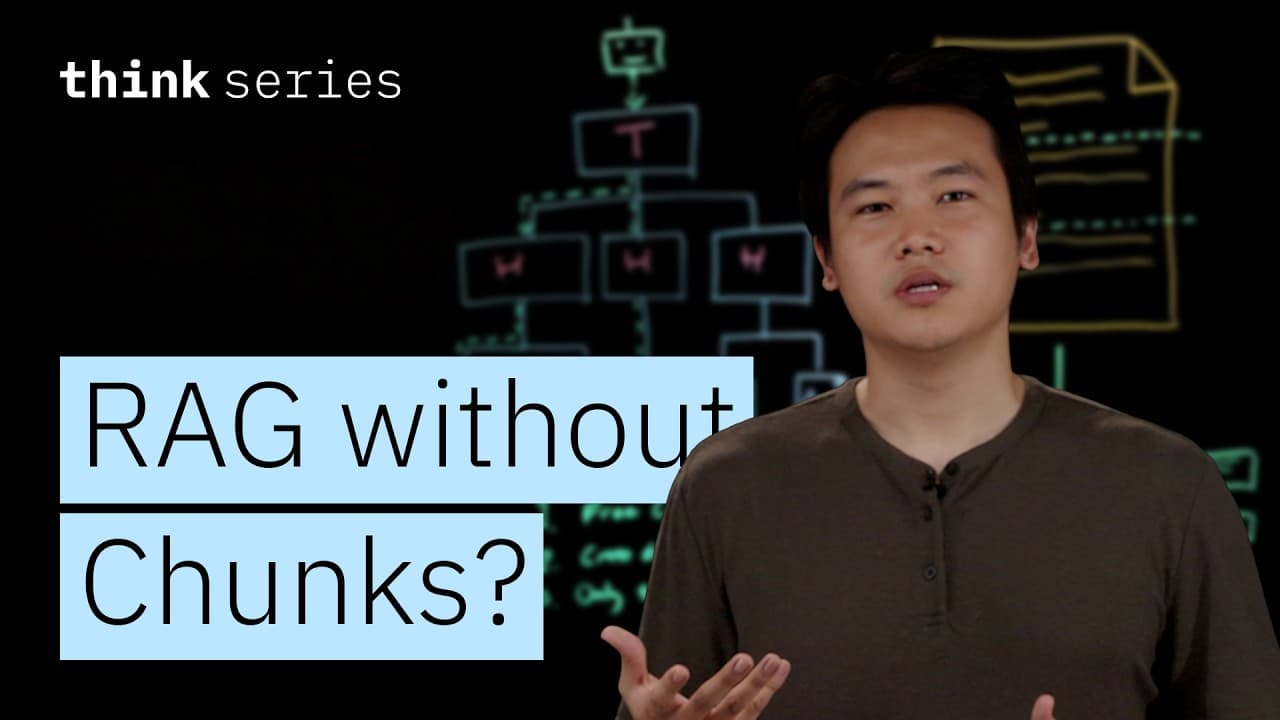
How does chunkless RAG use document structure to answer
TL;DR
Chunkless RAG keeps the document tree intact and lets the model reason over sections to locate the answer, then reads only the most relevant parts. It preserves headings and paths, enabling cross section reasoning and location-aware context while avoiding fragmentation caused by flat chunking. This improves accuracy for long, structured documents.
Transcript
Say you hand a model a 200-page annual report and ask it one specific question, something like, what changed in the revenue recognition policy this year, and where does the report explain why? That's a normal question. A person who knows the document could answer it in about two minutes. They'd flip to the right section and read it. But watch what ... Read More
Key Insights
- Chunkless RAG uses the document tree instead of chunking into flat pieces.
- The agent reads by sections, preserving headings and paths to maintain context.
- Structure-aware retrieval allows cross-section questions to be answered without losing relationships.
- Traditional chunking can separate related content and break context.
- Maintaining structure enables the model to navigate to the right material efficiently.
- Docling reconstructs the document structure from PDFs to enable this approach.
- The method trades some latency for higher accuracy on long, organized documents.
- A combined approach can use similarity search for initial narrowing and structure reasoning for precision.
- More videos from this channel:
- More from this channel: IBM Technology
Install to Summarize YouTube Videos and Get Transcripts
Explore YouTube Video Summarizer or Get YouTube Transcript Extractor
Questions & Answers
Q: How to implement chunkless RAG in a system that handles long structured documents
Chunkless RAG is implemented by first reconstructing the document as a tree with sections and subsections, keeping headings and reading order. The model then reasons along the path of the document structure to locate the right section, reading only necessary parts. This preserves context and enables cross-reference navigation, improving accuracy for multi section questions.
Q: What is the advantage of keeping the document tree versus chunking it
Keeping the document tree preserves the original relationships between sections, headings, and tables. The model can follow the path through the structure to locate the answer, reducing fragmentation and misalignment that occurs when content is flattened into small chunks. Context remains attached to its structural metadata.
Q: Why is Docling important for chunkless RAG
Docling provides the reconstruction of PDFs into a clean structured tree with real sections and headings, preserving reading order and table formats. This structured object allows the agent to navigate the document directly, apply summaries to sections, and perform multi section reasoning without losing contextual links.
Q: How does structure-based reasoning improve accuracy
Structure-based reasoning keeps the relationship between sections, subsections, and tables intact, making it possible to answer questions that depend on how information is organized. The model can read a section, follow references, and then move to related parts, producing cleaner, more grounded answers.
Q: What is a typical trade-off of chunkless RAG
The main trade-off is increased latency and more back and forth between the model and the document structure. Since the agent reasons through the tree rather than performing a single similarity search, there are more steps and calls, but the results are typically more precise for structured documents.
Q: When should you prefer similarity search over structure-based retrieval
Similarity search is effective for large volumes of unstructured or loosely connected text where a quick retrieval of relevant fragments suffices. It remains useful for fuzzy queries across many documents, whereas structure-based retrieval shines on long organized documents where exact relationships and sections matter.
Q: Can both methods be used together
Yes, in real systems you can use similarity search to identify the most relevant document and then apply structure-based navigation inside that document. This hybrid approach leverages fast rough matching with precise, structure-grounded reasoning to maximize accuracy and efficiency.
Q: What problem does chunkless RAG aim to solve with document structure
Chunkless RAG aims to solve the loss of context and disjointed reasoning that happens when documents are chunked. By reasoning over the document tree and maintaining section headings, paths, and relationships, it enables accurate answers for questions that span multiple parts of a document without losing structural context.
Summary & Key Takeaways
-
Chunkless RAG preserves document structure rather than flattening it into chunks, enabling the model to navigate by headings and sections. This approach provides context from the correct part of the document and supports multi-section reasoning when the answer spans different areas.
-
The method relies on a tree that outlines sections and subsections, with each part carrying a short summary to guide the model to the right material. It enables targeted reading and reduces the risk of disjointed or invented content.
-
The trade off is increased complexity and latency because reasoning over structure requires more back and forth with the model. It also depends on having a clean structure and a capable tool to reconstruct it from PDFs, like Docling.
Read in Other Languages (beta)
Share This Summary 📚
Summarize YouTube Videos and Get Video Transcripts with 1-Click
Try YouTube Summary with ChatGPT & Claude or YouTube Transcript Generator
Explore More Summaries from IBM Technology 📚




Summarize YouTube Videos and Get Video Transcripts with 1-Click
Try YouTube Summary with ChatGPT & Claude or YouTube Transcript Generator