How to Evaluate AI Outputs Using LLM Judges
TL;DR
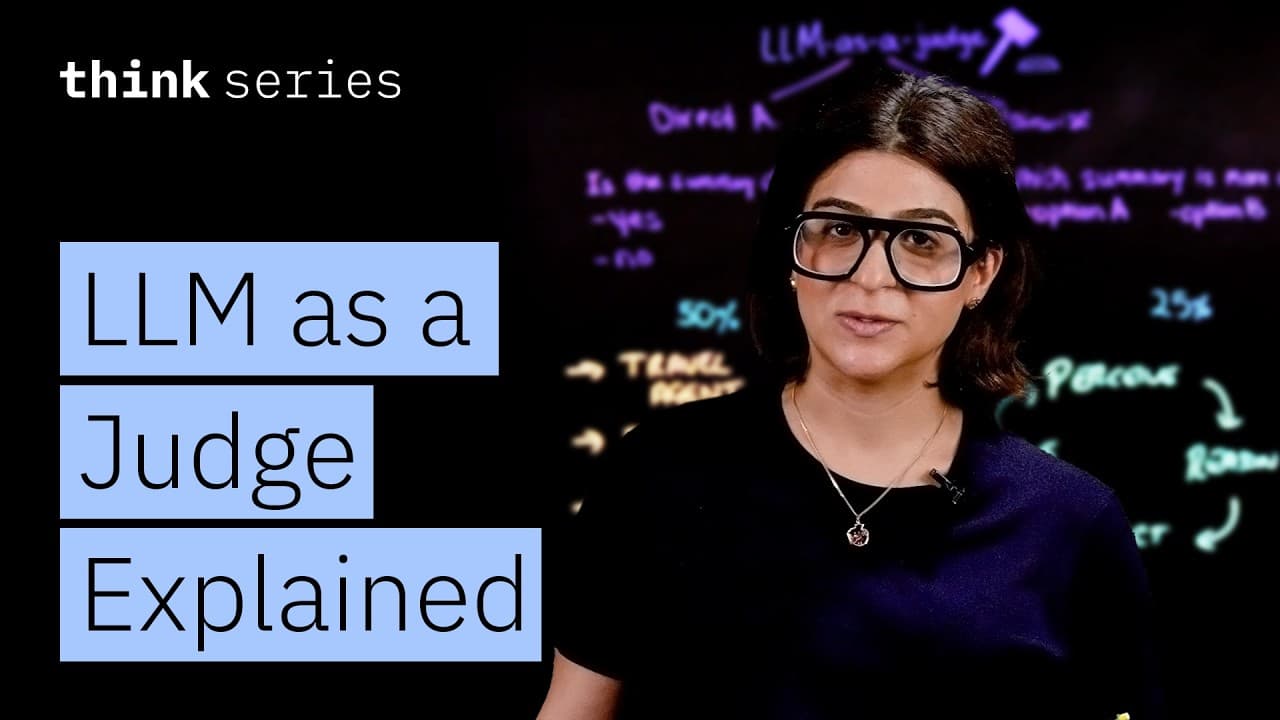
LLMs can evaluate outputs at scale by direct assessment or pairwise comparison, offering flexible, reference-free evaluation while noting biases. Use a rubric for direct assessment or compare two options for ranking, and consider combining approaches for better results. Frameworks like EvalAssist illustrate user preferences and task dependence in choosing methods.
Transcript
How can you evaluate all of the texts that AI spits out? Traditional metrics might not cut it for your task, and manual labeling takes a really long time. Enter LLM as a judge or LLMs judging other LLM outputs. If you've ever manually tried labeling hundreds of outputs, whether it be chatbot replies or summaries, you know that it's a lot of work. N... Read More
Key Insights
- Direct assessment hinges on a rubric to measure criteria like coherence or clarity, enabling transparent scoring.
- Pairwise comparison asks which option is better, producing relative rankings that work well for subjective tasks.
- EvalAssist research shows user preferences split between direct assessment and pairwise comparison, with a portion favoring a mixed approach.
- LLM evaluation scales to large volumes, offering faster feedback than manual labeling while preserving structured outputs.
- Criteria refinement is possible with LLM judges, allowing rubrics and prompts to adapt as data evolves.
- Biases such as positional bias can skew judgments, requiring checks like positional swaps to test robustness.
- Verbosity bias may favor longer outputs, highlighting the need to balance length with content quality.
- Self-enhancement bias occurs when models favor outputs they generated, not necessarily the best quality.
- More videos from this channel:
- More from this channel: IBM Technology
Install to Summarize YouTube Videos and Get Transcripts
Explore YouTube Video Summarizer or Get YouTube Transcript Extractor
Questions & Answers
Q: What is direct assessment in LLM judging and how does it work?
Direct assessment is a method where you design a rubric and evaluate each output against explicit criteria such as coherence and clarity. Outputs are scored according to whether they meet the rubric, enabling straightforward, rule-based judgments. This approach provides strong control over evaluation factors but requires careful, thorough rubric construction and ongoing maintenance as tasks evolve.
Q: How does pairwise comparison differ from direct assessment in LLM evaluation?
Pairwise comparison asks the model to choose the better option between two outputs rather than assigning an absolute score to each. This yields relative rankings and can be more intuitive for subjective qualities. It can be combined with ranking algorithms to scale evaluations across many outputs, but it may introduce biases if comparisons favor certain patterns or styles.
Q: What is EvalAssist and what did user research reveal about evaluation strategies?
EvalAssist is a framework used for evaluating outputs with LLMs. User research shows about half of participants prefer direct assessment for clear and controllable rubric criteria, about a quarter prefer pairwise comparison for subjective tasks, and the remainder favor a combined approach. The choice depends on the task and user needs.
Q: What are the main benefits of using LLMs as judges for evaluation?
The primary benefits are scalability, flexibility, and nuance. LLM judges can evaluate hundreds or thousands of outputs quickly, adapt rubrics as criteria shift, and assess subjective qualities without a reference. This makes evaluation more efficient and adaptable to changing requirements, enabling comprehensive analysis across large datasets.
Q: What are common biases in LLM judging and how can they be mitigated?
Common biases include positional bias, where the model favors earlier options, verbosity bias favoring longer outputs, and self-enhancement bias where the model prefers its own outputs. Mitigation strategies involve running positional swaps, controlling for length, and using independent evaluation prompts to reduce self-generated content influence.
Q: Why is a reference-free evaluation important in some contexts?
Reference-free evaluation is important when there is no ground truth for comparison or when the task is highly subjective. It enables assessing naturalness, coherence, and usefulness without requiring a fixed reference text. This flexibility can capture nuances that traditional metric-based approaches might miss.
Q: How can direct assessment and pairwise comparison be combined effectively?
A combined approach uses direct assessment to enforce compliance with a rubric while applying pairwise comparison to rank outputs for subjective criteria. This synergy allows stable, transparent evaluation with the ability to refine prompts and criteria over time, improving both reliability and adaptability across diverse tasks.
Q: What should be considered when choosing an evaluation strategy for a new task?
Consider the task type (objective vs subjective), the need for rubric control, the volume of outputs, and how criteria may evolve. For objective tasks with clear criteria, direct assessment may suffice, while for subjective tasks or large datasets, a mix of direct assessment and pairwise comparison with adaptive prompts often yields better results.
Summary & Key Takeaways
-
Direct assessment relies on a predefined rubric to score outputs on coherence or clarity, enabling control but potentially requiring extensive rubric design and updates as tasks evolve.
-
Pairwise comparison contrasts two outputs to determine which is better, producing rankings that can guide selection when many options exist, though it may introduce bias and requires careful aggregation.
-
A combined approach can leverage the strengths of both methods, using direct assessment for compliance and pairwise comparison for ranking to achieve scalable, nuanced evaluation while mitigating single-method limitations.
Read in Other Languages (beta)
Share This Summary 📚
Summarize YouTube Videos and Get Video Transcripts with 1-Click
Try YouTube Summary with ChatGPT & Claude or YouTube Transcript Generator
Explore More Summaries from IBM Technology 📚






Summarize YouTube Videos and Get Video Transcripts with 1-Click
Try YouTube Summary with ChatGPT & Claude or YouTube Transcript Generator