How does heat treatment change steel properties
TL;DR
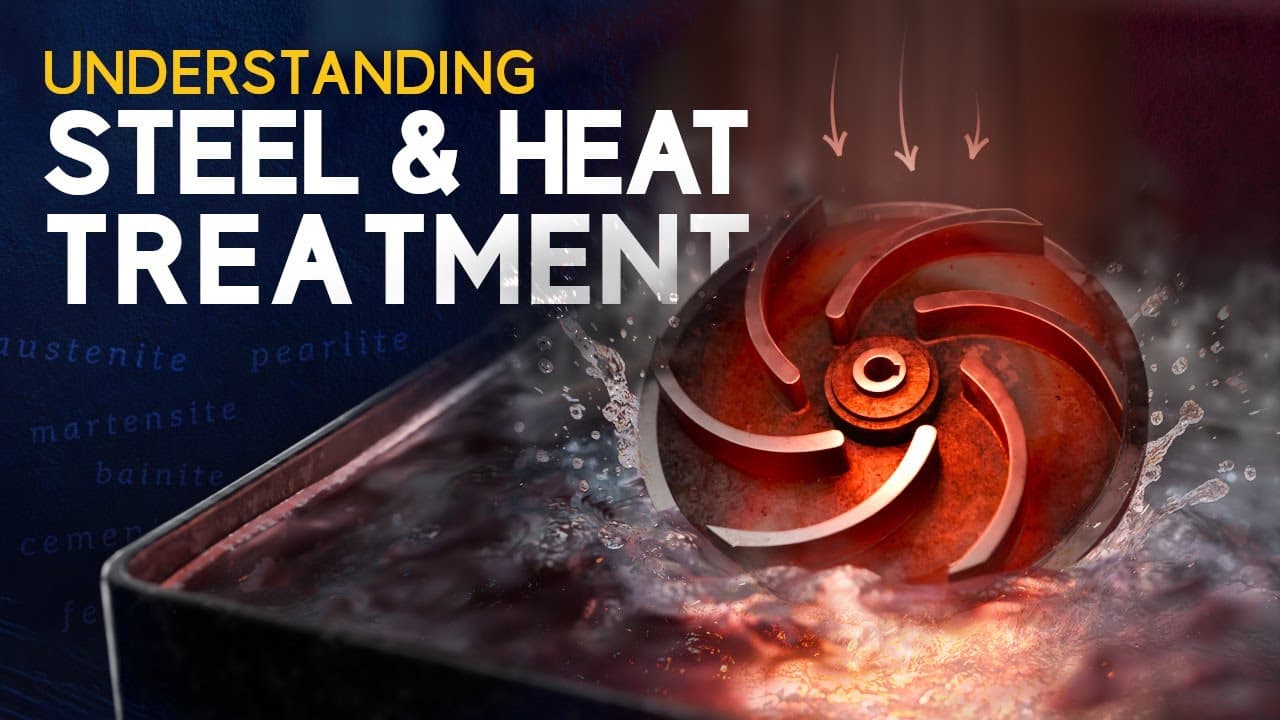
Heat treatment tunes steel properties by altering its microstructure through controlled heating and cooling. The process moves iron-carbon phases between ferrite, austenite, pearlite, and cementite, and can create diffusionless martensite for high hardness. Time temperature strategies like TTT and CCT diagrams guide these transformations to achieve strength, toughness, or wear resistance.
Transcript
If there's one material that defines modern engineering, it's steel. Accounting for over 90% of global metal production, the overwhelming dominance of steel comes not just from its strength and affordability, but from something unique: its ability to be transformed through heat treatment. Take these three steel parts. The first is soft and duct... Read More
Key Insights
- Steel properties are controlled by heat treatment that changes its microstructure without altering composition.
- Iron changes phase as temperature rises, forming ferrite and austenite at specific temperatures, which then transform upon cooling.
- Carbon content shifts transformation temperatures and creates cementite or allows austenite to hold more carbon, forming phases like pearlite.
- Pearlite forms from austenite at the eutectoid point in eutectoid steels, producing layered ferrite and cementite.
- The phase diagram shows how carbon amount affects phases and transformation temperatures during heating and cooling.
- TTT diagrams map how quickly austenite transforms into ferrite and cementite at fixed temperatures, revealing diffusion-based transformations.
- Martensite appears when austenite is cooled rapidly, trapping carbon and forming a diffusionless, hard, and brittle structure.
- CCT diagrams model continuous cooling, showing how real-world processes yield different microstructures than single temperature holds.
- More videos from this channel:
- More from this channel: The Efficient Engineer
Install to Summarize YouTube Videos and Get Transcripts
Explore YouTube Video Summarizer or Get YouTube Transcript Extractor
Questions & Answers
Q: A real search query question about the video (e.g. 'How to...', 'What is...', 'Why does...', 'When should...'). Question 1
How does carbon content influence the phases that form in steel during heat treatment and what structures result from low, medium, and high carbon levels. The answer involves ferrite, austenite, pearlite, and cementite, and explains how carbon solubility in ferrite is limited while austenite can hold more carbon. This drives diffusion and phase formation during heating and cooling.
Q: Question 2
Why is martensite formed during rapid cooling and what makes it so hard yet brittle. Martensite forms when austenite cools so fast that carbon atoms cannot diffuse out to form cementite, forcing a diffusionless transformation to a body-centered tetragonal structure, which strengthens the steel but reduces ductility.
Q: Question 3
What is the significance of the eutectoid point in steel heat treatment and how does it define the final microstructure. At this point, austenite transforms into ferrite and cementite to form pearlite, and steels near this composition are called eutectoid steels, with final microstructure depending on cooling path.
Q: Question 4
How do phase diagrams aid in predicting steel microstructures during heat treatment. Phase diagrams show equilibrium conditions and help determine which phases form at different temperatures and carbon contents, guiding cases like pearlite formation and cementite distribution in hypoeutectoid and hypereutectoid steels.
Q: Question 5
What roles do diffusion and diffusionless transformations play in heat treatment outcomes. Diffusion governs most phase changes as atoms move to form new phases, while diffusionless transformations like martensite occur without long-range atom movement, creating rapid and distinct microstructures.
Q: Question 6
What is the difference between TTT and CCT diagrams and how do they influence practical heat treatment. TTT diagrams assume isothermal holds to map transformations over time, while CCT diagrams model continuous cooling, showing how real processes yield different phase mixtures such as bainite or different pearlite structures.
Q: Question 7
How do bainite and pearlite differ in microstructure and properties. Bainite forms as a fine ferrite and cementite mixture formed at specific lower temperatures with irregular morphology, offering a balance of strength and toughness, while pearlite is a layered ferrite-cementite structure whose fineness or coarseness depends on cooling rate.
Q: Question 8
Why is Protolabs mentioned in the description and what is its relevance to the topic. The description includes a link to make an instant manufacturing quote, indicating a practical application path for steel components produced with heat-treated microstructures in real parts and tooling contexts.
Summary & Key Takeaways
-
Heat treatment of steel alters microstructure by changing phase content, enabling soft ductile, hard brittle, or strong tough outcomes from the same composition.
-
Phase transformations depend on carbon content and temperature; ferrite, austenite, pearlite, and cementite form in distinct ways, controlled by diffusion and equilibrium conditions.
-
Practical heat treatments use phase diagrams and time temperature relationships to tailor properties, including diffusionless martensite and combinations like bainite for strength and toughness.
Read in Other Languages (beta)
Share This Summary 📚
Summarize YouTube Videos and Get Video Transcripts with 1-Click
Try YouTube Summary with ChatGPT & Claude or YouTube Transcript Generator
Explore More Summaries from The Efficient Engineer 📚






Summarize YouTube Videos and Get Video Transcripts with 1-Click
Try YouTube Summary with ChatGPT & Claude or YouTube Transcript Generator