How Do Tresca, von Mises, Rankine, Coulomb-Mohr, and Modified Mohr Predict Material Failure?
TL;DR
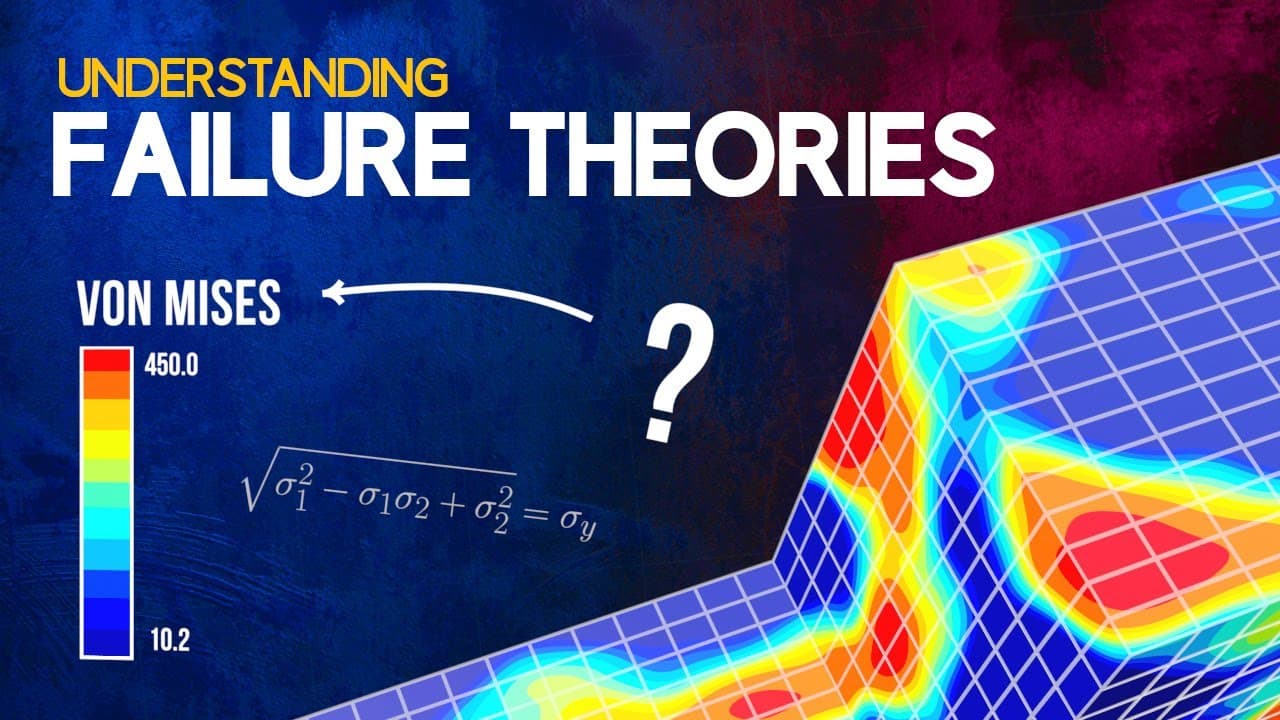
Failure theories predict static material failure by comparing the three principal stresses at a point with measured properties such as yield strength or ultimate strength. Ductile failure is associated with the onset of plastic deformation, while brittle failure occurs at fracture. Because no method works universally, engineers choose among criteria such as Tresca, von Mises, Rankine, Coulomb-Mohr, and Modified Mohr. Read on to understand how the major criteria differ.
Transcript
We know that when we apply loads to an object, like this bracket, if we keep increasing the magnitude of the load, at some point the material will fail. But how can we predict when static failure will occur? What level do the stresses in the object need to reach for it to fail? First we need to define what failure is. For ductile materials failure ... Read More
Key Insights
- Failure theories work by comparing the stress state in the object being assessed with material properties that are easy to determine from a uniaxial test, such as yield or ultimate strength. Since stress state at a point is described by three principal stresses, most theories are functions of principal stresses and material strength.
- There is no universally applicable method for predicting failure under tri-axial stress. Engineers instead select the most suitable one from a range of failure theories, each known from experimentation to work relatively well under certain circumstances, with ductile theories generally not applicable to brittle materials and vice versa.
- Hydrostatic stresses do not cause yielding in ductile materials. This is the key experimental observation that ductile failure theories must capture, because the mechanism causing ductile yielding is shear deformation, and a hydrostatic stress state has no shear stresses at all, so that component can be very large without contributing to yield.
- The hydrostatic component of a tri-axial stress state is calculated as the average of the three principal stresses, and the deviatoric component is found by subtracting the hydrostatic component from each principal stress. On Mohr's circle, hydrostatic stress shifts the circle horizontally and deviatoric stress changes its radius.
- Maximum Principal Stress theory, also called Rankine theory, says failure occurs when the maximum or minimum principal stress reaches the yield or ultimate strength. It is simple to apply but is not a good theory for ductile materials because it is inconsistent with yielding being independent of hydrostatic stress.
- The Tresca criterion, named after French engineer Henri Tresca and also called maximum shear stress theory, states yielding occurs when maximum shear stress equals the shear stress at yielding in a tensile test. Since tensile shear stress at yield is half the yield strength, the standard principal stress formulation follows.
- The von Mises criterion, also called maximum distortion energy theory, was initially developed by Austrian scientist Richard von Mises and refined by others, giving it the alternative name Maxwell-Huber-Hencky-von Mises theory. The term on the left of its equation is the equivalent von Mises stress, a common finite element analysis output.
- The Tresca yield surface lies entirely inside the von Mises surface, meaning Tresca is the more conservative theory. Assuming principal stresses increase in proportion so stress paths are straight lines, the maximum difference between the two theories can be calculated to be 15.5%, largest for three specific configurations.
Install to Summarize YouTube Videos and Get Transcripts
Explore YouTube Video Summarizer or Get YouTube Transcript Extractor
Questions & Answers
Q: How do failure theories predict when a material will fail?
Failure theories compare the stress state at a point with material properties obtained from a uniaxial test, such as yield strength or ultimate strength. Most express the stress state through the three principal stresses. Because no theory is universally applicable, the appropriate criterion depends on the material and circumstances supported by experiments.
Q: How is failure defined for ductile and brittle materials?
For ductile materials, failure is usually defined as the onset of plastic deformation, which occurs under uniaxial loading when normal stress reaches yield strength. For brittle materials, failure means fracture and occurs when normal stress reaches ultimate strength in a uniaxial test. Their different failure behavior means theories suited to one class usually do not apply to the other.
Q: Why do hydrostatic stresses not cause ductile materials to yield?
Ductile yielding is caused by shear deformation, but a hydrostatic stress state has three equal principal stresses and no shear stress. Hydrostatic stress can therefore be very large without contributing to yielding. Yielding instead depends on the deviatoric stresses that distort the material's shape.
Q: How are hydrostatic and deviatoric stresses calculated?
The hydrostatic component of a tri-axial stress state is the average of its three principal stresses. The deviatoric component is found by subtracting that hydrostatic value from each principal stress. Hydrostatic stress changes volume, whereas deviatoric stress changes shape.
Q: Why is Rankine theory unsuitable for ductile materials?
Maximum Principal Stress theory, also called Rankine theory, predicts failure when the maximum or minimum principal stress reaches the material's yield or ultimate strength. Although simple to apply, it is inconsistent with the experimental observation that ductile yielding is independent of hydrostatic stress. It is therefore not a good failure theory for ductile materials.
Q: What is the Tresca failure criterion?
The Tresca criterion, also called maximum shear stress theory, predicts yielding when maximum shear stress equals the shear stress at yield in a tensile test. For a tri-axial state, maximum shear stress is half the difference between the maximum and minimum principal stresses. Tresca is consistent with the observation that hydrostatic stress does not affect ductile yielding.
Q: What is the von Mises failure criterion?
The von Mises criterion, also called maximum distortion energy theory, predicts yielding when distortion energy equals the distortion energy at yield in a uniaxial tensile test. Its equivalent von Mises stress is commonly reported in finite element analysis. Yielding is predicted when that equivalent stress exceeds the material's yield strength.
Q: How do the Tresca and von Mises criteria compare?
Tresca and von Mises are the two most commonly used failure theories for ductile materials, and both exclude the hydrostatic component while matching experimental data well. The Tresca yield surface lies entirely inside the von Mises surface, making Tresca more conservative. Their maximum difference is 15.5% when principal stresses increase proportionally along straight stress paths.
Summary & Key Takeaways
-
Failure means different things by material class: for ductile materials failure is usually considered to occur at the onset of plastic deformation, and for brittle materials it occurs at fracture. Under uniaxial stress these points are simple, occurring when normal stress reaches yield strength or ultimate strength, but tri-axial stress states make prediction far less straightforward.
-
A tri-axial stress state decomposes into a hydrostatic component that changes volume and a deviatoric component that distorts shape. Hydrostatic stress has three equal principal stresses and no shear stress, so it cannot drive the shear deformation that causes ductile yielding. Any good ductile failure theory must therefore be independent of the hydrostatic component.
-
Tresca states yielding occurs when maximum shear stress equals the shear stress at yielding in a tensile test, while von Mises states yielding occurs when distortion energy equals the distortion energy at tensile yielding. Both ignore hydrostatic stress, both match experimental data well, and the maximum difference between them is 15.5%.
Read in Other Languages (beta)
Share This Summary 📚
Summarize YouTube Videos and Get Video Transcripts with 1-Click
Try YouTube Summary with ChatGPT & Claude or YouTube Transcript Generator
Explore More Summaries from The Efficient Engineer 📚
Summarize YouTube Videos and Get Video Transcripts with 1-Click
Try YouTube Summary with ChatGPT & Claude or YouTube Transcript Generator