How to design bolted joints for preload strength
TL;DR
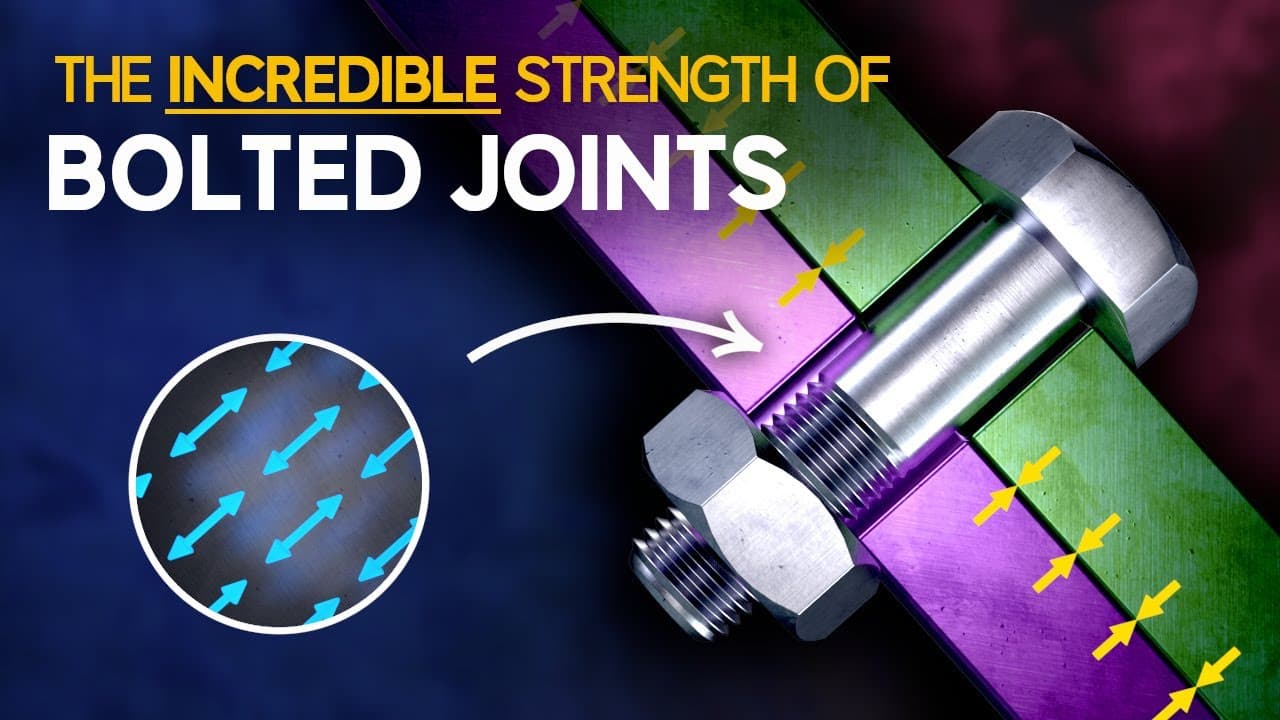
Preload creates a tensile force in the fastener that tightens the joint, increasing strength and fatigue life. In tension joints, preload transfers most load to the joined members, while in shear joints preload generates friction to resist slipping. Torque, turn of nut, and ultrasonic methods are common ways to control preload, each with varying accuracy.
Transcript
Nuts and bolts are extremely simple pieces of hardware that are actually quite incredible. Not only are they really cheap, they create joints that can be disassembled and reassembled multiple times, and a well designed joint can transmit huge forces without failing. So it's no surprise that bolted joints are used in everything from the most bas... Read More
Key Insights
- Preload is the tensile force developed in a fastener when the nut is tightened, which clamps joined parts together.
- The clamping force from preload carries most of an applied load in tension joints when the joint is stiffer than the bolt, reducing bolt stress.
- In shear joints, preload generates friction that resists sliding, allowing the bolt to carry little to no direct shear load.
- Bearing contact and slip resistance depend on friction and clamping force, determining if a joint slips or bears directly.
- Two shear planes (double shear) halve bolt shear stress compared to a single plane, enabling higher shear loads.
- Eccentric loads create additional shear and bending moments that must be assessed for fastener safety.
- Preload targets are often set to around 70 percent of the bolt yield strength to balance strength and part safety.
- Torque, turn of nut, and ultrasonic methods are used to control preload, each with tradeoffs in accuracy and practicality.
Install to Summarize YouTube Videos and Get Transcripts
Explore YouTube Video Summarizer or Get YouTube Transcript Extractor
Questions & Answers
Q: A real search query question about the video (e.g. 'How to...', 'What is...', 'Why does...'). Question 1
What is preload in bolted joints and why does it matter for joint performance Preload is the tensile force generated in a bolt as the nut is torqued, pulling the bolt threads and clamping the joined parts together. This clamping stores potential energy in the bolt and the joint, improving load distribution, reducing immediate separation under load, and significantly enhancing fatigue life by ensuring most external loads are carried by the stiff joined members rather than the bolt itself.
Q: Question 2
How does preload affect tension joints when external load is applied In tension joints the external load tends to pull components apart, but preload keeps them in contact. Most of the applied load is taken by the joined members as the bolt remains in tension. Only when clamping force is overcome does the bolt carry the rest of the load, potentially leading to bolt fracture or joint failure.
Q: Question 3
What happens in shear joints with preload and why is friction important In shear joints the load acts perpendicular to the bolt axis. Preload creates a clamping force that produces friction between joined surfaces, which resists sliding. If the frictional force exceeds the applied shear, the bolt experiences little direct shear load and is mainly loaded by the preload tensile force.
Q: Question 4
What are common methods to control preload and their tradeoffs Torque tightening is the most common method to achieve a target preload, but friction, lubrication, and thread conditions introduce variability, often within 25 percent of the target. Turn of nut and angle tightening offer alternatives with different levels of control, which can be more predictable in some scenarios.
Q: Question 5
Why is double shear often preferred over single shear in bolts Double shear distributes the resistance across two shear planes, effectively halving the shear stress in the bolt and enabling the joint to carry larger shear loads without increasing bolt size or risking failure at a single plane.
Q: Question 6
What role does joint stiffness play in load distribution and bolt design The relative stiffness of joined members versus the bolt determines how much external load is carried by the bolt. When joined parts are stiffer, more load is transferred through clamping force changes, reducing bolt load and improving fatigue life, particularly in cyclic loading.
Q: Question 7
How is preload linked to fatigue life and why is it beneficial Preload reduces the stress range experienced by the bolt by keeping clamping forces high, so the bolt undergoes smaller fluctuations during loading. This smaller stress range improves fatigue life and reduces the likelihood of bolt or joint failure under cyclic operation.
Q: Question 8
What is the recommended preload level relative to bolt yield strength and why The preload is often set to around 70 percent of the bolt yield strength to balance achieving high clamping force while avoiding material damage to the parts or bolt. This target helps ensure reliable performance under anticipated loads while maintaining part integrity.
Summary & Key Takeaways
-
Preload stiffens joints by pulling components together, enabling higher load capacity and better fatigue resistance.
-
In tension joints preload reduces clamping loss under load, shifting more stress to the joined parts as stiffness differences dictate load distribution.
-
In shear joints preload creates a frictional force that resists sliding, and designs like single vs double shear change bolt stress distribution.
Read in Other Languages (beta)
Share This Summary 📚
Summarize YouTube Videos and Get Video Transcripts with 1-Click
Try YouTube Summary with ChatGPT & Claude or YouTube Transcript Generator
Explore More Summaries from The Efficient Engineer 📚





Summarize YouTube Videos and Get Video Transcripts with 1-Click
Try YouTube Summary with ChatGPT & Claude or YouTube Transcript Generator