Understanding GD&T
TL;DR
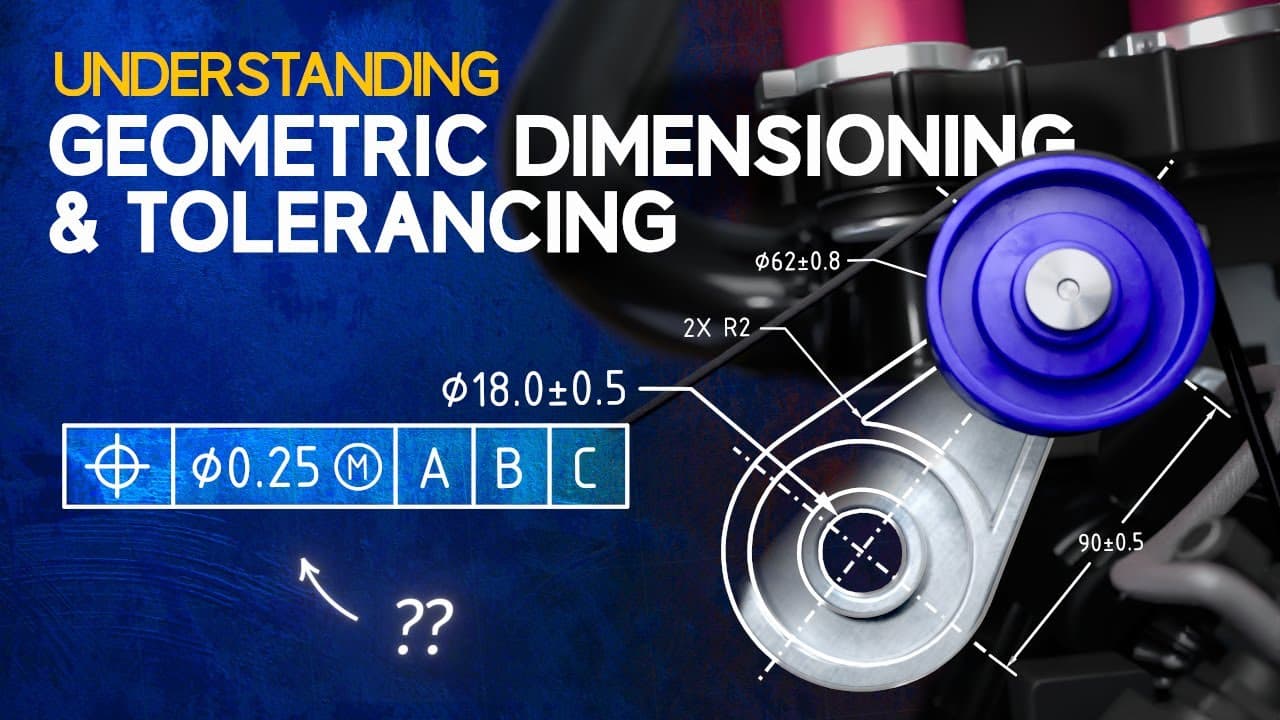
Geometric Dimensioning and Tolerancing (GD&T) is a method that allows designers to control tolerances in a way that reflects the intended function of a part, using 14 different geometric characteristics.
Transcript
Designing and building any kind of mechanical system is a complex process that needs to properly account for many different parameters, like cost, materials, and manufacturing techniques. But one of the key challenges is making sure that all of the parts, once manufactured, will fit together and function as intended. And that's why tolerancing ... Read More
Key Insights
- 😮 Designing and building mechanical systems require accounting for various parameters, including cost, materials, and manufacturing techniques.
- 📐 Tolerancing is a crucial part of the mechanical design process, ensuring that all parts fit together and function properly.
- 💡 Geometric dimensioning and tolerancing (GD&T) allows for better communication of design requirements by controlling 14 different geometric characteristics.
- 🔍 Geometric tolerances are applied to features, including surfaces, holes, or slots, rather than dimensions.
- 📝 Feature control frames contain symbols, tolerance values, datums, and modifiers to fully control geometric characteristics.
- 🔁 Datums are used as reference surfaces during inspection to locate features accurately.
- ⚙️ Orientation tolerances, such as parallelism and angularity, control the angles between features.
- 📏 Profile tolerances are versatile and can control form, orientation, and location of features simultaneously.
Install to Summarize YouTube Videos and Get Transcripts
Explore YouTube Video Summarizer or Get YouTube Transcript Extractor
Questions & Answers
Q: How does GD&T differ from dimensional tolerancing?
GD&T differs from dimensional tolerancing by allowing designers to control 14 different geometric characteristics instead of just dimensions, reflecting the intended function of the part.
Q: What are the five categories of geometric characteristics that GD&T controls?
The five categories of geometric characteristics controlled by GD&T are Form, Orientation, Location, Profile, and Runout.
Q: How are geometric tolerances assigned to features in GD&T?
Geometric tolerances are assigned to features using feature control frames, which contain all the information needed to fully control a particular geometric characteristic.
Q: How is the Envelope Principle used in GD&T?
The Envelope Principle, also known as GD&T Rule Number 1, establishes a boundary of perfect form at the maximum material condition (MMC), ensuring that the surface or surfaces of a regular feature of size do not extend beyond this envelope.
Q: How are runout tolerances used in GD&T?
Runout tolerances, such as circular runout and total runout, are used to control the eccentricity of a surface relative to a particular axis, ensuring proper functioning of rotating parts like shafts.
Summary & Key Takeaways
-
GD&T is an important part of the mechanical design process, ensuring that all parts fit together and function as intended.
-
GD&T complements dimensional tolerancing by allowing designers to control 14 different geometric characteristics.
-
GD&T uses feature control frames to assign tolerances to features and allows for better communication of design requirements.
Read in Other Languages (beta)
Share This Summary 📚
Summarize YouTube Videos and Get Video Transcripts with 1-Click
Try YouTube Summary with ChatGPT & Claude or YouTube Transcript Generator
Explore More Summaries from The Efficient Engineer 📚
Summarize YouTube Videos and Get Video Transcripts with 1-Click
Try YouTube Summary with ChatGPT & Claude or YouTube Transcript Generator