What Is a Truss and How Is It Analyzed in Structures?
TL;DR
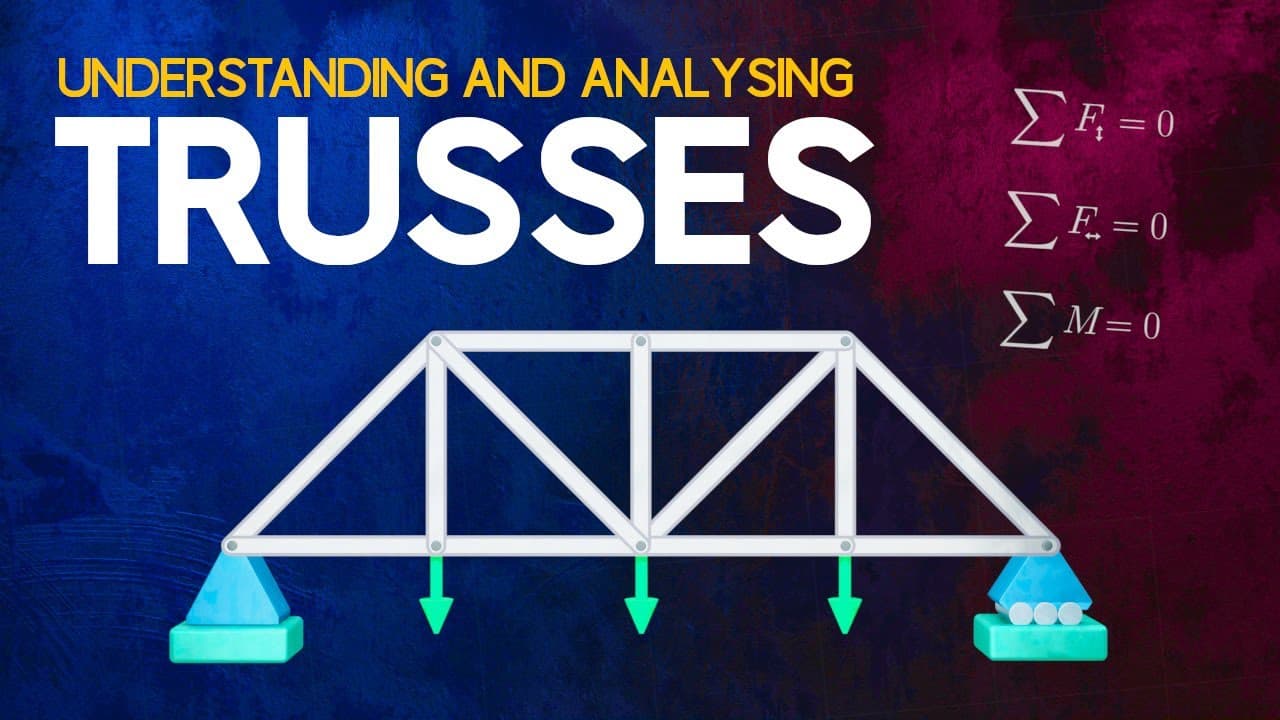
A truss is a rigid structure composed of straight members joined by pinned connections, enabling stable and efficient design. Analysis involves two key assumptions: loads are applied only at the joints, and members can only carry axial loads. Common methods for analyzing trusses include the Method of Joints and the Method of Sections.
Transcript
Trusses are everywhere. They are used in bridges, antenna towers, cranes. Even in parts of the International Space Station. And for good reason. They allow us to create strong structures while using materials in a very efficient and cost-effective way. So what exactly is a truss? It is essentially a rigid structure made up of a collection of straig... Read More
Key Insights
- 🏗️ Trusses are commonly used in various structures, such as bridges, towers, and cranes, due to their efficiency and cost-effectiveness.
- 🔩 Trusses are rigid structures made up of straight members connected by pinned joints, allowing for rotation at the joints.
- 📏 Load is only applied at the joints of a truss, and the members can only carry axial loads, simplifying the truss analysis.
- 🔀 Frames, unlike trusses, don't have pinned joints and can carry bending moments, as well as have loads applied directly to their members.
- 🔺 Triangular shapes are stable and efficient for truss designs, while four-sided shapes are not stable and require diagonal bracing to form triangles.
- 🔩 There are popular truss designs, such as the Fink roof truss, that have specific names and carry loads in different ways.
- 🌉 Planar trusses, with members located in the same plane, can be analyzed as two-dimensional structures, even if they appear three-dimensional.
- ✅ The Method of Joints and the Method of Sections are two main methods used to determine the internal forces in truss members and ensure structural stability.
Install to Summarize YouTube Videos and Get Transcripts
Explore YouTube Video Summarizer or Get YouTube Transcript Extractor
Questions & Answers
Q: What are the two important assumptions for a structure to be considered a truss?
The two important assumptions for a structure to be considered a truss are pinned joints, where all joints can rotate, and loads only at the joints.
Q: How do trusses differ from frames?
Trusses differ from frames in that trusses have pinned joints and loads only at the joints, while frames can have bending moments and loads directly applied to the members.
Q: Why is the triangle a stable shape for building trusses?
The triangle is a stable shape for building trusses because when a load is applied, the angles of the triangle cannot change if the length of each member stays the same.
Q: What are zero force members in a truss?
Zero force members are members in a truss that do not carry any loads and are typically included to provide stability or prevent buckling of other members under compression.
Q: What methods can be used to determine the forces in truss members?
The two main methods to determine forces in truss members are the Method of Joints, which analyzes forces at each joint, and the Method of Sections, which analyzes forces by making an imaginary cut through the truss members.
Q: What are some popular truss designs for bridges?
Some popular truss designs for bridges include the Howe, Pratt, and Warren trusses, each with different configurations of tension and compression members.
Q: Can trusses be analyzed in three dimensions?
Yes, trusses can be analyzed in three dimensions, and this type of truss is called a space truss, which can be assessed using methods like the Method of Joints and the Method of Sections with additional equilibrium equations.
Summary & Key Takeaways
-
Trusses are rigid structures made up of straight members that are used in bridges, towers, and other structures.
-
Two assumptions for a structure to be considered a truss are pinned joints and loads only at the joints.
-
Trusses can be designed and analyzed using methods such as the Method of Joints and the Method of Sections.
Read in Other Languages (beta)
Share This Summary 📚
Summarize YouTube Videos and Get Video Transcripts with 1-Click
Try YouTube Summary with ChatGPT & Claude or YouTube Transcript Generator
Explore More Summaries from The Efficient Engineer 📚
Summarize YouTube Videos and Get Video Transcripts with 1-Click
Try YouTube Summary with ChatGPT & Claude or YouTube Transcript Generator