What Is the Area Moment of Inertia and Its Importance?
TL;DR
The area moment of inertia quantifies a cross-section's resistance to bending, with greater stiffness achieved by spreading material further from the bending axis. It is essential in beam and column analysis, influencing resistance to bending and critical buckling load. It can be calculated using integration or through the parallel axis theorem for different reference axes.
Transcript
Let's say we have a plank of wood which we would like to use to cross a canal. It has a rectangular cross-section and so we could either use it like we have done here, or we could rotate it onto its side, like this. Intuitively we can tell that the plank will be stiffer if the load is applied to the shorter side of the cross-section. Some cross-sec... Read More
Key Insights
- 💡 Cross-sections with material located further from the bending axis are stiffer and better at resisting bending, as quantified by the area moment of inertia. The I-beam is a highly efficient cross-section for construction due to its distribution of material away from the bending axis.
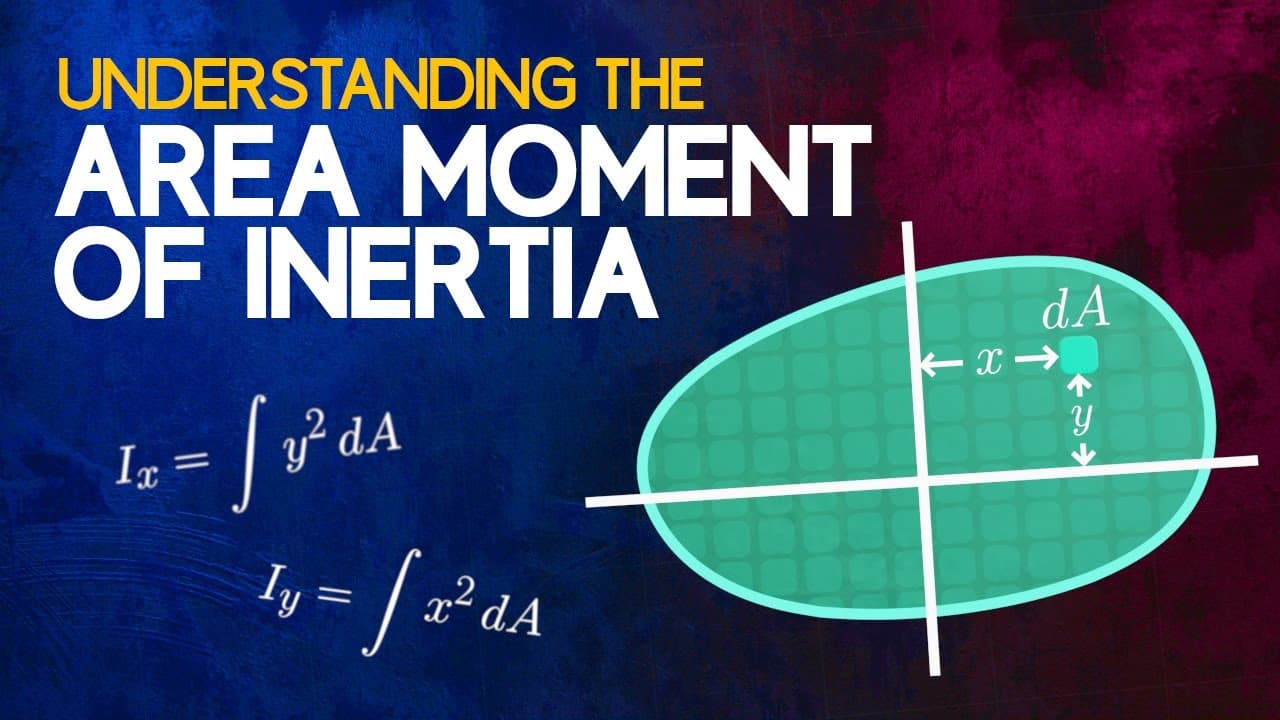
- 💪 The area moment of inertia (I) is calculated by summing up the values for all small elements of a cross-section. It can be calculated for both the X and Y axes using integration, or for centroidal axes using provided equations for common shapes.
- 🔁 The parallel axis theorem allows for the calculation of the area moment of inertia for any axis parallel to a centroidal axis by summing the centroidal axis' moment of inertia and the product of cross-sectional area and squared distance between the axes.
- ➕ Area moments of inertia can be added or subtracted to calculate the value for composite shapes. The parallel axis theorem is essential for calculating area moments of inertia for irregular composite cross-sections.
- 🔀 The area moment of inertia is not to be confused with the mass moment of inertia, which describes a body's resistance to changes in rotational velocity.
- 🚀 The area moment of inertia is crucial for analyzing beams and columns as it quantifies the resistance to bending (flexural rigidity) and critical buckling load. The radius of gyration and polar moment of inertia are also important parameters for columns and torsion, respectively.
- 🔄 Moments of inertia can be calculated for rotated axes using transformation equations or Mohr's circle, similar to how stresses are transformed. Principal moments of inertia, the maximum and minimum values, can be determined using Mohr's circle for any angle of rotation.
Install to Summarize YouTube Videos and Get Transcripts
Explore YouTube Video Summarizer or Get YouTube Transcript Extractor
Questions & Answers
Q: How does the distribution of material affect the area moment of inertia in a cross-section?
The distribution of material plays a crucial role in the area moment of inertia, with greater spread from the bending axis resulting in increased resistance to bending.
Q: What is the purpose of the area moment of inertia in engineering analysis?
The area moment of inertia is an essential parameter for analyzing beams and columns, as it helps determine factors like deflection, flexural rigidity, and critical buckling load.
Q: How can the parallel axis theorem be used to calculate the area moment of inertia for non-centroidal axes?
The parallel axis theorem allows for the adjustment of the area moment of inertia by summing the moment of inertia of the centroidal axis and the product of cross-sectional area and the squared distance between both axes.
Q: What is the relationship between the area moment of inertia and the radius of gyration?
The radius of gyration represents the theoretical distance at which the entire area of a cross-section can be condensed into a narrow strip with the same moment of inertia, and it is related to the area moment of inertia in the analysis of columns.
Q: How can the area moment of inertia be calculated for rotated axes?
The transformation equations and the product of inertia equation can be used to calculate the moments of inertia for rotated axes, similar to the transformation of stresses, with the use of Mohr's circle to find the principal moments of inertia.
Summary & Key Takeaways
-
The area moment of inertia quantifies a cross-section's resistance to bending, with more material spread from the bending axis resulting in greater stiffness.
-
Calculating the area moment of inertia involves integrating the small elements of a cross-section in relation to a reference axis.
-
The parallel axis theorem allows for the calculation of the area moment of inertia for axes parallel to centroidal axes, while the perpendicular axis theorem is used for twisting situations.
Read in Other Languages (beta)
Share This Summary 📚
Summarize YouTube Videos and Get Video Transcripts with 1-Click
Try YouTube Summary with ChatGPT & Claude or YouTube Transcript Generator
Explore More Summaries from The Efficient Engineer 📚




Summarize YouTube Videos and Get Video Transcripts with 1-Click
Try YouTube Summary with ChatGPT & Claude or YouTube Transcript Generator