How Do Stress and Strain Describe Deformation?
TL;DR
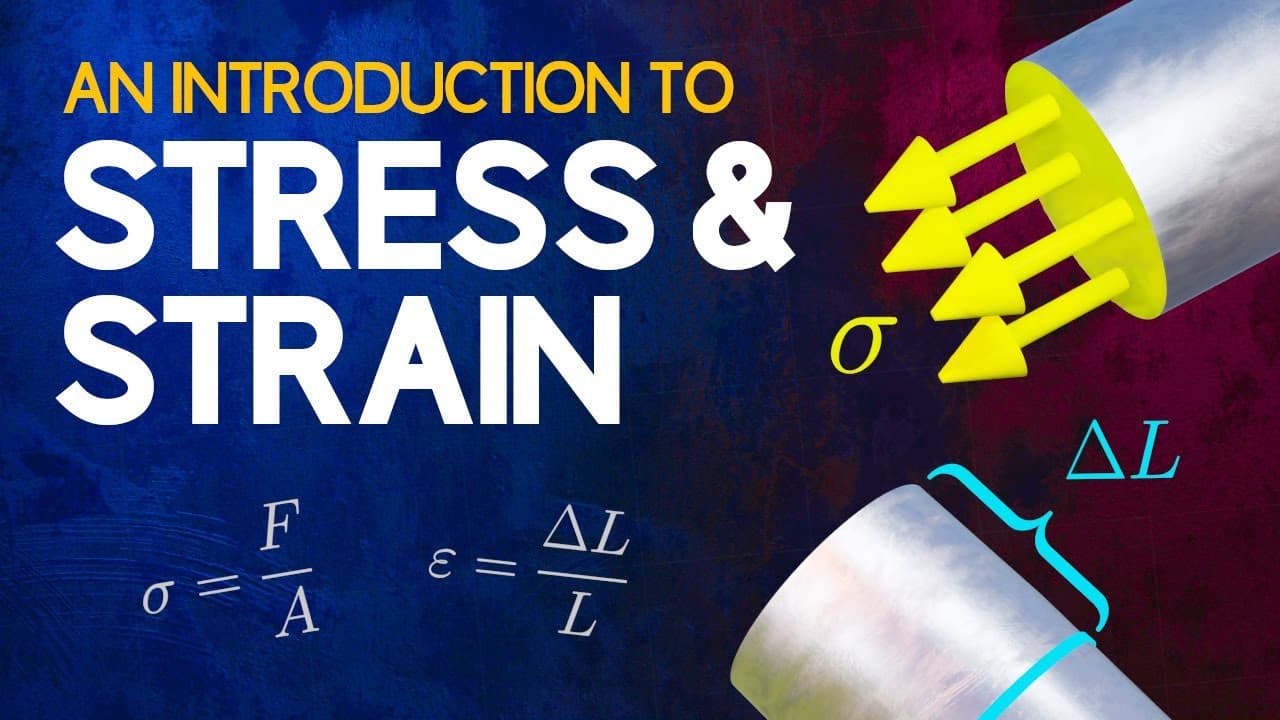
Stress measures internal force per unit area, while strain measures deformation relative to an original dimension. Normal and shear components describe forces perpendicular and parallel to a surface, respectively. Their relationship depends on the material: Hooke's law describes the initial linear elastic region, while larger strains can produce nonlinear behavior and permanent plastic deformation.
Transcript
Stress and strain are fundamental concepts that are used to describe how a body responds to external loads. In this video we'll explore these concepts using the simple example of a loaded bar. Here we have a solid metal bar that is loaded by two equal but opposite forces. We refer to this as uniaxial loading, because all of the applied loads are ac... Read More
Key Insights
- Stress is the internal force per unit area within a loaded body, providing a practical way to describe distributed internal forces rather than treating them as a collection of separate forces. Its SI unit is the Pascal, which equals a Newton per square meter.
- Normal stress is stress acting perpendicular to a surface. For a uniformly loaded axial bar, it is calculated as the applied force divided by the cross-sectional area and is represented by the Greek letter sigma.
- Material failure can be predicted by comparing stress with material strength. A mild steel bar with a stated strength of 250 MPa and a diameter of 20 mm will fail when the applied axial force exceeds 79 kN.
- Tensile stress is produced when forces stretch a body, while compressive stress is produced when forces shorten it. The stated sign convention assigns positive values to tensile stress and negative values to compressive stress.
- Normal strain is the change in length divided by the original length. It is a non-dimensional quantity that can be expressed as a percentage, and it can be tensile when a body lengthens or compressive when it shortens.
- A stress-strain diagram is determined through a tensile test that applies a known force while measuring stress and strain. Different materials produce different diagrams, allowing their mechanical responses to applied loading to be characterized.
- Hooke's law defines the initial linear relationship between stress and strain at low strain values. Deformation in this region is elastic and fully reverses after unloading, while the stress-to-strain ratio is Young's modulus.
- Shear stress acts parallel to a surface and is represented by tau. Average shear stress can be calculated as force divided by area, while shear strain is a change in angle and relates to shear stress through the shear modulus G.
Install to Summarize YouTube Videos and Get Transcripts
Explore YouTube Video Summarizer or Get YouTube Transcript Extractor
Questions & Answers
Q: What is stress in a loaded body?
Stress is a quantity that describes the distribution of internal forces developing within a body as it resists externally applied loads. It measures internal force per unit area, so its SI unit is Newtons per meter squared, also called Pascals. Using stress is more meaningful than identifying separate internal forces because those forces are distributed across a cross-sectional surface.
Q: How is normal stress calculated in an axially loaded bar?
Normal stress in a uniformly loaded axial bar is calculated by dividing the applied force F by the bar's cross-sectional area A. It is represented by the Greek letter sigma. The stress is called normal because the internal forces act perpendicular to the cut surface. This calculation assumes the stress is distributed uniformly across the cross-section.
Q: How can stress be used to predict material failure?
Failure can be predicted by comparing the stress inside an object with the stated strength of its material. The object fails when its stress exceeds that strength. In the example, mild steel has a strength of 250 MPa. A bar made from it with a diameter of 20 mm fails when the applied force is greater than 79 kN.
Q: What is the difference between tensile and compressive stress?
Tensile stress occurs when applied forces pull on and stretch a body, while compressive stress occurs when forces act to shorten it. Under the sign convention presented, tensile stress has a positive value and compressive stress has a negative value. Both are forms of normal stress because they act perpendicular to the relevant surface.
Q: What is normal strain and how is it calculated?
Normal strain describes the deformation associated with a change in a body's length. It is calculated by dividing the change in length, Delta-L, by the original length, L. Because it is a ratio of two lengths, strain is non-dimensional and is often expressed as a percentage. Normal strain may be tensile or compressive.
Q: What does a stress-strain diagram show?
A stress-strain diagram shows the relationship between stress and strain for a particular material. It can be obtained through a tensile test, which applies a known force to a test piece while measuring its stress and strain as the force increases. Because different materials respond differently, their stress-strain diagrams are also different.
Q: When does Hooke's law apply to stress and strain?
Hooke's law describes the initial linear relationship between stress and strain at low strain values and usually applies only for small strains. Deformation within this region is elastic, meaning it fully reverses when the load is removed. The ratio of normal stress to normal strain in this linear region is called Young's modulus.
Q: What are shear stress and shear strain?
Shear stress acts parallel to a surface and develops when internal shear forces resist loading such as a force applied perpendicular to a bar's axis. Its average value is force divided by cross-sectional area and is represented by tau. Shear strain is the resulting change in angle, represented by gamma, and its Hooke's law relationship uses shear modulus G.
Summary & Key Takeaways
-
External loads produce internal forces that maintain equilibrium within a body. Stress describes how those forces are distributed per unit area. For an axially loaded bar with a uniform distribution, normal stress equals the applied force divided by cross-sectional area, with tensile stress treated as positive and compressive stress as negative.
-
Strain describes deformation. Normal strain equals the change in length divided by the original length, while shear strain is defined by a change in angle. A tensile test produces a material's stress-strain diagram, revealing its linear elastic response and, at larger strains, nonlinear behavior associated with permanent plastic deformation.
-
Normal stress acts perpendicular to a surface, while shear stress acts parallel to it. A point can experience both components, and their magnitudes depend on the orientation of the observed plane. Stress elements represent this local stress state in two or three dimensions and support analysis of more advanced loading situations.
Read in Other Languages (beta)
Share This Summary 📚
Summarize YouTube Videos and Get Video Transcripts with 1-Click
Try YouTube Summary with ChatGPT & Claude or YouTube Transcript Generator
Explore More Summaries from The Efficient Engineer 📚
Summarize YouTube Videos and Get Video Transcripts with 1-Click
Try YouTube Summary with ChatGPT & Claude or YouTube Transcript Generator