How Metal Microstructure and Alloying Affect Strength
TL;DR
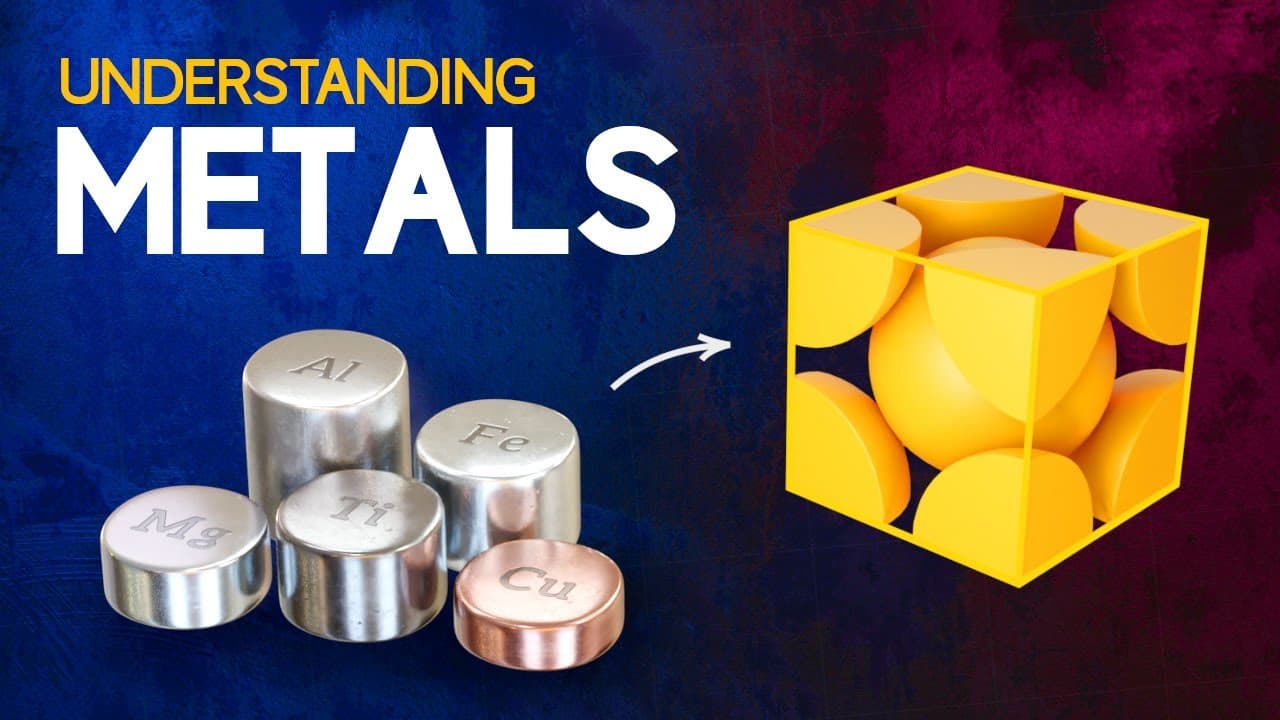
Metals are crystalline materials whose atoms pack into regular lattices, most commonly face-centred cubic (74% packing), body-centred cubic (68%), or hexagonal close-packed (74%). Their strength is controlled by lattice defects called dislocations. Engineers strengthen metals by shrinking grain size, work hardening, and alloying, which all impede dislocation motion.
Transcript
Thanks to CuriosityStream for sponsoring this video. Engineering materials are normally split into 4 categories - metals, polymers, ceramics and composites. Understanding the different types of materials, their properties and how to use them effectively is a crucial part of engineering. In this video we’ll explore metals, their microstructure, and ... Read More
Key Insights
- Engineering materials split into four categories: metals, polymers, ceramics, and composites. Around two thirds of the periodic table's elements are metals, though engineers focus on a handful like iron, aluminum, titanium, magnesium, copper, and nickel.
- Metals are crystalline because their atoms pack closely in a regular grid called the crystal lattice, unlike amorphous materials such as glass where atoms are arranged randomly. This close packing gives metals higher densities than most other materials.
- The three most common crystal structures are face-centred cubic (FCC), body-centred cubic (BCC), and hexagonal close-packed (HCP). FCC and HCP have a 74% packing factor, while BCC is slightly less packed at 68%. Copper is FCC, iron is BCC, and titanium is HCP.
- Dislocations are linear lattice defects where atoms are offset from their usual positions. Edge dislocations contain an extra half plane of atoms, while screw dislocations shift an entire block out of alignment, spiraling like a screw thread.
- Plastic deformation is essentially the motion of a large number of dislocations, and it is irreversible because dislocations move by breaking and re-forming atomic bonds. Elastic deformation, by contrast, is the reversible stretching of atomic bonds.
- Higher dislocation density increases a material's yield strength because dislocations become tangled and prevent each other from moving through the lattice. Work hardening exploits this by plastically deforming a metal through cold rolling or forging, though it reduces ductility.
- Grain boundary strengthening works because smaller grains impede dislocation motion, as captured by the Hall-Petch equation. Grain size is controlled by adding inoculants to create more nucleation sites, or by cooling the metal rapidly so grains have less time to grow.
- Alloys are metals combined with small quantities of other elements to improve properties. Steel is an interstitial alloy of iron and carbon, and alloying distorts the lattice to impede dislocation motion, an effect called solid solution strengthening.
Install to Summarize YouTube Videos and Get Transcripts
Explore YouTube Video Summarizer or Get YouTube Transcript Extractor
Questions & Answers
Q: What are the four categories of engineering materials?
Engineering materials are normally split into four categories: metals, polymers, ceramics, and composites. Understanding the different types of materials, their properties, and how to use them effectively is a crucial part of engineering. This video focuses specifically on metals, exploring their microstructure and techniques like alloying and heat treatment that can improve their properties for various engineering applications.
Q: Why is iron the most important engineering metal?
Iron is probably the most important metal because it is used to create steel, a high strength material with a wide range of engineering applications. Pure iron is too soft for structural use, but combining it with small amounts of carbon, and sometimes other elements, produces steels with incredibly useful properties. Iron atoms pack together in a body-centred cubic structure at the atomic level.
Q: What is the difference between a crystalline and an amorphous material?
A crystalline material has its atoms packed closely together and arranged in a very regular grid called the crystal lattice, which is the case for metals. An amorphous material, like glass, has its atoms arranged randomly with no regular structure. This regular close packing is one reason metals have much higher densities than most other materials.
Q: What are the three most common crystal structures in metals?
The three most common crystal structures are face-centred cubic (FCC), body-centred cubic (BCC), and hexagonal close-packed (HCP). In FCC there is an atom at each corner of the unit cell and one at the centre of each face. BCC replaces the face-centre atoms with a single atom in the middle. FCC and HCP have a 74% packing factor, while BCC has 68%.
Q: How do dislocations cause plastic deformation in metals?
Dislocations are linear defects where atoms are offset from their usual lattice positions. When stress is applied, atomic bonds break and re-form, allowing the dislocation to glide through the lattice. Plastic deformation is essentially the motion of a large number of these dislocations at the atomic level. Because the bonds break and re-form, the process is irreversible, so the dislocation does not return to its original position when stress is removed.
Q: What is the difference between elastic and plastic deformation?
Elastic deformation is caused by the stretching of atomic bonds, and this stretching is completely reversed when the load is removed. Plastic deformation is caused by the motion of dislocations through the lattice, which involves breaking and re-forming atomic bonds. Unlike elastic stretching, dislocation motion is irreversible, so plastic deformation remains after the applied stress is removed.
Q: How does grain size affect the strength of a metal?
The smaller the grain size, the stronger the material will be, a relationship captured by the Hall-Petch equation. Grains are separated by grain boundaries, and since each grain has specific planes along which slip occurs, grain boundaries impede the motion of dislocations. Engineers control grain size by adding inoculants to create more nucleation sites, or by cooling the metal rapidly so crystals have less time to grow, producing a finer, stronger structure.
Q: What is an alloy and how does alloying strengthen a metal?
An alloy is a metal created by mixing the base metal with small quantities of other metallic and non-metallic elements to improve its properties. Alloys can be substitutional or interstitial depending on the relative size of the atoms; steel is interstitial because carbon's atomic radius is much smaller than iron's. Alloying elements distort the crystal lattice, which impedes the motion of dislocations, an effect called solid solution strengthening. Alloys are split into ferrous and non-ferrous categories depending on whether the base metal is iron.
Summary & Key Takeaways
-
Engineering materials fall into four categories, and metals are the focus here. Around two thirds of periodic table elements are metals, but engineers concentrate on iron (for steel), aluminum (high strength-to-weight, low melting point, inexpensive), titanium (even stronger, aerospace, but costly), plus magnesium, copper, and nickel.
-
Metals are crystalline, packing atoms into regular lattices built from repeating unit cells. The three common structures are FCC, BCC, and HCP, with packing factors of 74%, 68%, and 74%. Real lattices contain defects: point defects like vacancies, interstitials, and substitutions, plus linear dislocations.
-
Dislocation motion drives plastic deformation and determines strength. Engineers strengthen metals through grain boundary strengthening (finer grains via inoculants or rapid cooling), work hardening (cold rolling or forging), and alloying such as steel's iron-carbon mix, all of which impede dislocations moving through the lattice.
Read in Other Languages (beta)
Share This Summary 📚
Summarize YouTube Videos and Get Video Transcripts with 1-Click
Try YouTube Summary with ChatGPT & Claude or YouTube Transcript Generator
Explore More Summaries from The Efficient Engineer 📚
Summarize YouTube Videos and Get Video Transcripts with 1-Click
Try YouTube Summary with ChatGPT & Claude or YouTube Transcript Generator