What Are Material Strength, Ductility, and Toughness?
TL;DR
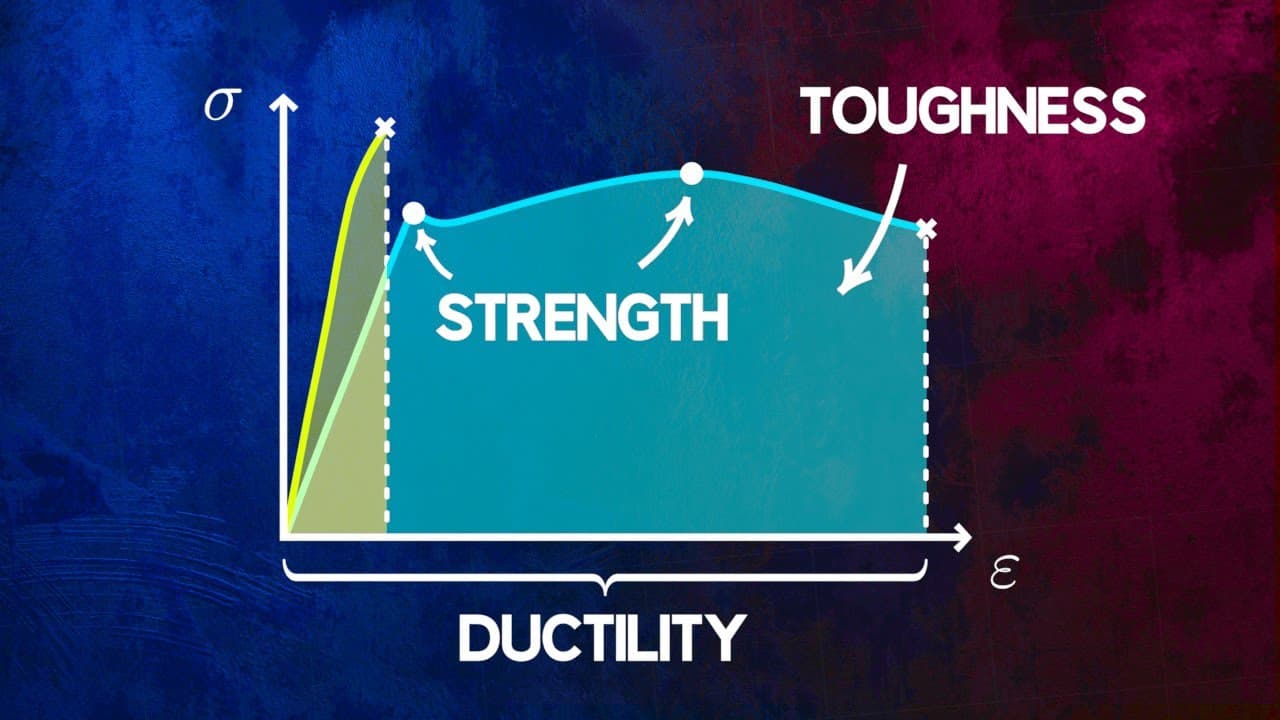
Material strength measures the maximum stress a material can withstand, defined by ultimate and yield strength. Ductility indicates how much a material can deform before breaking, with ductile materials allowing significant plastic deformation. Toughness reflects energy absorption up to fracture, achieved by balancing strength and ductility, critical for preventing failures in engineering applications.
Transcript
In this video we're going to take a closer look at strength, ductility and toughness - three very important material properties. Let's get started! Strength is a measure of the stress a material can withstand. Two different values are typically used to define the strength of a material - the ultimate strength and the yield strength. Let's define th... Read More
Key Insights
- 📶 Strength is a vital property in materials, and the ultimate strength and yield strength are commonly used values to define it.
- 😘 Ductility refers to a material's ability to deform plastically before fracturing, while brittle materials fracture at low strains with little to no plastic deformation.
- ⚖️ The ability to absorb energy up to fracture is known as toughness, which depends on a material's balance of ductility and strength.
- ❓ Resilience is another property related to toughness and measures a material's ability to absorb energy when deforming elastically.
- 📶 The 0.2% offset method is used to define yield strength for materials with unclear elastic-plastic transitions.
- 😌 Tensile loads promote crack formation in brittle materials, while plastic deformation in ductile materials relieves localized stresses.
- 😘 Ductile to brittle transition temperature is an important consideration, as materials become brittle at low temperatures, leading to catastrophic failure.
Install to Summarize YouTube Videos and Get Transcripts
Explore YouTube Video Summarizer or Get YouTube Transcript Extractor
Questions & Answers
Q: What is the difference between ultimate strength and yield strength?
Ultimate strength is the maximum stress a material can withstand during a tensile test, while yield strength is the stress at which a material begins to deform plastically.
Q: How is the yield strength defined for materials without a clear transition from elastic to plastic deformation?
The 0.2% offset method is used, involving drawing a line with the slope equal to Young's modulus and shifting it 0.2% to the right on the stress-strain curve.
Q: Why are tension tests more common than compression tests for ductile materials?
Tensile tests are easier to carry out, and for ductile materials like mild steel, the yield and ultimate strengths are similar in both the tensile and compressive directions.
Q: Why are brittle materials stronger in compression than in tension?
Tensile loads encourage crack formation and propagation in brittle materials, while compressive loads do not. Additionally, brittle materials lack plastic deformation to redistribute stresses at flaws, leading to fracture.
Summary & Key Takeaways
-
Strength is a measure of a material's ability to withstand stress, with ultimate strength and yield strength as commonly used values.
-
Ductility refers to a material's ability to deform plastically before fracturing, with ductile materials undergoing large amounts of plastic deformation.
-
Toughness measures a material's ability to absorb energy up to fracture, with a good balance of ductility and strength leading to high toughness.
Read in Other Languages (beta)
Share This Summary 📚
Summarize YouTube Videos and Get Video Transcripts with 1-Click
Try YouTube Summary with ChatGPT & Claude or YouTube Transcript Generator
Explore More Summaries from The Efficient Engineer 📚




Summarize YouTube Videos and Get Video Transcripts with 1-Click
Try YouTube Summary with ChatGPT & Claude or YouTube Transcript Generator