How to apply Bernoulli's equation in fluid flow?
TL;DR
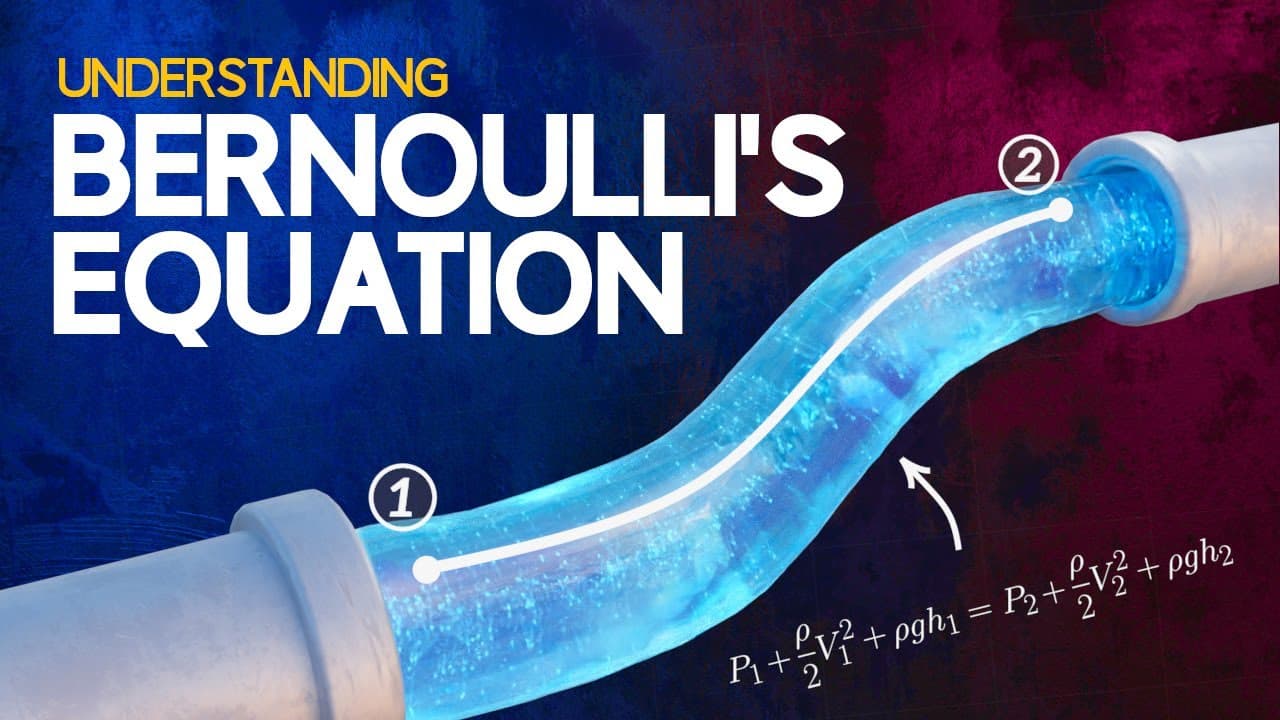
Bernoulli's equation links static pressure, dynamic pressure, and elevation along a streamline. It expresses energy conservation in fluid flow and explains why faster flow lowers pressure in horizontal sections. The principle applies to incompressible, steady, inviscid flow and has multiple practical applications like lift, flow measurement, and simple drain problems.
Transcript
Thanks to CuriosityStream for sponsoring this video. Watch thousands of documentaries and get access to Nebula for free, when you sign up using the link in the description. Bernoulli's equation is a simple but incredibly important equation in physics and engineering that can help us understand a lot about the flow of fluids in the world around ... Read More
Key Insights
- Bernoulli's equation summarizes the conservation of energy for a flowing fluid by combining pressure energy, kinetic energy, and potential energy along a streamline.
- The static pressure is the fluid pressure at a point, the dynamic pressure relates to the fluid density and velocity, and the hydrostatic pressure accounts for gravity and elevation.
- Along a streamline, if the velocity increases, the pressure energy must decrease to keep the total energy constant, illustrating Bernoulli's principle in horizontal flow.
- The equation is derived under key assumptions: laminar, steady, inviscid, and incompressible flow, and it may not hold in viscous or highly compressible conditions.
- The continuity equation links mass flow rate to density, cross-sectional area, and velocity, showing how narrowing a pipe increases velocity and lowers pressure in that region.
- Applications include explaining lift generation on airfoils, where faster flow above except more pressure difference below creates lift, and in gas burners where velocity changes control draft and mixing.
- Flow measurement devices like Pitot-static tubes and Venturi meters use Bernoulli’s principle to determine velocity and flow rate from pressure readings.
- Real world uses of Bernoulli’s principle extend to gravity-fed systems, such as calculating exit speed from taps or drains when elevations are known.
- More videos from this channel:
- More from this channel: The Efficient Engineer
Install to Summarize YouTube Videos and Get Transcripts
Explore YouTube Video Summarizer or Get YouTube Transcript Extractor
Questions & Answers
Q: A real search query question about the video (e.g. 'How to...', 'What is...', 'Why does...', 'When should...'). Question 1
What does Bernoulli's equation state and how are its terms interpreted in a flowing fluid? Bernoulli's equation states that the sum of static pressure, dynamic pressure, and hydrostatic pressure remains constant along a streamline. The static pressure is the fluid pressure at a point, the dynamic pressure is proportional to density times velocity squared and represents kinetic energy per unit volume, and the hydrostatic term accounts for gravity through elevation. This framework allows analyzing energy transfer between pressure and velocity in fluid flow.
Q: Question 2
How does Bernoulli's principle explain pressure changes in a pipe with changing diameter? When a pipe narrows, the velocity increases to satisfy continuity, and according to Bernoulli's equation the increase in kinetic energy must be balanced by a decrease in pressure energy. Thus, static pressure drops as velocity rises, illustrating the inverse relationship between flow speed and pressure in horizontal sections.
Q: Question 3
In what conditions is Bernoulli’s equation applicable, and why are those conditions important? Bernoulli’s equation applies along a streamline in steady, inviscid, incompressible flow. These conditions matter because viscosity dissipates energy, and compressibility can alter energy balance; violating these assumptions means the equation may not accurately predict pressure-velocity relationships, so adaptations or more complex models are required.
Q: Question 4
How is Bernoulli’s equation connected to lift on an airplane wing? Bernoulli’s principle posits that fluid speeds up over the wing, creating a region of lower pressure above the wing and higher pressure below it; this pressure difference produces an upward lift force, contributing to aircraft flight in combination with other aerodynamic effects acknowledged in this context.
Q: Question 5
What are some practical devices that rely on Bernoulli’s equation to measure flow and velocity? Devices such as Pitot-static tubes measure stagnation and static pressures to determine velocity, while Venturi meters use a converging section to create a pressure drop that yields flow rate. Both rely on the relationship between pressure and velocity dictated by Bernoulli’s equation.
Q: Question 6
How does Bernoulli’s equation relate to a gravity-fed beer keg example from the video? In a gravity-fed keg with atmospheric pressures at both points, the height difference drives flow, and Bernoulli’s equation helps relate the vertical elevation to the exit velocity, showing how potential energy converts to kinetic energy as the liquid exits through the tap.
Q: Question 7
What are the limitations of Bernoulli’s equation and how can they be addressed? The limitations arise from assumptions of laminar, steady, inviscid, incompressible flow; real fluids exhibit viscosity, turbulence, and sometimes compressibility. Adapted forms of the equation or alternative models can be used in those cases, enabling more accurate predictions where the basic form falls short.
Q: Question 8
Why is it useful to understand Bernoulli’s equation for engineers and scientists? Understanding Bernoulli’s equation provides a powerful tool to analyze and predict fluid behavior across many systems, from aircraft and burners to pipes and measurement devices, guiding design decisions and troubleshooting by linking pressure, velocity, and elevation in a consistent energy framework.
Summary & Key Takeaways
-
Bernoulli's equation describes the relation between pressure, velocity, and height in a flowing fluid and is useful for analyzing a wide range of problems. The video emphasizes the energy form and emphasizes the conditions under which the equation is valid, including along a streamline and for certain flow assumptions.
-
The video demonstrates practical applications such as lift over an airfoil, gas flow in a Bunsen burner, and flow measurement devices like Pitot tubes and Venturi meters, showing how pressure differences relate to velocity changes in real systems.
-
The presentation stresses limitations and derivations of Bernoulli’s equation, noting that assumptions include steady, laminar, inviscid, and incompressible flow, with adaptations possible for unsteady or compressible cases, guiding engineers on correct usage.
Read in Other Languages (beta)
Share This Summary 📚
Summarize YouTube Videos and Get Video Transcripts with 1-Click
Try YouTube Summary with ChatGPT & Claude or YouTube Transcript Generator
Explore More Summaries from The Efficient Engineer 📚





Summarize YouTube Videos and Get Video Transcripts with 1-Click
Try YouTube Summary with ChatGPT & Claude or YouTube Transcript Generator