How Do Superalloys Survive Extreme Heat?
TL;DR
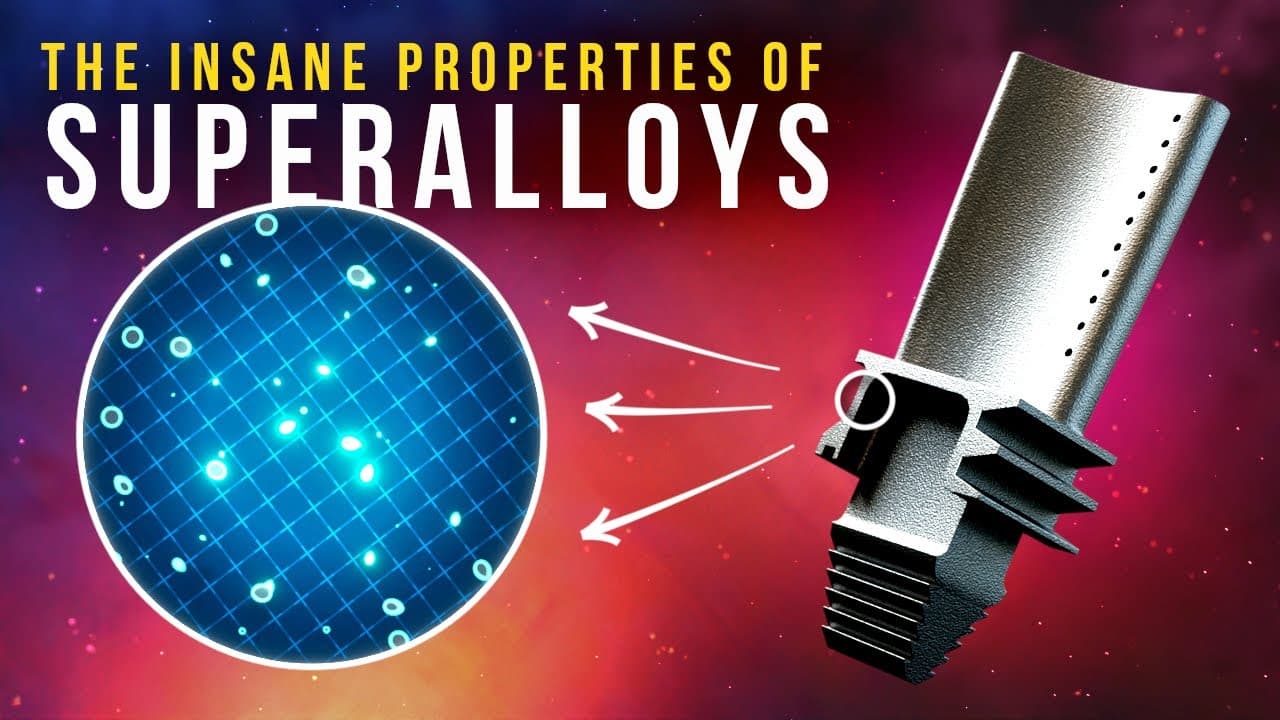
Superalloys retain strength, resist creep, and withstand oxidation under high temperatures and sustained mechanical stress because their compositions and microstructures are carefully engineered. Inconel 718, for example, uses a stable nickel-rich matrix and strengthening precipitates to remain useful up to roughly 700 degrees Celsius, while chromium forms a protective, self-healing oxide film.
Transcript
Superalloys are a class of high-performance metallic materials that have been specifically engineered to endure high stress environments while operating at ridiculously high temperatures, in some cases approaching 1000 degrees Celsius. These materials really are marvels of metallurgy. Carefully selected alloying elements combine to create mater... Read More
Key Insights
- Superalloys are engineered metallic materials that maintain strength and stability under high stress at temperatures that can approach 1000 degrees Celsius. Their combination of thermal stability, creep resistance, oxidation resistance, and mechanical strength makes them suitable for turbine blades, fasteners, and other demanding components.
- Nickel-based, cobalt-based, and iron-based superalloys serve different operating needs. Nickel-based alloys offer excellent high-temperature mechanical properties and oxidation resistance, cobalt-based alloys excel under rapid thermal cycling, and iron-based alloys provide a lower-cost option for applications with less severe operating conditions.
- Inconel 718 retains a yield strength of about 1200 megapascals at room temperature and remains remarkably stable until roughly 700 degrees Celsius, where its strength begins to decline. Some other nickel-based superalloys retain useful strength at temperatures above 850 degrees Celsius.
- Creep is slow, permanent deformation caused by sustained loading over a long period at elevated temperature. Under 300 megapascals at 600 degrees Celsius, 304 stainless steel ruptures after about 10 hours, titanium alloy after about 30 hours, A-286 after three and a half years, and Inconel 718 after eight years.
- Precipitation strengthening works by dispersing secondary phases throughout a primary matrix. These precipitates obstruct dislocation motion, increasing strength and resistance to creep. In Inconel 718, gamma-double-prime provides most of the precipitation strengthening, while gamma-prime also contributes within the nickel-rich gamma matrix.
- Nickel provides a stable face-centred-cubic matrix that persists to its melting point and readily incorporates elements such as iron and chromium as a solid solution. Niobium and molybdenum support high-temperature mechanical properties, while niobium also combines with nickel to create the strengthening gamma-double-prime phase.
- Chromium improves corrosion and oxidation resistance by forming a thin chromium oxide film on the surface. The protective layer becomes thicker at higher temperatures and can rapidly reform in the presence of oxygen after disruption, giving the alloy a self-healing surface barrier.
- Single-crystal turbine blades eliminate grain boundaries that can promote creep deformation and initiate cracks at high temperatures. This manufacturing approach significantly improves creep resistance and thermal fatigue performance, while internal cooling channels and thermal-barrier coatings help turbine components tolerate even higher operating temperatures.
Install to Summarize YouTube Videos and Get Transcripts
Explore YouTube Video Summarizer or Get YouTube Transcript Extractor
Questions & Answers
Q: What are superalloys and why are they used?
Superalloys are high-performance metallic materials engineered to retain strength and stability when high temperatures, substantial mechanical stresses, and long service periods occur together. Some can operate at temperatures approaching 1000 degrees Celsius. They are used for components such as jet-engine turbine blades and high-performance fasteners because conventional aluminum, titanium, and stainless-steel alloys lose too much strength or creep too quickly under comparable conditions.
Q: What are the three main types of superalloys?
Superalloys are categorized by their main alloying element as nickel-based, cobalt-based, or iron-based. Nickel-based superalloys are the most widely used and combine strong high-temperature mechanical properties with oxidation resistance. Cobalt-based alloys have lower strength but excellent thermal fatigue resistance during rapid temperature cycling. Iron-based superalloys are lower-cost alternatives intended for applications where conditions are less extreme.
Q: Why does Inconel 718 remain strong at high temperatures?
Inconel 718 remains strong because its carefully engineered composition creates a stable nickel-rich gamma matrix reinforced by gamma-prime and gamma-double-prime precipitates. These precipitates obstruct dislocation motion, which improves both strength and creep resistance. Gamma-double-prime provides most of the strengthening. Nickel stabilizes the matrix, while refractory metals such as niobium and molybdenum support mechanical performance at elevated temperatures.
Q: How does Inconel 718 compare with conventional alloys under heat?
Inconel 718 has a room-temperature yield strength of about 1200 megapascals and preserves it remarkably well until roughly 700 degrees Celsius. By comparison, titanium alloys gradually lose strength as temperature rises, aluminum alloys are not suitable for use above about 200 degrees Celsius, and 304 stainless steel falls below half of its room-temperature yield strength at 500 degrees Celsius.
Q: What is creep, and how resistant are superalloys to it?
Creep is the slow, permanent deformation of a material held under sustained load for a long period at elevated temperature. At 600 degrees Celsius and 300 megapascals, 304 stainless steel ruptures after about 10 hours and titanium alloy after about 30 hours. A-286 lasts roughly three and a half years, while Inconel 718 lasts about eight years under the stated comparison.
Q: How does chromium protect a superalloy from oxidation?
Chromium forms a very thin chromium oxide film on the alloy's surface. This film acts as a protective shield that substantially improves corrosion and oxidation resistance. It grows thicker as temperature increases, so oxidation resistance can improve under more extreme thermal conditions. The layer is also self-healing because it rapidly reforms in the presence of oxygen when the surface film is disrupted.
Q: Why are some turbine blades cast as single crystals?
Conventionally cast superalloy turbine blades are polycrystalline and contain grain boundaries, which can become sites for creep deformation and crack initiation at high temperatures. Casting a blade as a single crystal removes these grain boundaries from its microstructure. This significantly increases creep resistance and thermal fatigue performance, helping the blade endure combustion heat and mechanical stresses produced by high rotational speeds.
Q: What are the main disadvantages of using superalloys?
Superalloys are expensive, dense, and difficult to machine. Inconel 718 can cost up to ten times more than conventional alloys. These materials work-harden quickly, causing rapid tool wear and requiring specialized tooling and low cutting speeds. Their nickel and cobalt content also makes them significantly denser than aluminum or titanium alloys, so they are generally reserved for conditions where alternatives cannot perform.
Summary & Key Takeaways
-
Superalloys are high-performance metallic materials designed for environments combining elevated temperatures, substantial mechanical stress, and long operating periods. Nickel-based alloys provide excellent strength and oxidation resistance, cobalt-based alloys resist thermal fatigue during rapid temperature cycling, and lower-cost iron-based alloys suit less extreme applications where comparable peak performance is unnecessary.
-
Inconel 718 derives its performance from a nickel-rich gamma matrix reinforced by gamma-prime and gamma-double-prime precipitates. These finely dispersed phases obstruct dislocation motion, increasing strength and creep resistance. Niobium helps form the especially important gamma-double-prime phase, while refractory metals and solid-solution elements support high-temperature stability and mechanical performance.
-
Superalloys enable turbine blades, fasteners, and other components exposed to extreme conditions. Single-crystal casting eliminates grain boundaries that encourage creep and crack initiation, while cooling channels and thermal-barrier coatings permit higher turbine temperatures. Their disadvantages include high material costs, difficult machining, rapid tool wear, low cutting speeds, and substantial density.
Read in Other Languages (beta)
Share This Summary 📚
Summarize YouTube Videos and Get Video Transcripts with 1-Click
Try YouTube Summary with ChatGPT & Claude or YouTube Transcript Generator
Explore More Summaries from The Efficient Engineer 📚



Summarize YouTube Videos and Get Video Transcripts with 1-Click
Try YouTube Summary with ChatGPT & Claude or YouTube Transcript Generator