What Is Buckling and How Does It Impact Structures?
TL;DR
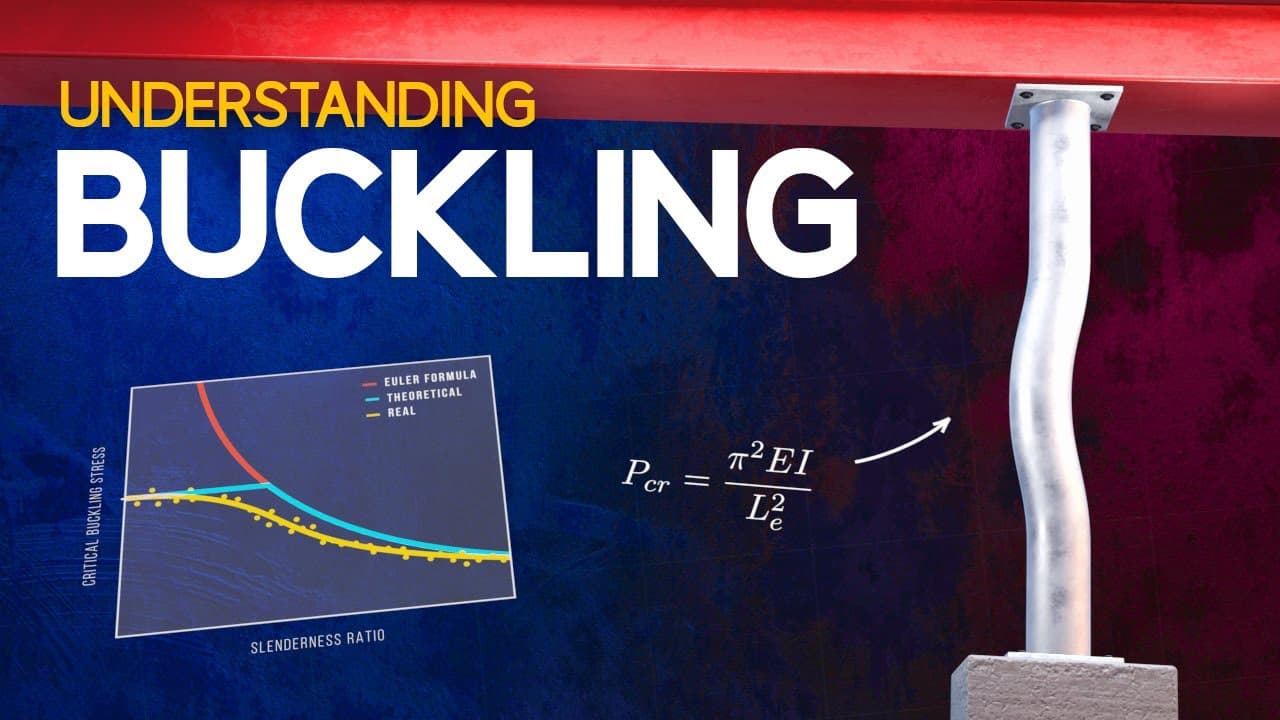
Buckling is a structural failure mode resulting from compressive loads exceeding critical limits, leading to instability and deformation. The Euler buckling formula helps engineers calculate the critical load for columns, emphasizing the importance of slenderness ratio — longer, thinner columns are more susceptible to buckling. Factors like end conditions and imperfections significantly influence buckling behavior and design considerations.
Transcript
Thanks to CuriosityStream for sponsoring this video. When a bar is loaded in uniaxial tension, it will fail when the normal stress in the bar exceeds the yield or tensile strength of the material. And if it's loaded in compression it will fail by crushing when the compressive strength of the material is exceeded. But there's an additional way the b... Read More
Key Insights
- 🏗️ Buckling is a failure mode that occurs when a compressive load on a bar reaches a critical point, causing a change in shape and loss of stability. It can lead to catastrophic failure.
- 🚂 Heat expansion in railway tracks and subsea pipelines can lead to compressive forces and buckling, posing a risk to structures.
- 📏 Euler's buckling formula, published in 1744, is still used today to design columns and other members loaded in compression. It depends on the material's Young's modulus, area moment of inertia, and length.
- 🔧 End conditions, such as how the column is fixed or pinned, greatly impact the critical buckling load and must be carefully considered in engineering design.
- 🏗️ Slender columns are at a higher risk of buckling than stocky ones. The slenderness ratio, calculated by dividing length by the radius of gyration, determines the critical buckling stress.
- 💪 Real columns may experience inelastic buckling, a combination of plastic failure and elastic buckling. Experimental data shows a gradual transition in the behavior of columns.
- 💡 Euler's formula assumes load acts through the centroid and a straight column. Eccentric loading and imperfections affect the buckling behavior and should be considered in design.
- 📐 Plates, shells, and thin-walled open cross-sections, such as those found in storage tanks, are also susceptible to buckling and often require detailed non-linear analysis.
Install to Summarize YouTube Videos and Get Transcripts
Explore YouTube Video Summarizer or Get YouTube Transcript Extractor
Questions & Answers
Q: How does buckling differ from yielding or fracturing in structures?
Buckling is a failure mode that occurs when compressive loads cause a change in the shape of a structure, leading to instability and the inability to support loads as designed. Unlike yielding or fracturing, buckling does not necessarily result in material failure but renders the structure incapable of carrying a load effectively.
Q: What are some examples of structures at risk of buckling?
Columns in trusses and frames, railway tracks on hot days, and subsea pipelines carrying hot product are all examples of structures that can be at risk of buckling when subjected to compressive loads.
Q: How does Euler's formula determine the critical buckling load of a column?
Euler's formula, developed by Leonhard Euler, relates the critical buckling load of a column to three parameters: the Young's modulus of the material, the area moment of inertia of the cross-section, and the length of the column. It does not depend on the strength of the material.
Q: How do different end conditions affect the critical buckling load of a column?
The end conditions of a column, such as being pinned at both ends or fixed at one end, significantly influence the critical buckling load. An effective length is introduced to account for different end conditions, and design codes provide guidance on selecting appropriate effective lengths.
Q: What is the slenderness ratio, and how does it affect the critical buckling stress of a column?
The slenderness ratio, calculated as the column length divided by the radius of gyration, determines a column's susceptibility to buckling. Very slender columns, with high slenderness ratios, have low critical buckling stresses, while stocky columns, with low slenderness ratios, have high critical buckling stresses.
Q: How does eccentric loading or the presence of imperfections affect Euler's formula for buckling?
Eccentric loading, where the applied load is offset from the centroid of the cross-section, and the presence of imperfections can both reduce the critical buckling load of a column and change how buckling occurs. These effects are modeled using the Secant formula and can introduce additional bending moments.
Q: Are there other types of buckling beyond flexural buckling of columns?
Yes, thin-walled open cross-sections can buckle by twisting (torsional buckling) or a combination of twisting and bending (torsional-flexural buckling). Thin plates and shells can also buckle, but predicting their behavior is more complex and often requires non-linear analysis using methods like the finite element method.
Summary & Key Takeaways
-
Buckling is a failure mode that occurs when compressive loads cause a change in the shape of a structure, leading to instability and the inability to support loads as designed.
-
Euler's formula, developed in the 18th century, provides a simple equation for calculating the critical buckling load of columns and other compression-loaded members.
-
Slender columns are more prone to buckling, and the slenderness ratio, defined as the length divided by the radius of gyration, determines a column's susceptibility to buckling.
Read in Other Languages (beta)
Share This Summary 📚
Summarize YouTube Videos and Get Video Transcripts with 1-Click
Try YouTube Summary with ChatGPT & Claude or YouTube Transcript Generator
Explore More Summaries from The Efficient Engineer 📚

Summarize YouTube Videos and Get Video Transcripts with 1-Click
Try YouTube Summary with ChatGPT & Claude or YouTube Transcript Generator