How to Analyze Shear Force and Bending Moment Diagrams
TL;DR
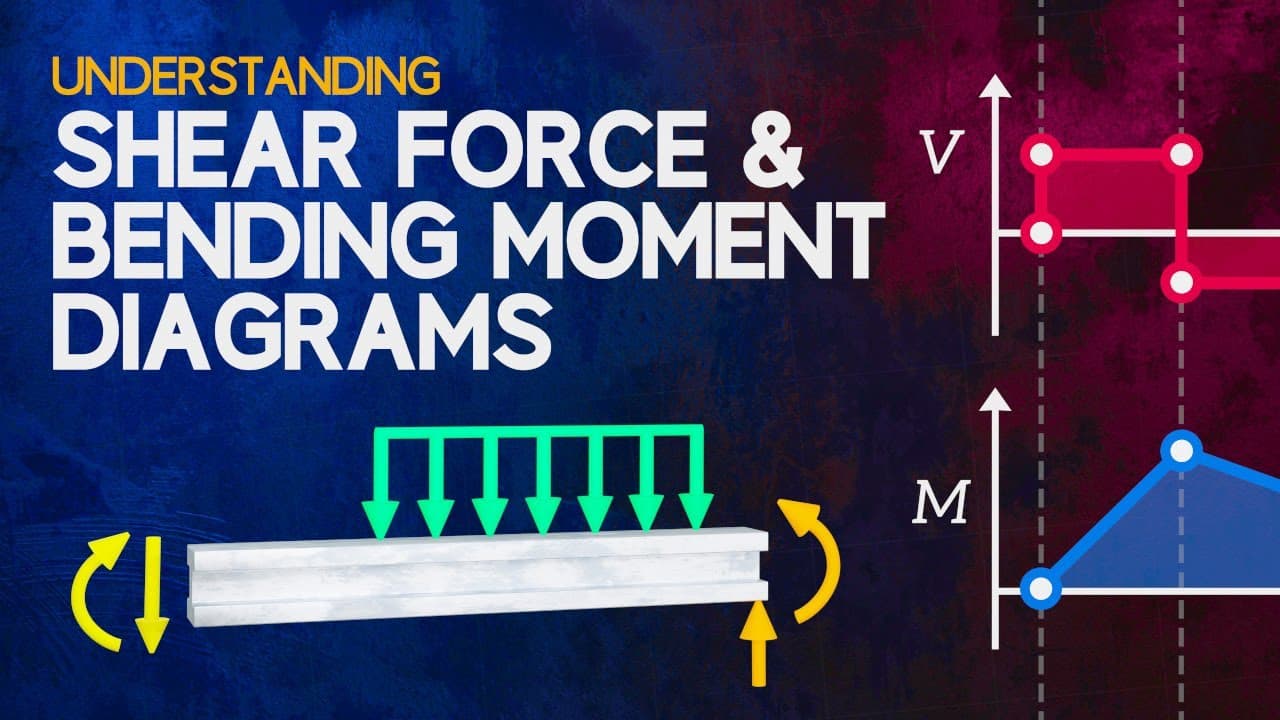
To analyze shear force and bending moment diagrams, start by drawing a free body diagram of the beam and calculate the reaction forces using equilibrium equations. Then, determine the internal shear forces and bending moments by cutting the beam at various points and applying the concept of equilibrium to maintain balance. This method provides clear insights into how a beam responds to loading.
Transcript
Shear force and bending moment diagrams are powerful graphical methods that every mechanical and civil engineer should know how to use to analyse a beam under loading. In this video I’ll explain exactly how to master these diagrams, and we will see how they can be used to understand how a beam is loaded. I want to start by explaining what shear for... Read More
Key Insights
- 🧪 Shear force and bending moment diagrams are powerful graphical methods used by mechanical and civil engineers to analyze beams under loading.
- 📏 Shear forces are oriented vertically, while normal forces are oriented along the axis of the beam. Tensile and compressive forces have equal magnitudes but opposite directions, resulting in a net moment.
- 🔧 Shear force and bending moment diagrams represent the internal forces acting on a beam's cross-section. Drawing these diagrams involves identifying the internal forces at each location along the beam.
- ⚖️ Beam loads can be concentrated forces, distributed forces, or concentrated moments. Beams can be supported with pinned supports, roller supports, or fixed supports, each with different restraining capabilities.
- 📊 The process of determining shear forces and bending moments involves three steps: drawing a free body diagram, calculating reaction forces and moments, and analyzing equilibrium equations.
- 📐 Statically determinate beams can have all reaction loads calculated using equilibrium equations. Statically indeterminate beams require more complex methods and consideration of boundary conditions.
- 🔍 Shear forces and bending moments at each location along the beam are determined by applying the concept of equilibrium. The sign convention for shear forces and bending moments is defined based on beam orientation.
- 🔄 Shear force and bending moment diagrams can be checked using relationships between applied loads, shear forces, and bending moments. The area under the loading diagram can help sense check the diagrams.
Install to Summarize YouTube Videos and Get Transcripts
Explore YouTube Video Summarizer or Get YouTube Transcript Extractor
Questions & Answers
Q: How are shear forces and bending moments represented graphically?
Shear forces are plotted on a shear force diagram, with downward forces being positive on the left side of the beam and upward forces being positive on the right side. Bending moments are plotted on a bending moment diagram, with positive moments causing tension on the lower section of the beam.
Q: What are the three main steps to determine shear forces and bending moments in a beam?
The first step is to draw a free body diagram of the beam and calculate the reaction forces and moments. The second step is to cut the beam and apply equilibrium equations to determine internal forces and moments. The third step is to plot the shear force and bending moment diagrams.
Q: How do different loading and support conditions affect shear forces and bending moments in a beam?
Different types of loads, such as concentrated forces or distributed forces, will result in different shear force and bending moment diagrams. Similarly, different types of supports, such as pinned supports or roller supports, will also affect the diagrams.
Q: What is the difference between a statically determinate and statically indeterminate beam?
A statically determinate beam can have all reaction loads calculated using equilibrium equations, while a statically indeterminate beam has more unknowns than equilibrium equations, requiring more complex methods to solve. This video only covers statically determinate beams.
Q: How can the area under the shear force and bending moment curves be used to verify the accuracy of the diagrams?
The change in shear force between two points is equal to the area under the loading curve between those points. Similarly, the change in bending moment between two points is equal to the area under the shear force curve. Calculating these areas can help check the correctness of the diagrams.
Q: What are some key observations or relationships that can be made based on the equations for shear force and bending moment?
When shear force is equal to zero, the bending moment curve will be at a local minimum or maximum. Discontinuities in the diagrams occur where there are concentrated forces or moments. The slope of the shear force curve is equal to the distributed force, and the slope of the bending moment curve is equal to the shear force.
Summary & Key Takeaways
-
Shear forces and bending moments develop within a loaded beam to maintain equilibrium.
-
Shear force is the resultant of vertical internal forces, while bending moment is the resultant of normal internal forces.
-
To determine shear forces and bending moments, a free body diagram of the beam is drawn, reaction forces are calculated using equilibrium equations, and the internal forces are found by cutting the beam and applying equilibrium principles.
Read in Other Languages (beta)
Share This Summary 📚
Summarize YouTube Videos and Get Video Transcripts with 1-Click
Try YouTube Summary with ChatGPT & Claude or YouTube Transcript Generator
Explore More Summaries from The Efficient Engineer 📚


Summarize YouTube Videos and Get Video Transcripts with 1-Click
Try YouTube Summary with ChatGPT & Claude or YouTube Transcript Generator