What Are Bending and Shear Stresses in Beams?
TL;DR
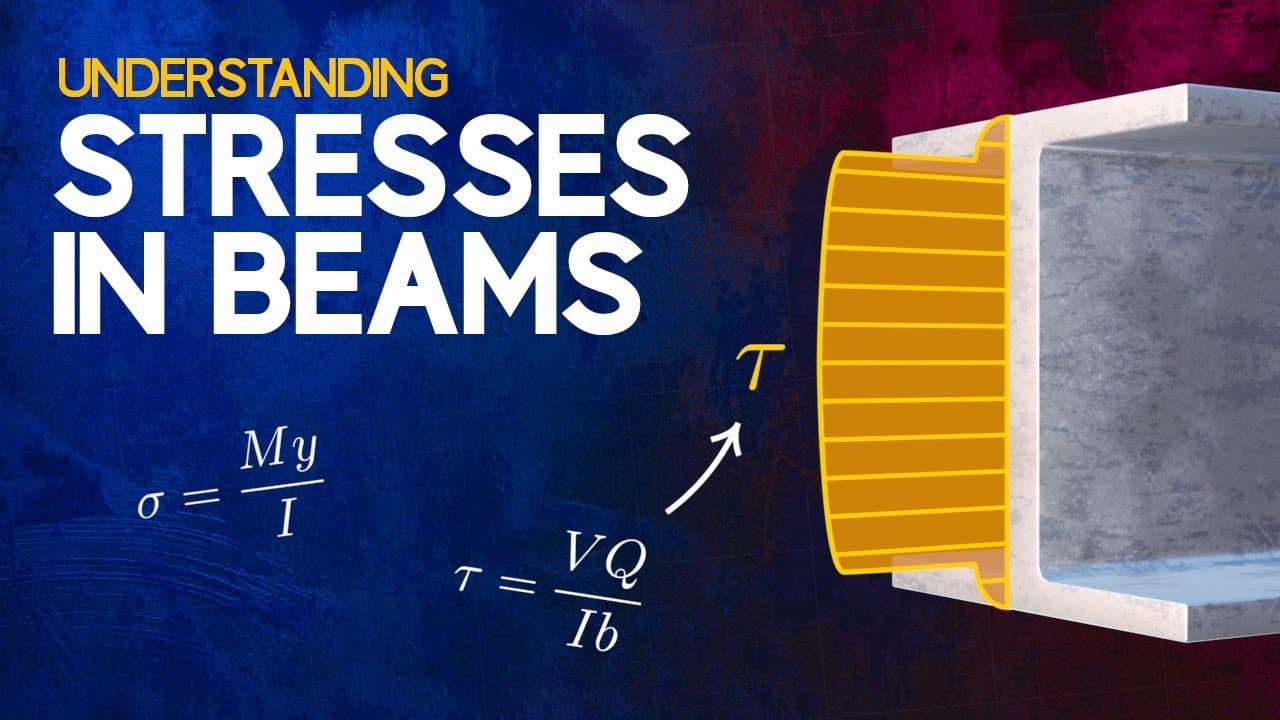
Bending stresses in beams develop when loads cause deformation, resulting in compression at the top fibers and tension at the bottom. Shear stresses act vertically and are calculated using specific equations, peaking at the neutral axis. Understanding these stresses is critical for analyzing beam design and structural integrity.
Transcript
If we apply a load to a beam, it will deform by bending. This generates internal stresses, which can be represented by a shear force acting in the vertical direction, and a bending moment. The shear force is the resultant of vertical shear stresses, which act parallel to the cross-section, and the bending moment is the resultant of normal stresses,... Read More
Key Insights
- 😁 Bending in beams generates internal stresses represented by a shear force and a bending moment.
- 😁 Bending stresses occur when the shear force is zero and the bending moment remains constant along the beam's length.
- 😐 The neutral surface or neutral axis is a surface containing fibers that stay the same length during beam deflection.
- 😐 Bending stresses increase with increasing bending moment and distance from the neutral axis, while they decrease with a larger area moment of inertia.
- 😵 Shear forces result in shear stresses, which act parallel to the cross-section and can be calculated using equations.
- 😁 Shear stresses are zero at the free surfaces of the beam, and the maximum shear stress occurs at the neutral axis.
- 😐 The flexure formula relates bending moment, distance from the neutral axis, and area moment of inertia to calculate bending stresses.
Install to Summarize YouTube Videos and Get Transcripts
Explore YouTube Video Summarizer or Get YouTube Transcript Extractor
Questions & Answers
Q: How do bending stresses develop in beams?
Bending stresses develop in beams when subjected to loads and result in compression on the top fibers and tension on the bottom fibers of the beam.
Q: What is the neutral surface in a beam?
The neutral surface in a beam is a surface containing fibers that stay the same length when the beam deflects. It passes through the centroid of the cross-section and is also known as the neutral axis.
Q: How can bending stresses be calculated?
Bending stresses can be calculated using the flexure formula, which relates the bending moment, distance from the neutral axis, and the area moment of inertia of the cross-section. The maximum stress occurs at the fibers furthest from the neutral axis.
Q: How does the presence of shear force affect bending stresses?
In most cases, the presence of a shear force does not significantly affect bending stresses. Thus, the flexure formula derived for pure bending can also be used for a more general case of bending.
Key Insights:
- Bending in beams generates internal stresses represented by a shear force and a bending moment.
- Bending stresses occur when the shear force is zero and the bending moment remains constant along the beam's length.
- The neutral surface or neutral axis is a surface containing fibers that stay the same length during beam deflection.
- Bending stresses increase with increasing bending moment and distance from the neutral axis, while they decrease with a larger area moment of inertia.
- Shear forces result in shear stresses, which act parallel to the cross-section and can be calculated using equations.
- Shear stresses are zero at the free surfaces of the beam, and the maximum shear stress occurs at the neutral axis.
- The flexure formula relates bending moment, distance from the neutral axis, and area moment of inertia to calculate bending stresses.
- The distribution of bending and shear stresses varies depending on the shape and properties of the beam's cross-section.
Summary & Key Takeaways
-
Bending in beams generates internal stresses represented by a shear force acting vertically and a bending moment.
-
Bending stresses occur when the shear force is zero, and the bending moment remains constant along the beam's length.
-
Shear stresses act parallel to the cross-section, while bending stresses act perpendicular to it.
Read in Other Languages (beta)
Share This Summary 📚
Summarize YouTube Videos and Get Video Transcripts with 1-Click
Try YouTube Summary with ChatGPT & Claude or YouTube Transcript Generator
Explore More Summaries from The Efficient Engineer 📚



Summarize YouTube Videos and Get Video Transcripts with 1-Click
Try YouTube Summary with ChatGPT & Claude or YouTube Transcript Generator