What is the difference between true and engineering stress?
TL;DR
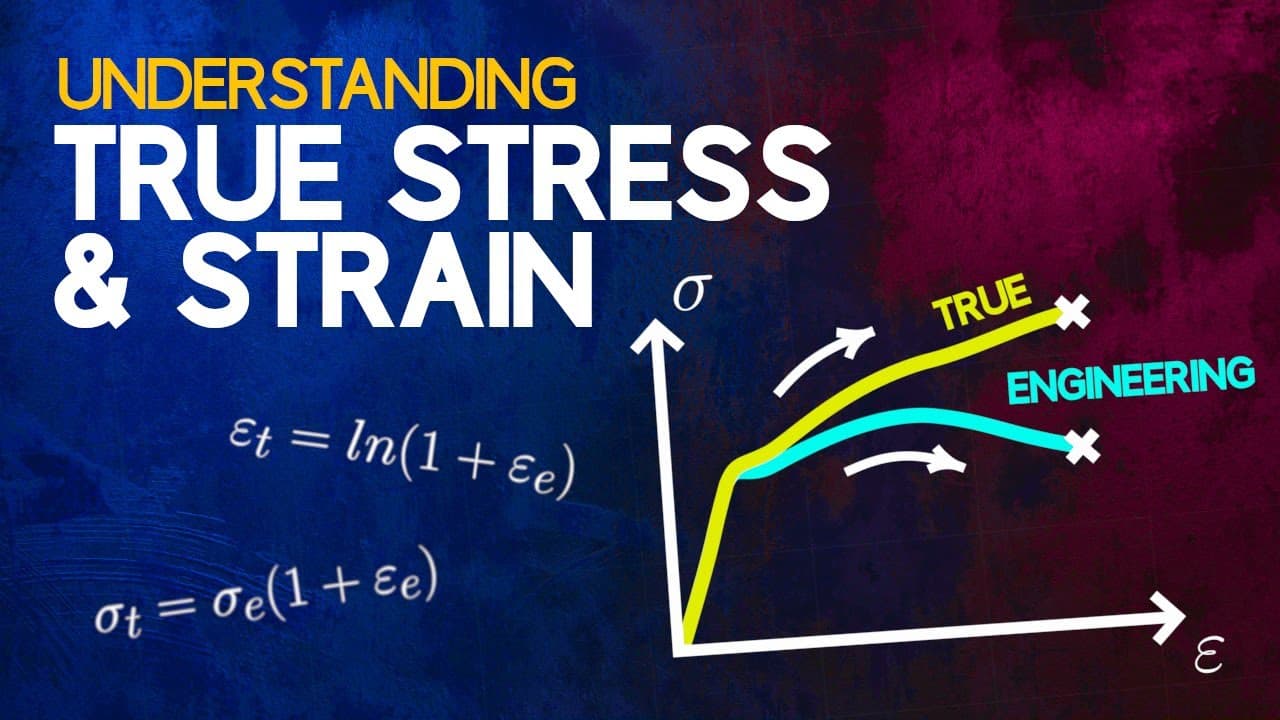
Engineering stress uses initial cross sectional area, while true stress uses instantaneous area, leading to different curves especially after necking. True strain is logarithmic and accounts for changing length, while engineering strain uses original length. The true curve generally rises with necking, whereas the engineering curve drops after necking.
Transcript
The typical stress-strain curve for a ductile material, which is obtained by performing a tensile test, looks something like this. But this curve is just an approximation! It doesn’t represent the actual stress or strain in the test piece during the tensile test. In this video we're going to talk about true stress and true strain. In the typical st... Read More
Key Insights
- True stress uses instantaneous cross sectional area, not the initial area.
- Engineering stress can decrease after necking due to area reduction.
- True strain is the logarithmic or natural strain derived from length changes.
- Engineering strain is based on the original length, not the current length.
- Necking marks the divergence between true and engineering curves.
- Volume constancy is assumed to relate area and length in the elastic and plastic regions.
- The true stress curve increases during necking, unlike the engineering curve.
- Measurement challenges and typical elastic-domain designs motivate use of engineering curves.
- More videos from this channel:
- More from this channel: The Efficient Engineer
Install to Summarize YouTube Videos and Get Transcripts
Explore YouTube Video Summarizer or Get YouTube Transcript Extractor
Questions & Answers
Q: What is engineering stress and how is it defined during a tensile test?
Engineering stress is defined as the applied force divided by the initial cross sectional area of the test specimen. This means it uses the original dimensions to calculate stress, which makes it an approximation of the true stress, especially as the specimen deforms and its cross sectional area changes during the test. This simplification is why engineering stress is widely used in practice, particularly for elastic behavior.
Q: How does true stress differ from engineering stress in terms of cross sectional area?
True stress uses the instantaneous cross sectional area at each moment during the test, while engineering stress uses the initial cross sectional area. This difference becomes significant when the specimen experiences necking, because the area changes rapidly and the true stress reflects that enlargement of stress concentration, whereas engineering stress does not capture the real stress state at later stages.
Q: What is necking and how does it affect the stress-strain curves?
Necking is the rapid reduction in the cross sectional area of the test piece that begins when the engineering curve reaches its maximum value, the ultimate tensile strength. After necking, the engineering stress curve typically drops, while the true stress curve continues to increase. This divergence is a key distinction between the two curves and highlights the limitations of engineering stress after necking.
Q: Why do engineers still use engineering curves despite true curves being more accurate in some cases?
Engineers use engineering curves because it is very difficult to measure the instantaneous cross sectional area during a tensile test, and most analyses focus on the elastic region where the curves are similar. This practical approach simplifies testing and design, avoiding the complexity of tracking changing area and true stress in many standard applications.
Q: What is true strain and how is it calculated?
True strain is the logarithmic or natural strain, which accounts for continuous changes in length during the test. It can be derived mathematically by considering the length at each increment and integrating, effectively summing the infinitesimal changes in length relative to the current length. This approach leads to a strain measure that grows as the material deforms.
Q: How is the product of instantaneous area and length related to the original area and length in true stress calculations?
Under the assumption of constant volume, the product of the instantaneous cross sectional area and the instantaneous length remains equal to the product of the original area and original length during the elastic and plastic regions. This relationship allows rewriting the true stress equation in terms of engineering stress and strain, provided necking has not occurred.
Q: What limits the constant volume assumption in true stress calculations?
The constant volume assumption holds in the elastic region and also in the plastic region because materials are considered incompressible during plastic deformation. However, after necking begins, this assumption breaks down due to the changing cross sectional area, and true stress must be based on actual measurements of the instantaneous area.
Q: How can engineers estimate true stress and true strain from engineering data?
Engineers can estimate true stress and true strain from engineering data by using the relationship between instantaneous area and length, assuming constant volume until necking occurs, and applying the derived formulas that convert engineering stress and strain to their true counterparts. This avoids direct measurement of instantaneous area in many cases, especially before necking.
Summary & Key Takeaways
-
Engineering stress is defined as the applied force divided by the initial cross sectional area, whereas true stress uses the instantaneous area. This distinction becomes important when necking occurs and large plastic deformations develop.
-
True strain accounts for continuous changes in length and is equivalent to logarithmic strain, derived via integration, while engineering strain uses the original length. These definitions lead to different representations during tensile testing.
-
In practice, engineers often use engineering curves because measuring instantaneous area is difficult and many designs stay in the elastic region, where the two curves are similar.
Read in Other Languages (beta)
Share This Summary 📚
Summarize YouTube Videos and Get Video Transcripts with 1-Click
Try YouTube Summary with ChatGPT & Claude or YouTube Transcript Generator
Explore More Summaries from The Efficient Engineer 📚
Summarize YouTube Videos and Get Video Transcripts with 1-Click
Try YouTube Summary with ChatGPT & Claude or YouTube Transcript Generator