How to Use Dual CBOs in Facebook Ads for Better Spend
TL;DR
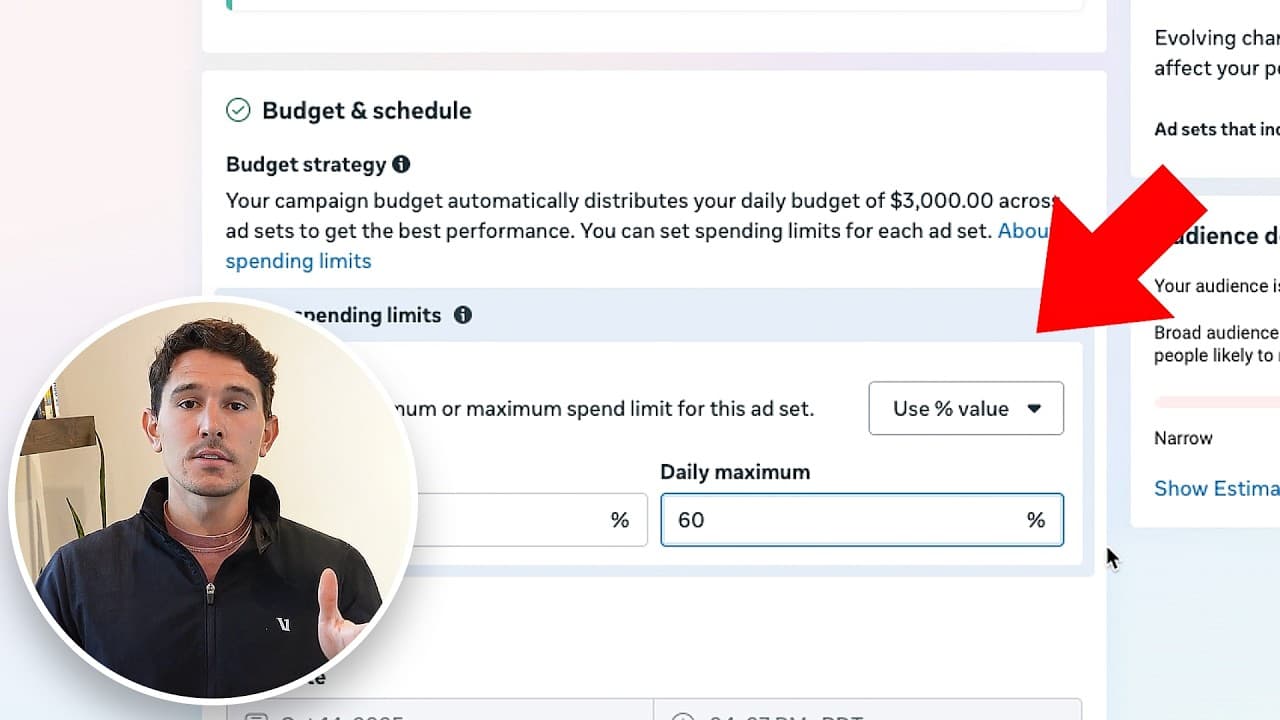
Split your budget with a percentage cap on the top spending adset while letting others share the remainder. This creates two CBOS in one campaign, preventing the dominant adset from hogging all the budget and enabling new adsets to spend enough to prove value. The approach scales with budget as you adjust the cap.
Transcript
If you are running CBO campaigns in Facebook, then you've probably encountered one single problem. And that core problem is that your same creatives get all of the spend. In this video, I'm going to show you exactly how we are solving this across dozens of ad accounts with a brand new feature that has just been released across Facebook ads. So, whe... Read More
Key Insights
- CBO campaigns can misallocate spend when new adsets enter the mix.
- A percentage based maximum creates a scalable cap that adapts as total budget changes.
- Two CBOS inside one campaign prevent a single adset from hogging all funds.
- Using a maximum percentage, not a dollar cap, scales with budget levels.
- Adjusting the cap helps distribute spend to underperformers in a controlled way.
- The approach preserves the top performers’ gains while opening room for new creatives.
- The strategy is presented as a practical test that can impact Q4 performance.
- This method complements existing CBO logic rather than replacing it.
- More videos from this channel:
- More from this channel: Sam Piliero
Install to Summarize YouTube Videos and Get Transcripts
Explore YouTube Video Summarizer or Get YouTube Transcript Extractor
Questions & Answers
Q: What is the core idea behind using dual CBOS in Facebook Ads?
The core idea is to run two levels of budget optimization within a single campaign: a top adset or group of adsets can be capped by a percentage of the total budget, while the remaining budget is allocated to other adsets. This prevents any single adset from hogging all spend while allowing new adsets to accumulate data and show their potential.
Q: How does the percentage based maximum differ from a dollar based maximum?
A percentage based maximum scales with the total campaign budget, so as you increase or decrease the overall budget, the cap adjusts automatically. In contrast, a dollar based maximum remains fixed and can become too restrictive or too loose as the budget changes, making it harder to manage at scale.
Q: Why would a marketer want to set a minimum daily spend for new adsets?
Setting a minimum daily spend aligns the new adset spend with the target cost per acquisition, ensuring early data collection is sufficient to evaluate performance. This helps avoid underfunding new creatives that could be high performers and ensures meaningful signals are gathered before scaling decisions.
Q: What problem does the new feature aim to solve according to the video?
The feature addresses the issue of new packs or adsets not receiving enough spend to accurately determine their viability. By introducing a percentage based cap, the system ensures that newer ads get fair exposure while the campaign’s overall spend remains controlled and efficient.
Q: How does the dual CBO concept affect a budget when a new adset is introduced?
When a new adset is added, the dual CBO setup prevents existing high spenders from consuming the entire budget, allowing the new adset to receive its share of the remaining funds. This maintains a balance that supports testing while preserving performance for top performers.
Q: What is the recommended approach to testing this strategy?
Treat it as an experimental framework within existing campaigns: enable the percentage based maximum, monitor how spend distributes across adsets, and adjust the cap (60%, 70%, etc.) based on observed performance and budget changes. The key is to iterate and learn what cap yields the best balance between data collection and efficiency.
Q: What rationale does the speaker give for not using a fixed maximum dollar amount?
A fixed dollar maximum can become misaligned with budget changes and scaling, leading to suboptimal spend distribution. A percentage cap remains proportional to the total budget, preserving the relative spending dynamics of the campaign as it scales up or down, and thus providing more robust control.
Q: What impact is this strategy expected to have in the fourth quarter?
The speaker believes this approach will be huge for Q4 because it stabilizes spend distribution across adsets during scaling periods, improves data collection for new creatives, and helps prevent budget hogging, ultimately supporting better ROAS and lower CPA as campaigns intensify during peak season.
Summary & Key Takeaways
-
The video introduces a dual CBO approach inside a single campaign to manage spend more fairly across adsets. It explains replacing fixed dollar caps with percentage based maximums to scale with budget changes. The method aims to prevent a single adset from consuming the majority of spend while allowing new packs to accumulate data.
-
The presenter argues that using a percentage cap creates a secondary CBO that controls risk while maintaining performance, ensuring more adsets reach meaningful spend quickly. It emphasizes testing and adjusting caps as campaigns scale through the fourth quarter.
-
The method is presented as a practical testing framework, encouraging viewers to experiment with caps and to consider this technique when realigning budgets within CBO campaigns to improve overall spend efficiency and adset vitality.
Read in Other Languages (beta)
Share This Summary 📚
Summarize YouTube Videos and Get Video Transcripts with 1-Click
Try YouTube Summary with ChatGPT & Claude or YouTube Transcript Generator
Explore More Summaries from Sam Piliero 📚






Summarize YouTube Videos and Get Video Transcripts with 1-Click
Try YouTube Summary with ChatGPT & Claude or YouTube Transcript Generator