How to structure Facebook ads for ecommerce growth
TL;DR
A clear, swim-lane account with prospecting, retention, and retargeting drives ROAS and scalable spend. Start with two campaigns under 3-5k spend: a broad prospecting campaign and an existing customer campaign, then expand as performance and budget allow, maintaining core structure across accounts.
Transcript
if you want to successfully run Facebook ads and Instagram ads for your e-commerce store one of the most important things that you absolutely need to nail is your account structure the meta ads ecosystem has changed a ton in the last year specifically for e-commerce brands so you need to keep up the structures I'm going to break down in this video ... Read More
Key Insights
- The core structure uses swim lanes in the ad account to separate prospecting, retention, and retargeting for precise messaging and budget control.
- The base recommendation is to start with a broad prospecting campaign and an existing customer campaign when spend is under 3,000 to 5,000 dollars per month.
- The system emphasizes not expanding audiences automatically and instead targeting only established customers to ensure retention campaigns are precise.
- Scaling is achieved by keeping the core structure while adding campaigns and adjusting budgets as spend increases.
- Different brands can have variations like retention being absent or included depending on their business needs and lifecycle stage.
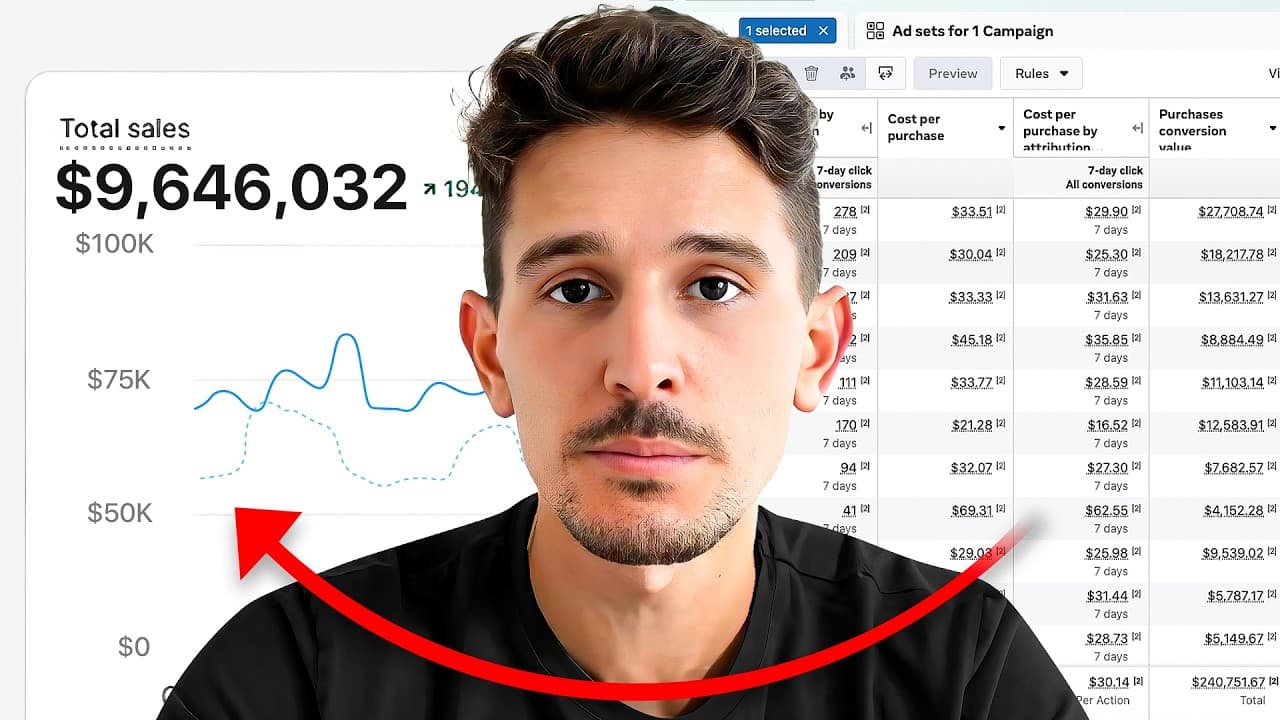
- The video shows that even small ad spends can yield strong ROAS if the structure is executed correctly, as demonstrated by examples of growing accounts.
- The recommended approach includes careful budget distribution between prospecting, retention, and retargeting to stabilize performance while increasing spend gradually.
- The creator highlights that the same core structure should be applied across brands of all sizes, with tweaks per account to fit goals and spending levels.
- More videos from this channel:
- More from this channel: Sam Piliero
Install to Summarize YouTube Videos and Get Transcripts
Explore YouTube Video Summarizer or Get YouTube Transcript Extractor
Questions & Answers
Q: How do you start structuring a new ecommerce ad account on Facebook for growth?
To start, use a two-pronged approach: a broad prospecting campaign and an existing customer or retention campaign. Do not let Facebook automatically expand your audience; target purchasers from your pixel in the last 180 days and your CRM list, and keep your budget focused on expanding new customer acquisition while still remarketing to past buyers. This base setup is designed to be simple yet scalable, enabling you to add complexity as spend grows while preserving core messaging targeted to different stages of the customer journey.
Q: What are the three swim lanes mentioned for organizing campaigns?
The three swim lanes are prospecting, retention, and retargeting. Prospecting targets new, potential customers and should receive the majority of the budget. Retention focuses on existing customers and helps maintain engagement, while retargeting reaches people who have interacted with the site or added items to cart. This separation allows tailored creative and messaging for each audience, supporting safer budget distribution and scalable growth.
Q: When is it appropriate to add a retention campaign in the structure?
A retention campaign is appropriate once you have enough data to identify existing customers and measure their behavior. In the guidance, retention is discussed as a key component of several example accounts, but not required for every initial setup. For brands just starting out, retention can be introduced as part of the existing customer campaign to keep current buyers engaged, while prospecting builds new customer acquisition.
Q: How should you set up the existing customer audience in Meta Ads?
In the audience settings, you should select a custom audience that includes anyone who has purchased from you, sourced from the pixel in the last 180 days and from your CRM list. Do not enable the option to reach beyond your custom audience, as that expands targeting in ways that are not suitable for a controlled retention strategy. This precise targeting ensures retention spend remains focused on existing customers and avoids diluting performance with broad reach.
Q: What is the recommended budget distribution for a new account under 3,000 to 5,000 spend?
For accounts in this range, start with a pure broad prospecting campaign and an existing customer campaign, then allocate the majority of the budget to prospecting to drive new customer acquisition while using a smaller portion for retention to remind existing customers. This balance helps maximize new customer growth while maintaining a baseline of engagement with current buyers, enabling healthier long term scaling.
Q: How can you justify a rapid increase in ad spend according to the video?
A rapid increase in ad spend can be justified when the core structure remains intact and performance metrics improve or stay stable. The examples show that even with increases in daily spend, maintaining the swim lane structure and targeted audiences can preserve or improve ROAS. In practice, this means increasing budgets within the established framework rather than dramatically altering targeting or creative without data to support the change.
Q: What is the role of testing within this account structure?
Testing exists as a supplementary element to the core structure. While the primary emphasis is on the three swim lanes and maintaining a clear budget distribution, you can run additional tests to explore new creatives or nested audiences. However, most spend should remain allocated to the main campaigns that drive broad acquisition and key retargeting, ensuring that experimentation does not destabilize the fundamental approach.
Q: Why is the same core structure recommended for brands of different sizes?
The core structure is recommended because it provides a consistent, scalable framework that works across brands regardless of size. It focuses on separating audiences by lifecycle stage, controlling spend across prospecting, retention, and retargeting, and enabling incremental growth. The video illustrates that while the specifics vary by brand, the underlying approach remains the same, allowing customization without sacrificing the benefits of a proven system.
Summary & Key Takeaways
-
The video explains a base structure with swim lanes for prospecting, retention, and retargeting, which helps allocate budgets safely and scale campaigns over time.
-
It provides examples from different brands and emphasizes adapting the same core framework to each account based on spend and growth stage.
-
The creator discusses practical setup tips, audience targeting rules, and how to start small and scale up while preserving effective messaging across audiences.
Read in Other Languages (beta)
Share This Summary 📚
Summarize YouTube Videos and Get Video Transcripts with 1-Click
Try YouTube Summary with ChatGPT & Claude or YouTube Transcript Generator
Explore More Summaries from Sam Piliero 📚




Summarize YouTube Videos and Get Video Transcripts with 1-Click
Try YouTube Summary with ChatGPT & Claude or YouTube Transcript Generator