How to Structure Facebook Ads for Better ROAS
TL;DR
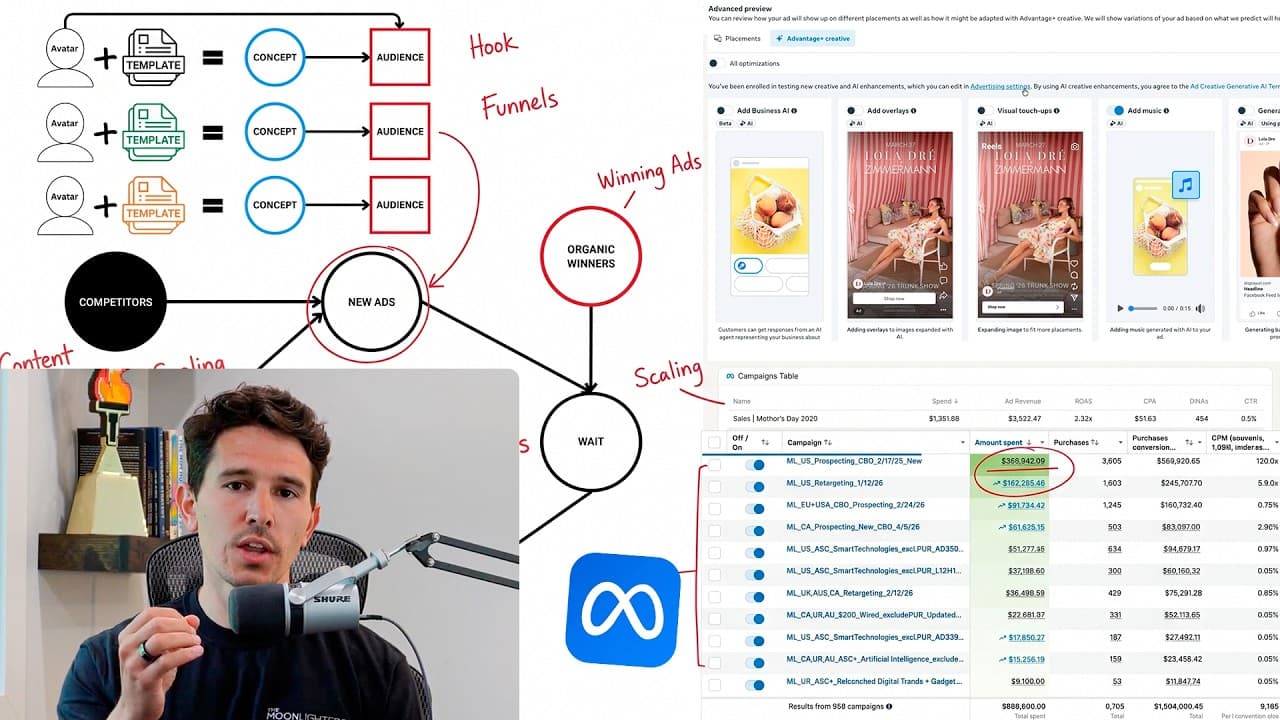
Build the account around a prospecting campaign for new customers and a retention campaign for past purchasers, then add retargeting or scaling campaigns only when account data supports them. Organize prospecting ad sets into concept-based packs, exclude purchasers, optimize for purchases, and begin with a budget near one target CPA when that amount fits what the business can risk.
Transcript
If you're running Facebook ads and you've either hit a wall, can't achieve your target return on ad spend or CPA, and you don't know what your next step is, then I'm going to solve that for you in today's video. Because in this video right now, I'm going to take you through A to Z, everything you need to know about Facebook ads. We're going to be g... Read More
Key Insights
- Account structure is the foundation of the M4 system because strong creative, offers, and products can still reach a performance ceiling when campaigns lack clear roles. The structure separates customer acquisition, customer retention, optional retargeting, and controlled scaling into distinct operational functions.
- The prospecting campaign is the core source of new customers, and its ad sets are organized as modular packs grouped by concept. Additional packs accumulate over time, creating a consistent system for introducing, identifying, and managing advertising ideas inside the account.
- The retention campaign targets all past purchasers with a diverse mix of winning advertisements, evergreen material, sales, promotions, upsells, and downsells. It intentionally creates higher frequency to encourage repeat purchases, which the presenter identifies as the primary profit source for many e-commerce businesses.
- A separate retargeting campaign is optional because engaged users are often reached within prospecting. Audience segment reporting should determine whether prospecting is overspending on engaged audiences, in which case those users can be removed and addressed through dedicated retargeting ad sets.
- Retargeting audiences can include Facebook and Instagram engagers, 30–60-day site visitors, and users who added to cart or initiated checkout over 90 days or more. Larger businesses can narrow these windows, while smaller businesses can broaden them to maintain usable audience sizes.
- The scale campaign is a broad, single-ad-set campaign containing only the account's strongest proven advertisements. The presenter suggests roughly five advertisements and describes its sole purpose as forcing more spending toward winners that advertisers already understand extremely well.
- A prospecting campaign's starting daily budget can be set near one target CPA, provided that amount reflects what the business can afford to lose or is willing to risk. Existing advertisers can retain their current campaign and introduce the pack system instead of rebuilding everything.
- Purchase is the preferred conversion event in almost every circumstance because the campaign's objective is to generate purchases. New advertisers can maximize the number of conversions to gather signals, while advertisers promoting many products can consider maximizing conversion value.
Install to Summarize YouTube Videos and Get Transcripts
Explore YouTube Video Summarizer or Get YouTube Transcript Extractor
Questions & Answers
Q: How should a Facebook ads account be structured?
A Facebook ads account should begin with two core campaigns: prospecting for acquiring new customers and retention for reaching past purchasers. Retargeting can be separated when audience reporting shows excessive prospecting spend on engaged users. A scale campaign can also be added for a small group of proven winners. The exact number and complexity of campaigns can grow with regions, offers, avatars, and overall account size.
Q: What is the purpose of a Facebook ads prospecting campaign?
A prospecting campaign is designed to acquire as many new customers as possible. In the M4 structure, it uses modular ad sets called packs, with each pack grouped by a concept and named according to its avatar, concept, and release number. Previous purchasers are excluded so spending remains focused on acquisition, while audience segment reporting tracks new, engaged, and existing customer groups.
Q: How should a Facebook ads retention campaign work?
A retention campaign should target all past purchasers and contain a diverse selection of winning advertisements, evergreen creative, sales, promotions, upsells, and downsells. Its ad sets are consolidated so previous customers see advertisements frequently and have repeated reasons to return. The presenter calls retention the cash cow of e-commerce because many businesses do not make their money from a customer's first purchase.
Q: When should a separate Facebook retargeting campaign be used?
A separate retargeting campaign should be used after consistent advertising produces enough audience data to identify overspending on engaged users inside prospecting. Audience segment reporting for new, engaged, and existing customers reveals whether separation is necessary. If engaged audiences receive too much prospecting spend, remove them from that campaign and address their objections with dedicated retargeting advertisements, promotions, and offers.
Q: Which audiences should a Facebook retargeting campaign include?
A retargeting campaign can include Facebook and Instagram engagers, site visitors from the previous 30–60 days, and people who added products to a cart or initiated checkout over a period of 90 days or more. These windows should reflect business size. A large business can use narrower ranges, while a smaller business can broaden them to create audiences large enough to serve.
Q: How much should a new Facebook prospecting campaign spend?
A new prospecting campaign can start with a daily budget equal to one target CPA, which the presenter describes as a general sweet spot for beginners. The actual amount must still be based on what the business can afford to lose or is willing to risk. Advertisers already spending consistently do not necessarily need a replacement campaign and can instead build concept packs within their existing structure.
Q: Which conversion event should Facebook sales campaigns optimize for?
Facebook sales campaigns should almost always optimize for the purchase event because purchases are the intended business outcome. The presenter says there is almost no circumstance in which an add-to-cart or initiate-checkout event would replace it. Beginners can maximize the number of conversions to gather more signals, while accounts advertising many different products can use the option to maximize conversion value.
Q: How should a Facebook ads scale campaign be configured?
A scale campaign should use one broad ad set containing only the best proven advertisements in the account. The presenter suggests approximately five advertisements and warns against filling it with less-established creative. Its function is limited to directing more spending toward known winners. Advertisers should understand these advertisements thoroughly before moving them into this campaign, rather than using scaling as another testing environment.
Summary & Key Takeaways
-
The M4 system begins with account structure. Its two required campaigns are prospecting, which acquires new customers, and retention, which brings past purchasers back through winning ads, evergreen creative, promotions, upsells, and downsells. Retargeting and scale campaigns remain optional because their usefulness depends on audience spending patterns and proven creative performance.
-
Prospecting uses a campaign budget optimization structure with ad sets called packs. Each pack groups advertisements around an avatar and concept, follows a clear naming convention, and excludes previous purchasers. Campaign settings use a sales objective, highest volume or value bidding, audience segment reporting, the correct data set, and purchase as the conversion event.
-
The system develops through consistent organization rather than acting as a shortcut for weak advertising. Starting budgets can equal one target CPA when that matches the business's risk tolerance. As spending and operational complexity increase, campaigns may expand across regions, offers, and avatars, while the same structural principles remain in place.
Read in Other Languages (beta)
Share This Summary 📚
Summarize YouTube Videos and Get Video Transcripts with 1-Click
Try YouTube Summary with ChatGPT & Claude or YouTube Transcript Generator
Explore More Summaries from Sam Piliero 📚






Summarize YouTube Videos and Get Video Transcripts with 1-Click
Try YouTube Summary with ChatGPT & Claude or YouTube Transcript Generator