How to Progress Through 7 Facebook Ads Levels

TL;DR
Optimize Facebook ads for purchases, continuously produce fresh creative, and separate prospecting, engaged, and existing customer spending. Advanced advertisers combine algorithmic delivery with controlled testing, graduate proven ads into dedicated scaling structures, and adjust budgets using business data instead of treating Meta’s learning phase as an absolute constraint.
Transcript
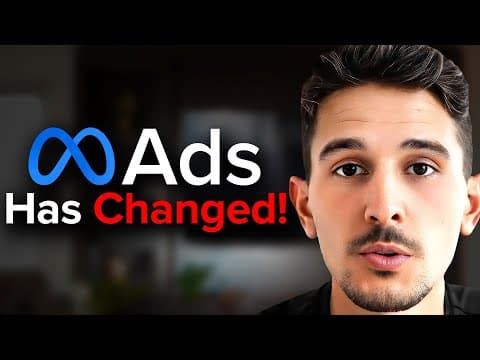
There are seven distinct levels of advertisers on Facebook ads. From the beginners who spend their entire budget every single day without making a single sale to the experts that are spending hundreds of thousands of dollars every single day scaling their ads profitably. In this video, I'm going to break down each of these seven levels so that one,... Read More
Key Insights
- Boosted posts are designed to increase post visibility and interaction, not to optimize directly for purchases. The transcript characterizes boosting as advertising to the wrong people at the wrong time with the wrong objective, making it an inefficient approach for advertisers whose actual goal is sales.
- Purchase optimization is the appropriate choice when purchases are the desired result. Running campaigns for site traffic, add-to-cart actions, or initiated checkouts asks Facebook to find people likely to complete those intermediate events, even though the advertiser ultimately cares about completed sales.
- Repeatedly recycling the same catalog ads, videos, images, and GIFs can produce a steady account, but it restricts growth. A continuous flow of new advertising content is presented as essential for expanding both ad performance and the underlying business.
- Excessive optimization makes results difficult to interpret because too many simultaneous changes prevent advertisers from identifying what caused success. Warning signs include maintaining a dozen active campaigns, mixing conflicting strategies, and assigning different attribution methods across campaigns while repeatedly trying new structures.
- A single consolidated campaign gives Meta’s algorithm room, creative options, and a budget to allocate. This approach is described as a useful baseline, but it can overspend on existing customers and engaged audiences because Meta seeks purchases regardless of whether buyers are new or already familiar.
- High creative output can compensate for many media-buying mistakes because fresh ads continuously give the account new opportunities. Successful scaling businesses generally pass through this creative-monster stage, although producing large quantities of creative requires substantial time, resources, and a repeatable production process.
- GOAT-tier account structure uses distinct swim lanes for new-customer prospecting, engaged customers, and existing customers. Existing buyers can be nurtured through email, SMS, events, and sales, while acquiring a first-time customer may require 10, 20, or even 30 impressions across different advertisements.
- Advanced scaling combines a prospecting CBO testing structure with a graduation system for proven advertisements. Advertisers use the algorithm to identify ads worthy of spending, dedicate additional budget to strong performers, and change budgets according to real business data rather than automatically obeying learning-phase guidance.
Install to Summarize YouTube Videos and Get Transcripts
Explore YouTube Video Summarizer or Get YouTube Transcript Extractor
Questions & Answers
Q: What are the seven levels of Facebook advertising?
The seven levels are the post booster, middle-funnel trafficker, recycler, ultra optimizer, single campaigner, creative monster, and GOAT tier. They progress from boosting posts without a sales objective through increasingly disciplined approaches involving purchase optimization, consolidated delivery, continuous creative production, distinct audience swim lanes, structured testing, ad graduation, and data-based scaling decisions.
Q: Why should advertisers avoid boosting Facebook or Instagram posts?
Boosting a post primarily seeks people who are likely to view or interact with that individual post rather than people likely to purchase. According to the transcript, this means targeting the wrong people at the wrong time with an unsuitable objective. It can also condition the account toward paying for more visibility instead of building advertising around direct sales outcomes.
Q: Should Facebook ads optimize for purchases or add-to-cart events?
Facebook ads should optimize for purchases when completed purchases are the advertiser’s actual objective. Selecting add-to-cart, initiated-checkout, or site-traffic events tells Facebook to deliver those specific outcomes, which may not become sales. The transcript argues that Facebook’s standard events reflect behavior across its ecosystem, so advertisers should request the final event they genuinely want.
Q: Why does Facebook ad creative need regular refreshing?
Regular creative refreshing is necessary because repeatedly serving the same catalog ads, videos, images, and GIFs limits growth. A recycler’s account may remain steady and stable rather than collapsing, but it lacks enough new content to expand. Continuous creative production gives the account fresh advertisements to distribute and is described as a foundational requirement for building a profitable, scaling brand.
Q: How can excessive Facebook ad optimization hurt performance analysis?
Excessive optimization creates numerous overlapping variables, making it difficult to determine why results improved or declined. Advertisers at this level may operate a dozen campaigns, mix attribution approaches, use conflicting strategies, and test many structures simultaneously. Even when success occurs, they cannot confidently identify its cause, while spending considerable time trying to outperform an algorithm designed to allocate money efficiently.
Q: What is the advantage of running one consolidated Facebook campaign?
A single campaign gives Meta’s algorithm multiple creatives, sufficient operating space, and one budget to distribute, making it a stronger baseline than fragmented or incorrectly optimized approaches. Its limitation appears during scaling: Meta may favor purchases from engaged audiences or existing customers because it values completed purchases without distinguishing whether the buyer is new, familiar with the brand, or already a customer.
Q: What does a creative monster do in Facebook advertising?
A creative monster produces new advertising creative continuously and inserts it into the account at scale. This high output can support strong results even when parts of the media-buying setup are imperfect. The approach is resource-intensive and is not presented as an ideal permanent state, but it is a stage that successful scaling businesses usually experience before reaching the most advanced level.
Q: How do advanced Facebook advertisers structure testing and scaling?
Advanced advertisers establish separate swim lanes for prospecting, engaged customers, and existing customers. They use a prospecting CBO campaign as the main source of spending, revenue, and testing, with rigid test methods that let the algorithm identify promising ads quickly. Successful ads enter a graduation system that dedicates spending to proven performers, while budget changes follow actual business patterns and data.
Summary & Key Takeaways
-
The first three levels describe advertisers who boost posts, optimize for intermediate events, or repeatedly use old creative. Boosting prioritizes interaction rather than sales, while traffic and add-to-cart campaigns request outcomes that are not the final goal. Recycled content may maintain stability, but it limits the account’s capacity to grow.
-
Level four advertisers make excessive adjustments across numerous campaigns, strategies, attribution methods, and tests. Level five improves on this by consolidating creative into one campaign and allowing the algorithm to allocate its budget. However, consolidation can direct too much spending toward engaged audiences and existing customers instead of acquiring new customers.
-
Levels six and seven combine sustained creative production with a disciplined account structure. Creative monsters produce new ads continuously, while GOAT-tier advertisers establish separate swim lanes, use prospecting CBO campaigns for spending and testing, graduate successful ads into scaling structures, and adjust budgets according to observed business performance rather than learning-phase warnings.
Read in Other Languages (beta)
Share This Summary 📚
Summarize YouTube Videos and Get Video Transcripts with 1-Click
Try YouTube Summary with ChatGPT & Claude or YouTube Transcript Generator
Explore More Summaries from Sam Piliero 📚





Summarize YouTube Videos and Get Video Transcripts with 1-Click
Try YouTube Summary with ChatGPT & Claude or YouTube Transcript Generator