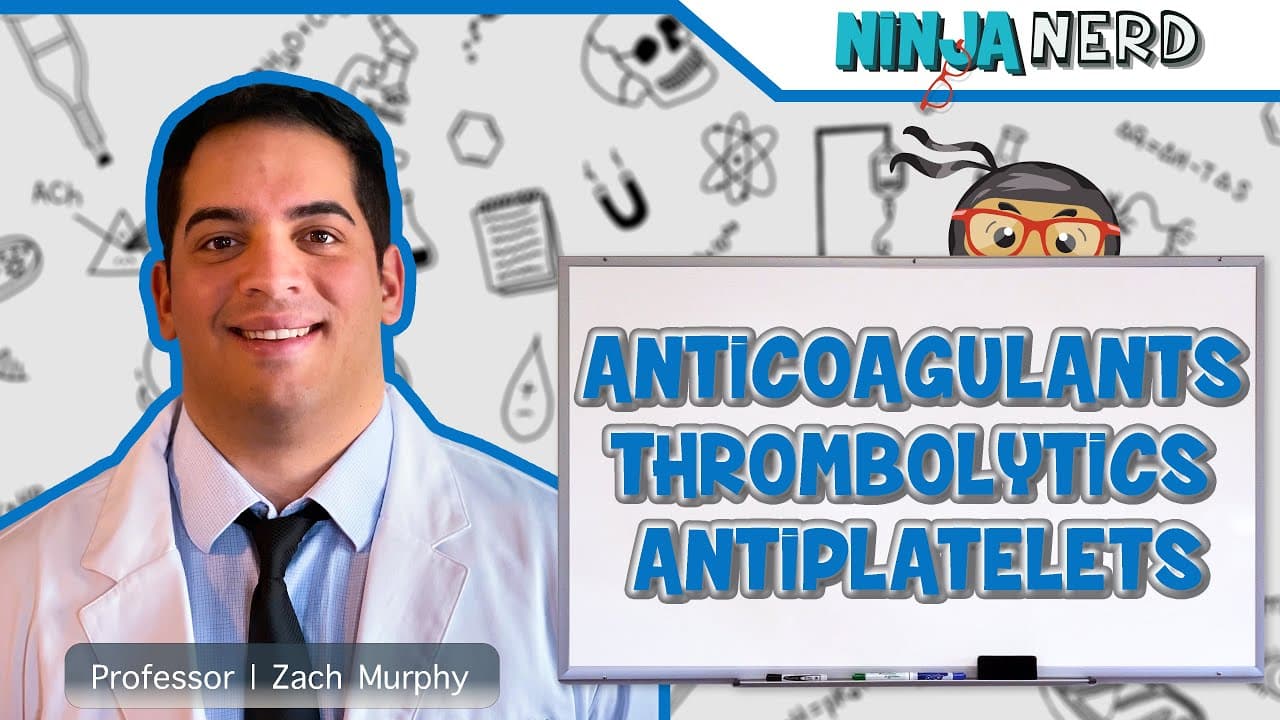
What are antiplatelets, anticoagulants, and thrombolytics?
TL;DR
Antiplatelets prevent platelet plug formation, anticoagulants hinder the coagulation cascade, and thrombolytics dissolve clots. The video explains how hemostasis has three phases, how platelets become activated and bind to damaged vessels, how clotting factors propagate the cascade, and how clot breakdown occurs, with emphasis on practical mechanisms and drug targets.
Transcript
foreign what's up Ninja nerds in this video today we're going to be talking about a behemoth of topics okay we're going to talk about anti-platelets anticoagulants and thrombolytics all the blood thinning medications we're going to get into them but what I want you to do is before we actually get started in this video If it makes sense if it helps ... Read More
Key Insights
- Antiplatelets target the platelet plug formation phase by interrupting platelet adhesion and aggregation.
- ADP release from activated platelets and P2Y12 receptor signaling drive an amplification loop that increases platelet activation and aggregation.
- Von Willebrand factor bridges platelets to damaged endothelium via specific receptors, initiating the plug formation process.
- GPIIb/IIIa receptors become more expressed on activated platelets and mediate cross-linking through fibrinogen bridges.
- Fibrinogen acts as the bridge between platelets, enabling the growing platelet plug and reinforcing aggregation.
- Anticoagulants primarily interfere with the coagulation cascade, reducing thrombin generation and fibrin formation.
- Thrombolytics activate plasmin or similar pathways to break down fibrin clots and dissolve established thrombi.
- The three drug classes are discussed in the context of the three hemostasis phases they affect, aiding clinical decision-making.
- More videos from this channel:
- More from this channel: Ninja Nerd
Install to Summarize YouTube Videos and Get Transcripts
Explore YouTube Video Summarizer or Get YouTube Transcript Extractor
Questions & Answers
Q: How do antiplatelets prevent platelet plug formation?
Antiplatelets prevent platelet plug formation by interrupting steps in platelet adhesion and aggregation. They can inhibit signaling pathways such as ADP receptor interactions, reduce the expression of GPIIb/IIIa receptors on the platelet surface, and limit the binding of platelets to subendothelial von Willebrand factor. This slows the initial accumulation of platelets at the injury site and reduces clot growth without affecting the initial vessel response to injury.
Q: What role does ADP play in platelet activation?
ADP released from activated platelets binds to P2Y12 receptors on nearby platelets, increasing intracellular calcium and promoting changes that enhance platelet activation. This signaling cascade increases the surface expression of GPIIb/IIIa receptors and encourages fibrinogen bridging between platelets, fostering a stronger, more stable platelet plug. Blocking this pathway reduces platelet aggregation.
Q: Why is von Willebrand factor important in hemostasis?
Von Willebrand factor is essential for platelet adhesion to the subendothelial collagen exposed by vessel injury. It binds to platelets and to the collagen via the gp1b receptor, helping platelets anchor at the injury site. This initial adhesion is the first step in forming the platelet plug, setting the stage for further activation and aggregation mediated by other molecules like fibrinogen.
Q: How do anticoagulants affect the coagulation cascade?
Anticoagulants interfere with the coagulation cascade by targeting various coagulation factors or pathways, reducing thrombin generation and subsequent fibrin formation. By dampening the cascade, they limit the conversion of soluble fibrinogen to insoluble fibrin, thereby decreasing the stability and size of clots. This mechanism helps prevent pathologic clot growth in vessels while maintaining hemostasis.
Q: What is the function of thrombolytics in clot resolution?
Thrombolytics promote clot resolution by activating plasmin or similar enzymes that degrade crosslinked fibrin, the main structural component of clots. By accelerating fibrinolysis, they dissolve established thrombi and restore blood flow in affected vessels. This therapy is particularly used for acute thrombosis where rapid reperfusion is essential.
Q: How do platelets become activated after adhesion?
After adhesion to exposed collagen via von Willebrand factor, platelets become activated and release granules containing mediators such as ADP and calcium. ADP amplifies the recruitment and activation of additional platelets through P2Y12 receptors, while calcium participates in various signaling pathways that promote granule secretion and surface receptor expression, reinforcing the platelet plug.
Q: What receptors are involved in platelet aggregation?
Platelet aggregation involves receptors such as GPIIb/IIIa, which bind fibrinogen to cross-link activated platelets. The exposure of these receptors is increased during platelet activation, allowing bridging by fibrinogen to stabilize the growing plug. Other key receptors include P2Y12, which responds to ADP to amplify activation, and gp1b, which helps initial adhesion to von Willebrand factor.
Q: What learning resources accompany this lecture?
The lecturer mentions notes and illustrations available on the website linked in the video description. These resources include detailed diagrams and written explanations to accompany the talk, helping learners follow along, fill in gaps, and solidify understanding of antiplatelets, anticoagulants, and thrombolytics through guided practice and visual aids.
Summary & Key Takeaways
-
The video explains three phases of hemostasis and maps antiplatelet, anticoagulant, and thrombolytic actions to platelet plug formation, coagulation cascade, and fibrinolysis, respectively, using clear visuals and stepwise explanations.
-
Key mechanisms are highlighted: platelets respond to von Willebrand factor and ADP, coagulation factors propagate a fibrin mesh, and thrombolytics promote clot dissolution, all tied back to clinical implications and drug targets.
-
The presenter emphasizes supplemental notes and illustrations available on the website to enhance learning and retention through guided note-taking and visual aids.
Read in Other Languages (beta)
Share This Summary 📚
Summarize YouTube Videos and Get Video Transcripts with 1-Click
Try YouTube Summary with ChatGPT & Claude or YouTube Transcript Generator
Explore More Summaries from Ninja Nerd 📚





Summarize YouTube Videos and Get Video Transcripts with 1-Click
Try YouTube Summary with ChatGPT & Claude or YouTube Transcript Generator