How to Identify Key Staphylococcus Species
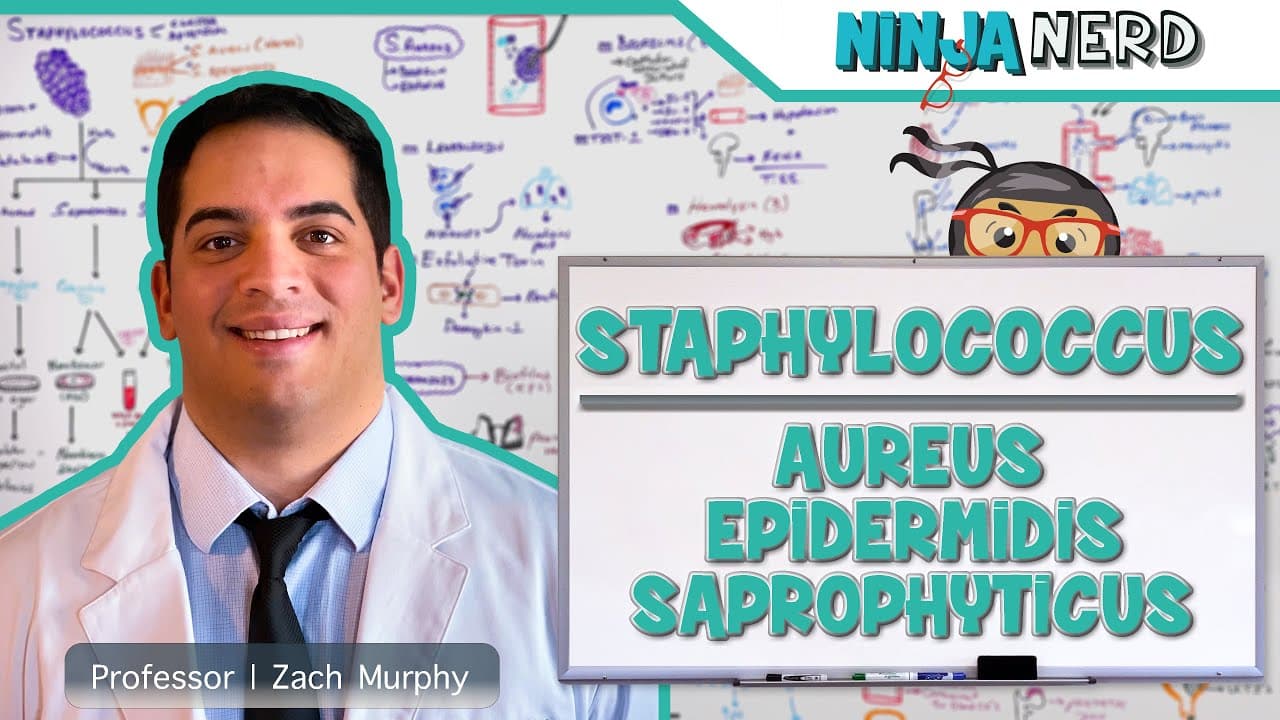
TL;DR
Identify Staphylococcus as Gram-positive, catalase-positive cocci arranged in grape-like clusters, then use coagulase testing to separate S. aureus from the coagulase-negative species. S. aureus produces golden-yellow colonies on mannitol salt agar, while S. epidermidis is associated with skin flora and prosthetic-device infections, and S. saprophyticus commonly causes urinary tract infections in young sexually active women.
Transcript
what's up ninja nerds in this video today we're going to be talking about staphylococcus bacteria before we get started if you guys really want to understand this topic down in the description box below we'll have a link to our website on there we'll have comprehensive notes we'll have illustrations we have pictures before the board after the board... Read More
Key Insights
- Staphylococcus bacteria are Gram-positive cocci arranged in clusters. Their thick peptidoglycan layer retains crystal violet during Gram staining, producing purple spherical cells whose clustered appearance resembles a bunch of grapes.
- Staphylococcus species are non-motile facultative anaerobes. They lack flagella for movement and can survive in environments with oxygen as well as environments without oxygen, characteristics shared by S. aureus, S. epidermidis, and S. saprophyticus.
- The catalase test identifies Staphylococcus species as catalase positive. Catalase converts hydrogen peroxide into water and oxygen, so adding hydrogen peroxide to these bacteria causes visible bubbling from released oxygen, but this test does not distinguish the three featured species.
- The coagulase test distinguishes S. aureus from the other featured staphylococci. S. aureus is coagulase positive and promotes the conversion of fibrinogen into fibrin, causing clumping, while S. epidermidis and S. saprophyticus are coagulase negative.
- S. aureus commonly colonizes the skin and nares. The transcript states that about 15 percent of the healthy population has S. aureus colonization in the skin of the nares, and the organism may also inhabit the armpits, ears, pharynx, groin, and perineum.
- S. aureus forms golden-yellow colonies on mannitol salt agar. This appearance explains the term aureus, and the combination of catalase positivity, coagulase positivity, and mannitol fermentation provides a laboratory profile for identifying this species.
- S. epidermidis is a prominent member of the natural skin flora. The description connects its ability to form biofilms with infections involving prosthetic devices, making its normal location on skin clinically important when artificial materials are present.
- S. saprophyticus colonizes the perineum and may reach the female urinary tract because of its proximity and the short female urethra. The description identifies it as a common cause of urinary tract infections, particularly among young sexually active women.
Install to Summarize YouTube Videos and Get Transcripts
Explore YouTube Video Summarizer or Get YouTube Transcript Extractor
Questions & Answers
Q: How can Staphylococcus bacteria be identified?
Staphylococcus bacteria can be recognized as Gram-positive, spherical organisms arranged in clusters that resemble grapes. They are non-motile, facultative anaerobes and catalase positive. In the catalase test, hydrogen peroxide produces visible bubbles because catalase converts it into water and oxygen. Further biochemical testing is needed to distinguish S. aureus, S. epidermidis, and S. saprophyticus from one another.
Q: What does a positive catalase test mean for Staphylococcus?
A positive catalase test means that the bacteria contain the enzyme catalase. When hydrogen peroxide is added to S. aureus, S. epidermidis, or S. saprophyticus, catalase converts it into water and oxygen. The released oxygen creates visible bubbling. Because all three featured Staphylococcus species give this reaction, catalase testing identifies the group but does not differentiate those species.
Q: How does the coagulase test identify Staphylococcus aureus?
The coagulase test identifies S. aureus by detecting its ability to promote the conversion of fibrinogen into fibrin. When an appropriate colloid solution is applied, fibrin formation causes visible clumping. Among the three featured organisms, only S. aureus produces this reaction and is coagulase positive. S. epidermidis and S. saprophyticus do not cause clumping and are classified as coagulase negative.
Q: Why does Staphylococcus aureus form golden-yellow colonies?
S. aureus ferments when grown on mannitol salt agar and produces colonies with a golden-yellow appearance. The term aureus comes from this characteristic color. In the laboratory profile presented, S. aureus is catalase positive, coagulase positive, and associated with golden-yellow colonies on mannitol salt agar, allowing it to be separated from the other discussed Staphylococcus species.
Q: Where does Staphylococcus aureus normally colonize the body?
S. aureus commonly colonizes the skin and can be found in areas including the armpits, ears, pharynx, groin, and perineum. The nares are an especially important colonization site. According to the transcript, about 15 percent of the healthy population has S. aureus colonization within the skin of the nares, a fact emphasized as clinically and academically important.
Q: What infections are associated with Staphylococcus aureus?
S. aureus is associated with a broad range of clinical presentations. The description identifies skin and soft tissue infections, endocarditis, osteomyelitis, toxic shock syndrome, and pneumonia among its disease associations. It also highlights virulence factors such as protein A, toxins, and enzymes, and notes the clinical importance of methicillin resistance in MRSA strains.
Q: Why is Staphylococcus epidermidis associated with prosthetic devices?
S. epidermidis is a major component of the natural skin flora and is associated with biofilm formation. The description links this biofilm capability to infections involving prosthetic devices. Its presence on the skin is therefore clinically relevant when artificial materials are introduced, because the organism is specifically discussed in the context of healthcare-associated infections and device-related infection.
Q: Why does Staphylococcus saprophyticus cause urinary tract infections?
S. saprophyticus can survive on decaying organic material, enter the gastrointestinal tract with food, and subsequently colonize the perineum. In females, the urinary tract is close to the anus and perineal region, and the urethra is short, allowing easier spread and colonization. The description identifies it as a common urinary tract infection cause, especially in young sexually active women.
Summary & Key Takeaways
-
Staphylococcus species are Gram-positive, spherical bacteria that characteristically form grape-like clusters. They are non-motile, facultative anaerobes and catalase positive. The catalase test produces bubbles because their catalase enzyme converts hydrogen peroxide into water and oxygen, helping distinguish Staphylococcus as a group during laboratory identification.
-
Coagulase testing separates S. aureus from S. epidermidis and S. saprophyticus. S. aureus is coagulase positive, converting fibrinogen into fibrin and causing visible clumping. It also ferments on mannitol salt agar and forms golden-yellow colonies, which explains the species name aureus. The other two species are coagulase negative.
-
The clinically important species differ in colonization and disease associations. S. aureus commonly colonizes skin and the nares and causes illnesses ranging from skin infections to endocarditis and pneumonia. S. epidermidis forms biofilms and infects prosthetic devices. S. saprophyticus colonizes the perineum and urinary tract and commonly causes urinary tract infections.
Read in Other Languages (beta)
Share This Summary 📚
Summarize YouTube Videos and Get Video Transcripts with 1-Click
Try YouTube Summary with ChatGPT & Claude or YouTube Transcript Generator
Explore More Summaries from Ninja Nerd 📚






Summarize YouTube Videos and Get Video Transcripts with 1-Click
Try YouTube Summary with ChatGPT & Claude or YouTube Transcript Generator